
The Silent Killer: When Coins Betrayed an Empire
Picture the Forum in the dying light of the third century: merchants haggle under colonnades that once echoed with the triumphs of legions, but now their voices carry a nervous edge. A farmer hands over a handful of “silver” coins for a sack of grain, only to watch the merchant bite one, spit, and shake his head.
The coin is mostly bronze, its thin silver wash flaking like lies in the sun. This is not a marketplace—it is a theater of betrayal. For centuries, Rome’s currency had been the empire’s unbreakable promise: pay your taxes, obey the laws, and Rome guarantees value. But emperors, desperate to fund endless wars and lavish courts, had diluted the denarius and aureus with cheaper metals until trust itself evaporated.
This was no accident. It was slow poison. Pure gold and silver coins vanished into private hoards the moment they appeared. Debased trash circulated instead.
Economists today call it Gresham’s Law—bad money drives out good—but Romans lived it as daily humiliation. Savings dissolved overnight. Trade slowed to a crawl. Soldiers demanded higher pay for worthless wages.
The entire machine of the empire began to seize. Money is trust made visible. When that trust dies, civilizations do not fall in fire—they rot from the inside.
Constantine’s Bold Gambit: Forging the Solidus
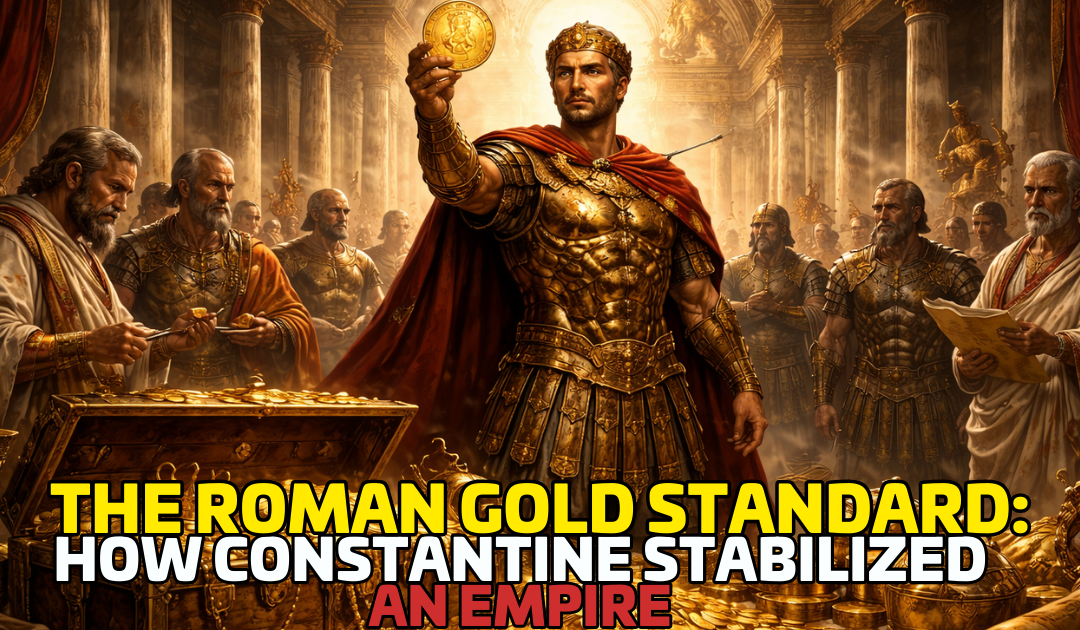
Into this wreckage stepped Flavius Valerius Constantinus—Constantine—the man who had already won the Battle of the Milvian Bridge under a cross in the sky. In 312 AD he claimed the throne; by 314 he turned his gaze to the empire’s bleeding wound. His solution was audacious in its simplicity: a new gold coin called the solidus.
Unlike the debased trash that had eroded confidence for generations, the solidus was pure—4.5 grams of nearly unadulterated gold, struck at 72 to the Roman pound. It gleamed with integrity. But Constantine did not stop at minting beauty.
He wielded the most powerful lever any ruler possesses: the tax code. From that moment forward, all taxes owed to the state had to be paid in solidi.
The genius was immediate. Merchants, farmers, and provincial governors suddenly needed solidi to survive the tax collector’s visit. Demand exploded. Markets adjusted overnight. People began demanding the coin in every transaction.
The solidus became the lifeblood of commerce, the anchor of trust. Where previous emperors had begun to buy time, Constantine restored value to buy centuries.
Seven Centuries of Stability: The Solidus’s Enduring Legacy
The results were almost miraculous. The solidus remained one of the most stable currencies in human history. It circulated through the Eastern Roman Empire—later called Byzantium—until roughly the year 1000 AD.
For nearly 700 years it held its weight with almost no inflation, a beacon of reliability in a world of chaos. Byzantine emperors minted it, merchants trusted it from Constantinople to the Levant, and even foreign kings accepted it as the gold standard of the Mediterranean.
This was no accident of fortune. The solidus created a virtuous cycle: stable money encouraged long-term contracts, trade flourished, taxes flowed reliably, and the state could fund defenses without resorting to desperate debasement.
The Eastern Empire outlasted its Western twin by nearly a thousand years in part because its currency never lied to its people. Constantine had not merely fixed a coin—he had rebuilt the empire’s spine.
Echoes in Modernity: Currency as Civilizational Glue
Currency stability is not an economic footnote; it is a civilizational heartbeat. When money loses value rapidly, citizens lose faith in institutions.
Economic uncertainty breeds political fracture. Rome proved this truth in blood and bronze.
Today the debate rages on. Economist and former Congressman Ron Paul has long argued for a return to a tangible standard—gold or otherwise—precisely because it prevents governments from printing their way out of accountability. The challenge is brutal: such a reform demands spending cuts, fiscal discipline, and short-term pain that politicians rarely stomach.
Yet history whispers that the alternative—endless debasement—is far more costly. Rome’s lesson is clear: you can fake the coins for a while, but you cannot fake trust forever.
The Eternal Question: Can Reform Rescue a Civilization?
Constantine’s solidus did not solve every crisis. It could not stop plagues, barbarian migrations, or court intrigue. But it gave the Eastern Empire a stable foundation that allowed it to adapt and endure long after the West had crumbled into feudal fragments.
His reform raises the uncomfortable question for our own age: Could meaningful currency reform strengthen modern economies the way the solidus strengthened Rome? Or have the political costs become so high that leaders will never attempt it? History rarely hands out simple answers. It only shows us the consequences of choices already made.
The solidus was more than a coin. It was a restoration of trust. And in an empire—or a civilization—trust is the only currency that truly lasts.
What do you think? Could currency reform stabilize modern economies the way Constantine stabilized Rome? Comment below.
If you enjoy historically grounded analysis like this, follow me at @jeremyryanslate and share this article. And if you have a message you want amplified on top podcasts, DM me or connect with my team at CYB Media.