
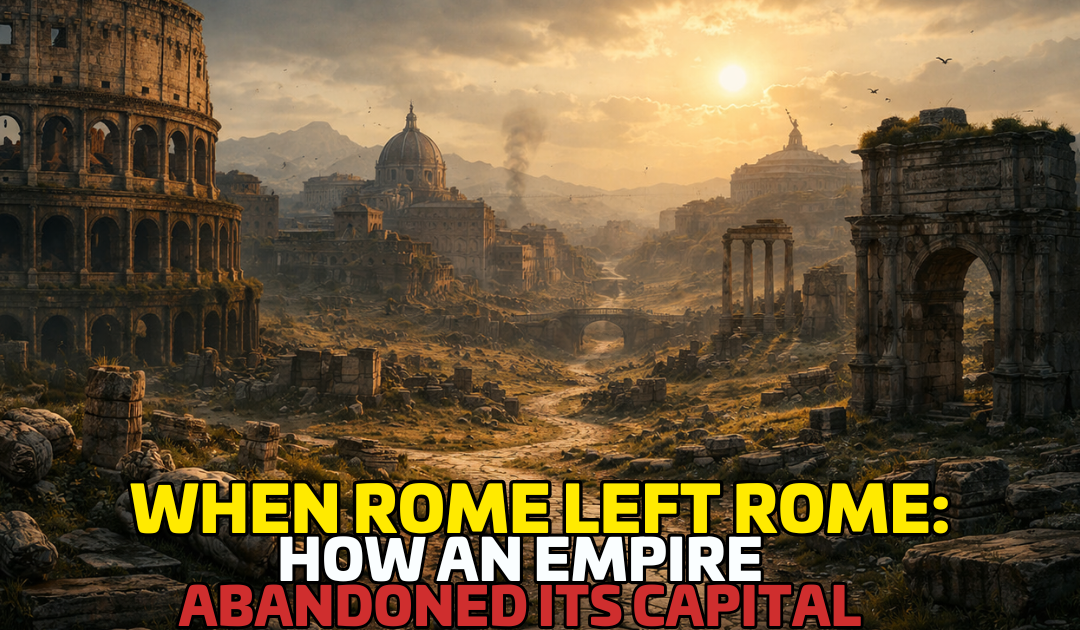
I’ve always been fascinated by how empires decline, not just from conquest, but from the slow erosion of economics, infrastructure, and politics. Rome’s story is a perfect example, especially when the city itself was effectively abandoned as the center of power.
By the third century AD, Rome’s fortunes were already shifting. Its port at Ostia, vital for trade, had silted up around 300 AD, cutting off commerce and choking the city’s economy. Meanwhile, Milan and later Ravenna offered better access to remaining trade routes, especially in the face of threats from invading tribes.
Provinces once under Rome’s control, like Britain and Gaul, had been lost by 410 AD. Taxes from these regions evaporated. The Western Empire had cash flow problems, while the Eastern Empire—Constantinople and surrounding territories—remained financially robust. Political power followed the money.
Politics and the Senate
By this time, the Senate in Rome was largely symbolic. Emperors and generals no longer needed the old city to govern. New administrative centers allowed rulers to avoid the drama and scrutiny of the Roman populace and the old aristocracy.
Political life moved away from Rome, further eroding its relevance. The decision to abandon the city as a real power hub was practical, but it carried a symbolic cost.
The Eternal City had been the heart of the world for centuries, and leaving it marked the end of an era.
Infrastructure Collapse and Population Decline
By 500 AD, Rome had shrunk to around 50,000 residents from over a million at its peak. Aqueducts broke, sanitation systems failed, and much of the population relied on local wells or fragmented grain supplies.
Natural disasters compounded these problems. The plague of 541 AD killed millions across the former empire. Communication was slow—messages from Rome to the eastern front could take weeks.
Meanwhile, Constantinople was strategically closer to the empire’s pressing threats, including Persians and Arabs. The defensive walls built by Theodosius II in 413 AD still stand today, a testament to the shift of focus to the east.
Lessons for Modern Civilizations
Rome’s abandonment of its capital offers a stark lesson: political and economic centers can move when survival requires it. Decisions driven by trade, security, and logistics often outweigh tradition or sentiment.
It makes me wonder: could a modern nation ever abandon its capital in a similar way? What would that look like in today’s interconnected world? Would citizens accept it, or would it spark outrage?
The answers may be uncomfortable, but Rome reminds us that pragmatism often wins over nostalgia.
Final Thoughts
Rome did not fall overnight. Its decline was a combination of economics, politics, infrastructure failure, and population collapse. Abandoning the capital was not a dramatic act of defeat—it was a rational response to a world that had changed around the city.
History does not give us soft lessons. It shows us the outcomes of decisions when priorities shift, resources vanish, and the old ways no longer serve survival.
What do you think? Could a modern nation ever abandon its capital? Comment below.
If you enjoy these insights, follow me at @jeremyryanslate and share this article. And if you want to amplify your message on top podcasts, DM me or connect with my team at CYB Media.