
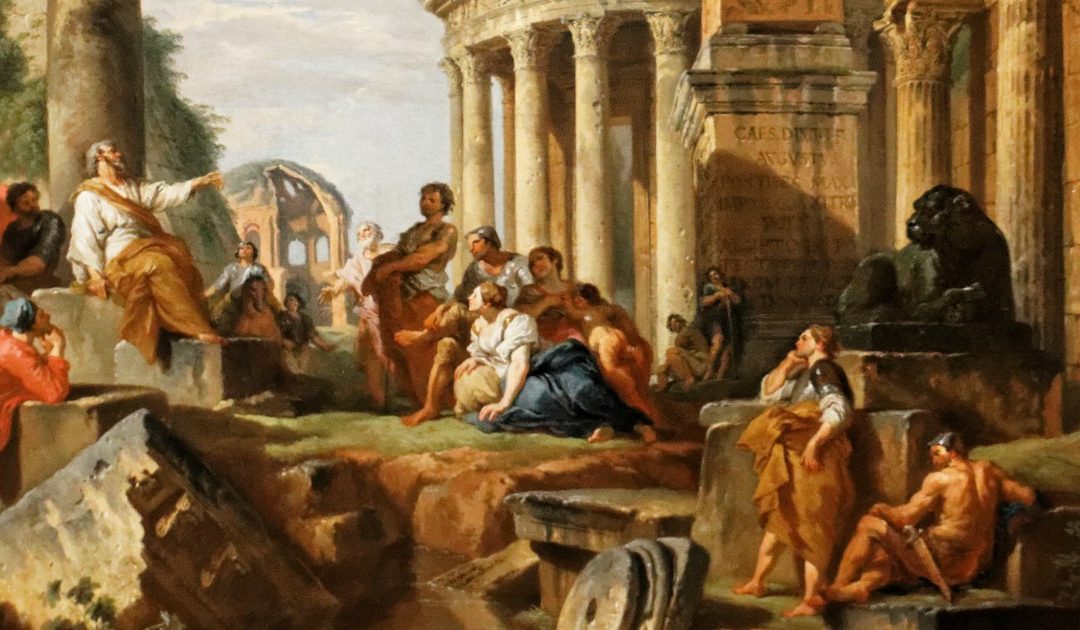
I keep coming back to this one fact about Rome that most people gloss over in history class. The Roman Empire didn’t fall because some barbarian horde showed up and knocked the whole thing down in a weekend. The empire actually left its own capital behind, slowly and deliberately, like a company moving its headquarters to a cheaper city and hoping nobody notices the old building falling apart.
The Port That Choked Rome’s Economy
Rome’s lifeline was its port at Ostia, and by around 300 AD, that port had silted up to the point where it couldn’t handle the shipping traffic the city needed. Think about what that means for a city of over a million people who depend on grain shipments from North Africa and Egypt. You can’t just build a new port overnight, and Rome’s geography wasn’t offering any easy alternatives.
So the emperors did what made practical sense. They shifted operations north to Milan and then to Ravenna, which had functioning harbors and better access to the frontier where the real military threats were gathering. Milan put you closer to the Alpine passes where Germanic tribes kept pushing south. Ravenna sat behind marshes that made it almost impossible to besiege, and it had direct access to the Adriatic and from there to Constantinople.
What gets me is how rational it all sounds when you lay it out like that. Every individual decision made perfect strategic sense. But the cumulative effect was that Rome, the actual city that gave the empire its name, became a backwater within its own political system.
Losing the Edges While the Center Hollowed Out
Provinces once under Rome’s control, like Britain and Gaul, were effectively gone by 410 AD. The legions had been pulled back years earlier, and local populations were left to organize their own defense against Saxon raiders and various Germanic groups pressing in from the east. Britain got a letter from Emperor Honorius basically telling them to look after themselves, which is one of the more brutal breakup messages in recorded history.
The loss of these provinces wasn’t just a military problem. Gaul and Britain represented tax revenue, grain production, mining operations, and recruitment pools for the army. Each province that slipped away made it harder to hold the ones that remained, which created a cycle that the western administration never figured out how to reverse. Meanwhile, the Senate still met in Rome, still debated, still passed decrees that carried less and less weight with each passing decade.
There’s something about the image of senators in their togas going through the motions of governance while the actual power sat hundreds of miles away in Ravenna that feels uncomfortably familiar. The institution survived long after its authority had evaporated, because nobody had the heart or the political will to officially shut it down.
A City That Forgot How to Be a City
The population numbers tell a story that’s hard to argue with. Rome at its peak held well over a million residents, making it the largest city the Western world had ever seen. By 500 AD, that number had collapsed to roughly 50,000 people rattling around in a city built for twenty times that many. Entire neighborhoods sat empty. The forums where Caesar and Cicero had walked became grazing land for goats.
Aqueducts broke and nobody had the engineering knowledge or the political organization to fix them. These were structures that had delivered fresh water from mountain sources for centuries, and when they failed, the remaining population had to cluster near the Tiber, drinking river water that carried disease. The infrastructure that had made Rome a marvel of urban planning became a collection of crumbling monuments that the locals quarried for building stone.
The plague of 541 AD hit what was left of the city and drove the population even lower. By that point, Rome had already been sacked twice and changed hands between Gothic kings and Byzantine generals more than once. The plague didn’t destroy Rome so much as it kicked a city that was already down.
Constantinople Picked Up Where Rome Gave Up
While Rome was shrinking into a shadow of itself, the eastern half of the empire was investing heavily in its own survival. The defensive walls built by Theodosius II in 413 AD turned Constantinople into one of the most fortified cities in the ancient world. Those walls held off Persians, Arabs, and various other armies for over a thousand years, which is a defensive record that nothing else in history really comes close to matching.
Constantinople had the geographic advantages that Rome had lost. It sat on a peninsula surrounded by water on three sides, controlled the straits between Europe and Asia, and collected tolls on every ship passing between the Mediterranean and the Black Sea. The eastern emperors had reliable tax revenue, functioning trade networks, and a professional army that actually answered to central command. They had what Rome used to have, and they built on it instead of watching it erode.
I keep thinking about how the same empire that couldn’t maintain aqueducts in Rome was simultaneously building some of the most sophisticated fortifications the world had ever seen, just in a different location. The resources existed. The engineering talent existed. The will to invest them in Rome specifically did not.
What This Actually Means for How We Build Things Today
The pattern here isn’t ancient history locked behind glass in a museum. Cities, companies, and institutions today face the same kind of slow drift where the center of gravity shifts and the original core gets left behind. Detroit built cars for the world and then watched the industry move to places with cheaper labor and fewer legacy costs. The comparison isn’t perfect, but the underlying dynamic is the same.
What Rome’s story shows is that decline rarely announces itself with a single catastrophic event. It accumulates through a series of reasonable decisions made by people dealing with immediate pressures. Moving the capital made military sense. Pulling legions from Britain freed up soldiers for more urgent fronts. Letting the aqueducts degrade saved money in the short term. Each choice was defensible on its own terms, and the aggregate result was that one of the greatest cities ever built became a village inside its own walls.
There’s something about that gradual quality of the decline that I find more unsettling than any dramatic collapse story. The people living through it probably didn’t experience a single day where they woke up and said, “This is the day Rome falls.” They just noticed that the fountain down the street stopped working, and nobody came to fix it, and after a while they stopped expecting anyone to come at all.