
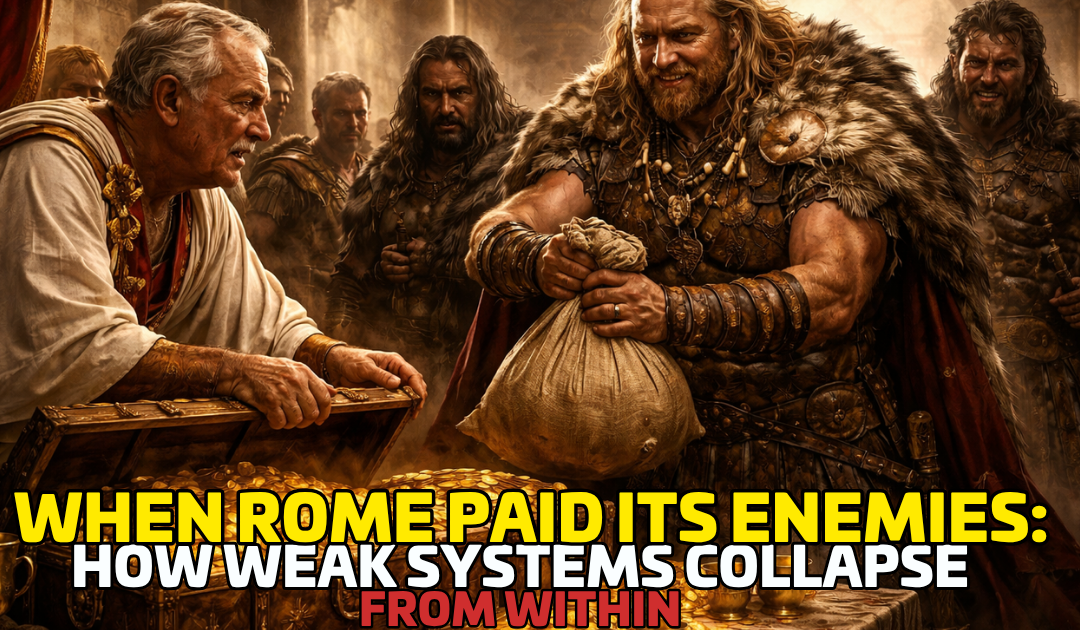
The Quiet Transaction That Doomed an Empire
Imagine the year 410 AD. The Eternal City, once the unchallenged mistress of the known world, lies humiliated. Alaric, king of the Visigoths, has breached the gates—not in a glorious storm of steel and fire, but through a calculated siege that exposed Rome’s hollow core.
Smoke rises from villas, treasures are carted away, and the proud Senate watches in stunned silence as the “barbarians” they once mocked now walk their streets as conquerors. Yet the true turning point is not the sack itself. It is what comes after: Rome begins writing checks to its enemies.
The empire, which had once demanded tribute from half the world, now pays tribute to survive. This single decision—buying peace instead of enforcing it—marks the beginning of the end.
It is not a dramatic battlefield defeat. It is a quiet admission that the Roman system can no longer sustain itself.
As we trace this narrative, we’ll see how paying for survival, outsourcing loyalty, and losing control of money and borders turned the mightiest empire into a ghost of its former self.
Paying for Survival: The Dangerous Bargain
After Alaric’s Visigoths ravaged Rome in 410 AD, the Western Empire faced a brutal choice: fight or buy time. It chose the latter.
Treaties were struck, gold and grain flowed northward, and barbarian groups were granted land and subsidies in exchange for a fragile peace. On the surface, it seemed pragmatic—a way to manage threats without exhausting what remained of Rome’s depleted legions.
But this arrangement carried a fatal flaw. The Visigoths were not loyal Roman subjects.
They were external powers with their own kings, ambitions, and warriors who answered first to their own leaders. Rome was no longer projecting strength; it was renting it. Every payment was an acknowledgment of weakness. As long as the gold flowed, the peace held.
The moment the coffers ran dry, so did the illusion of control. The empire had begun outsourcing its survival, and nothing is more dangerous than depending on others to defend what you cannot defend yourself.
When the Military Stops Being Yours
By the fifth century, the Roman army had transformed beyond recognition. The disciplined citizen legions of the Republic—farmers who fought for land, glory, and the Senate—were long gone.
In their place stood federates: barbarian war bands integrated into the empire as mercenaries. They fought under their own chieftains, spoke their own languages, and owed allegiance to coin rather than to Rome.
Emperors became increasingly dependent on these forces to hold the frontiers and suppress internal revolts. The arrangement seemed efficient at first: why raise expensive Roman recruits when you could hire ready-made warriors? But loyalty that is purchased is loyalty that expires.
When payments lagged, as they inevitably did in a cash-strapped empire, allegiance shifted. Generals like Stilicho walked a tightrope, balancing Roman authority with barbarian demands, but the balance was impossible to maintain forever.
The military was no longer an instrument of the state—it had become a collection of armed contractors whose swords pointed wherever the gold was heaviest. This is the slow death of sovereignty: when a nation can no longer field forces that answer to it alone, it has already begun to dissolve.
Puppet Emperors and the Illusion of Power
As the system weakened, the emperor’s role hollowed out into pure theater. By the mid-fifth century, Western Roman emperors were often teenagers or children—Romulus Augustulus, the last one, was barely a boy—installed and removed by barbarian generals who held the real power. The purple robe remained, but the authority had fled.
These figureheads presided over shrinking territories while real decisions were made in the camps of men like Ricimer or Odoacer. The Senate in Rome had become a ceremonial echo chamber.
The old aristocracy still met, still debated, but the legions answered to others. Power had migrated from the marble halls of the Forum to the sword belts of Germanic warlords.
This culminated in 476 AD. Odoacer, a Germanic chieftain serving in the Roman army, simply deposed the boy-emperor Romulus Augustulus. There was no epic final battle, no heroic last stand at the gates.
Odoacer sent the imperial regalia back to Constantinople with a polite note: the West no longer needed a separate emperor. The Western Roman Empire ended not with a bang, but with a quiet administrative note.
The system had become so hollow that removing the last symbol required almost no effort at all.
The Breaking Point: When the Money Ran Out
Beneath the military and political decay lay the true killer—financial exhaustion. Rome could no longer pay the very forces it depended upon.
The empire’s currency had been debased for generations, inflation eroded savings, and tax revenues from lost provinces had dried up. When the gold and grain subsidies to barbarian groups stopped flowing, the fragile alliances shattered.
Loyalty that is bought lasts only as long as the buyer can pay. Once Rome’s coffers emptied, the arrangement collapsed. Barbarian leaders who had once protected the empire now turned on it or carved out their own kingdoms.
The system did not fall because it was conquered in open war. It fell because it could no longer afford the mercenaries it had hired to defend it.
This is the brutal arithmetic of decline: when a state outsources its core functions—defense, border control, even legitimacy—and then loses the ability to fund those arrangements, the end comes swiftly and without ceremony.
Lessons That Still Echo Today
Rome’s story is not merely ancient history—it is a pattern. Systems built on unsustainable economics eventually break. When a civilization cannot fund its own defense, control its borders, or maintain the value of its currency, it becomes dangerously dependent on external forces.
Dependence breeds vulnerability. Political theater—figurehead leaders, symbolic institutions, grand titles—can mask structural rot for a time, but it cannot cure it.
Leadership matters, but policy matters more. Who sits on the throne is secondary to whether the system can still deliver protection, stability, and trust. Rome teaches us that paying others to do what you can no longer do for yourself is not strategy—it is slow surrender.
Final Thoughts: The Cost of Buying Time
The tale of Rome paying its enemies is not a footnote. It is a warning written in gold that ran out. A system that survives by purchasing peace rather than securing it is living on borrowed time. When the money stops, so does the illusion of control.
History does not flatter us with easy comforts. It forces uncomfortable questions: Are our own systems built on solid foundations, or are they propped up by temporary arrangements that mask deeper fractures? When the subsidies run dry and the loyalty proves transactional, what remains?
The final collapse is rarely the beginning of the story. It is usually the last sentence of a long chapter that began with quiet compromises.
What do you think? Are modern systems repeating Rome’s fatal bargain? Comment below.
If you enjoy historically grounded analysis like this, follow me at @jeremyryanslate and share this article. And if you have a message you want amplified on top podcasts, DM me or connect with my team at CYB Media.