
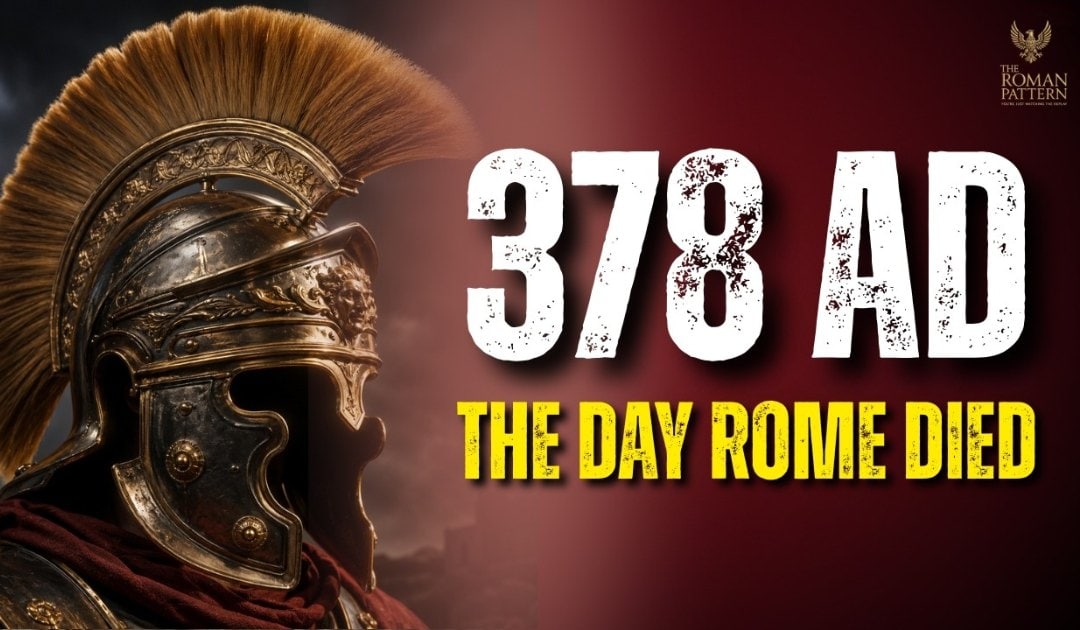
Most of us carry around a picture of Rome going down under a barbarian horde, a civilization simply outmatched by something stronger. The more time I spent with it for this episode, the more it looked like an autopsy of institutions that had been failing for a long time, with the Gothic cavalry arriving at the very end to finish a job that Roman money and Roman politics had already started.
On August 9, 378 AD, the emperor Valens led roughly two-thirds of the Eastern Roman army into a valley outside Adrianople, which is modern Edirne, in European Turkey. Western reinforcements were already marching toward him, and he chose not to wait. By sunset he was dead, with his body never recovered, and two-thirds of his army had gone down with him, close enough to erased that I keep reaching for that word. Ammianus Marcellinus, a former officer who was alive when it happened and wrote within a decade of the battle, called it worse than Cannae.
I walk through the whole thing, from the Danube crossing to the last hours in that valley, in the video here.
The money was gone before the battle
Money is usually where an autopsy like this begins. The denarius went from roughly 95 percent silver under Augustus to less than 5 percent, and the antoninianus, introduced as essentially a double denarius, had turned into a copper coin with a silver wash you could rub off with your thumb. The Romans could see it happening, so they hoarded the older coins that still had silver in them and moved toward barter, and black markets formed because nobody trusted the official currency to buy tomorrow what it bought today.
That’s where it starts touching the army, because Rome’s military problem in the late fourth century was, at bottom, a payroll problem. Legionaries had to be paid, or, more accurately, they expected to be paid, and the state had a harder and harder time producing honest money to do it. Diocletian’s Edict of Maximum Prices had made it a capital offense to charge above state-mandated rates, and it failed, because price controls destroy the signal that tells producers what’s worth making. By the time Valens took the throne, the Eastern government was funding its army through land taxes, horse requisitions and a currency almost nobody trusted. So when he refused to wait for Gratian, I read part of that as the fiscal logic of a state running out of room, where every extra day in the field cost money the empire no longer reliably had.
A border that Rome opened and then ran for profit
The Goths who destroyed Valens were already inside the empire, and Rome was the one who brought them there. In 376, two years before the battle, the Huns pushed the Tervingi and Greuthungi south toward the Danube, and Lupicinus, the Roman official in Thrace, looked at all those hungry, armed and desperate people and saw an opportunity. Recruitment was declining and the frontier was thin, and here were thousands of fighting-age men willing to serve if Rome let them cross.
So the Goths came over as foederati, allied military settlers placed on Roman land in exchange for service. Rome had been doing that with Germanic peoples for generations, and what set 376 apart was the scale and the corruption. Lupicinus disarmed them at the crossing points and then sold them food at famine prices, and at one point Roman officials were reportedly trading dogs for Gothic children, who were then sold into slavery. When the Gothic leaders, Fritigern among them, protested, Lupicinus invited them to a banquet at Marcianople and apparently tried to have them killed there. Fritigern escaped, and the revolt began.
The system was working well for the men running it. Crossing points that were supposed to regulate migration had become checkpoints for extraction, and the laws and the forts all still existed on paper while serving a very different purpose in practice.
Why Valens marched into that valley
Gratian, the Western emperor, was already marching east, messages had been sent telling Valens to hold his position, and together the two Roman forces would likely have outnumbered the Goths by a wide margin. The standard explanation for why Valens went anyway is hubris, and honestly I think that’s probably true to a point, though the pressure the system put on him explains a lot of what’s left.
Valens and Gratian were two Augusti who were technically equals, inside an imperial system that had always leaned on a single dominant figure. Gratian’s generals had recently beaten the Alamanni, and by this point military victory was the one real source of legitimacy an emperor had left. Rome had gone through somewhere between twenty-five and thirty emperors in roughly fifty years, many of them murdered by their own troops, and Valens, after fourteen years on the throne, still depended on looking capable, so the system around him had already taken the safe options off the table and turned a bad decision into a rational one. Waiting for Gratian would have meant publicly admitting that a crisis in his own territory needed Western help, which is the kind of signal that gets generals thinking about alternatives.
If you’d rather take this one in on a drive or a walk, the full episode is also on the audio podcast.
The afternoon itself
Valens marched his men roughly eight miles through the August heat, after they had been moving since dawn with almost no water. The Gothic wagons sat in a defensive circle on higher ground, and Fritigern sent negotiators forward mostly to buy time, since his cavalry was still out foraging in the hills. The Roman right wing attacked before the line was fully formed, and then the Gothic cavalry came out of the hills onto both Roman flanks, a double envelopment very close to what Hannibal did at Cannae. The infantry compressed into itself until the men were too crowded to fight or get away.
Ammianus tells us scarcely a third of the army escaped. Two magistri militum died, along with thirty-five tribunes and the emperor himself. One account says an arrow killed Valens, and another tradition says he was carried wounded to a farmhouse that the Goths burned without knowing who was inside, and nobody really knows which is true. What died with the army was veteran leadership and the practical knowledge of how a professional military actually works, and you can’t rebuild that overnight with conscription or decrees.
Ninety-eight years of afterward
Rome technically survived, and the Western Empire lasted another 98 years, which is the detail that confuses people, though everything after Adrianople turns defensive. Rome settled more barbarian groups inside the empire to defend it, the same policy that had produced the Gothic crisis in the first place, and four years later Valens’ successor Theodosius I signed the 382 treaty recognizing the Goths as autonomous foederati on Roman land, a precedent later repeated for Vandals, Burgundians, Alans and Ostrogoths.
I think of Adrianople as the point where the decline became irreversible, the last afternoon on which Rome could plausibly have restored its own border by force. Money had been debased past the point of trust, the border was run by officials profiting from the crisis they were supposed to solve, and power sat with men who couldn’t afford to look weak even when restraint was the right call. In the episode I also talk about where I see those same three pressures today. Watch it, or listen to it, and see whether you notice the same march I do.