
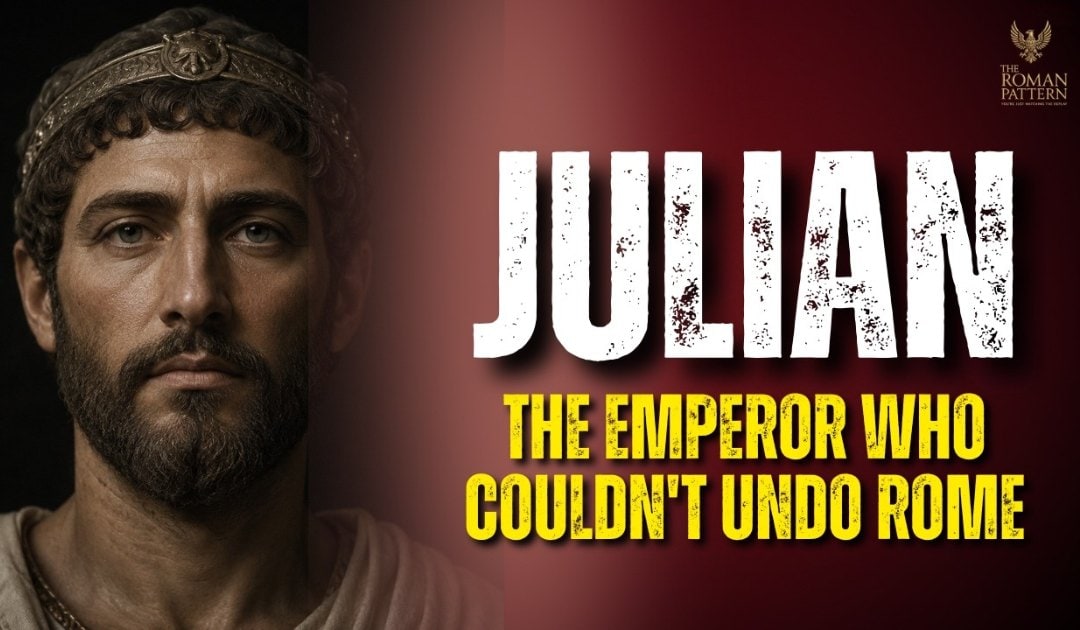
We tend to picture Julian as a romantic tragedy, the last pagan emperor, a philosopher and soldier and true believer pouring wine at the old altars while the Christian empire watches in silence. That picture is close enough to accurate. What it leaves out is why his project was doomed before he ever put on the imperial diadem, and that’s the part I wanted to work through in this episode of The Roman Pattern.
By 361 AD the church had become infrastructure. Bishops were running grain networks, the officer corps had been baptized for a generation, and the empire’s administrators had been trained inside a system that assumed Christianity was part of the structure. You can argue with a belief system, outlaw a ritual, even remove the people at the top, but once something is load-bearing, once the system itself depends on it, a decree can’t take it back out.
The video walks through Julian’s whole story, from his childhood in Constantine’s shadow to the spear in Persia.
Fifty years of wiring
To understand Julian you have to go back about fifty years to Constantine, who converted in 312 AD. Everybody knows the vision before the battle, though honestly, and a bit more accurately, what mattered most was what came after, because over the following decades Constantine made the church useful to the state. He gave bishops legal authority to arbitrate civil disputes, exempted church property from taxes, paid for massive basilicas with imperial money and made Sunday a legal day of rest, and in certain military units baptism became tied to advancement. Taken together, he was wiring Christianity into the operating system of the Roman Empire, and by the time Julian took the throne that process had been running for almost fifty years. An officer baptized as a young man under Constantine was elderly by then, and his sons had grown up in a Christian empire.
Julian himself was the nephew of Constantine, raised Christian because survival required it. After Constantine’s death, Constantius II spent years purging rivals inside the dynasty, and Julian survived partly because he seemed quiet and harmless, reading Plato and the Neoplatonists. Somewhere in those years, in secret, he stopped believing in Constantine’s God. By the time he became emperor at thirty he had been privately pagan for years, and he waited until he held power to say it publicly, which tells you he understood exactly how deeply Christianity was embedded. He tried to reverse it anyway.
Money, and the services attached to it
The first fault line was money. Constantine had handed the church property on a huge scale, including agricultural estates, urban real estate and mining rights in some regions, and alongside that the church had taken on functions the state increasingly depended on. Bishops handling arbitration saved the empire administrative costs, and church networks distributing grain during famines stabilized cities the state struggled to manage directly. Julian stripped the church’s tax exemptions, ended state funding for clergy and pushed for the return of lands granted under Constantine, and on paper that probably looked clean. In practice it was like pulling a support wall out of a building that had already settled around it, since you can revoke a title much faster than you can rebuild the work that came with it, and the people relying on those services cared whether grain arrived and hospitals functioned.
He also barred Christians from teaching classical literature, on the logic that they denied the gods those authors honored, which locked Christians out of the Roman education system in a single edict. He restored temples and sacrifices, tried to rebuild the Jewish Temple in Jerusalem until fires and earthquakes stopped the work, and wrote Against the Galileans, an attack on Christian theology so effective that later Christian authorities destroyed it, and what survives comes from fragments quoted by Cyril of Alexandria in his refutation.
Power, and a paganism built from Christian parts
The second fault line was institutional power. Julian seems to have assumed that changing the religion at the top would eventually pull the empire along with it, so he appointed pagans to key roles, and he quickly ran out of qualified ones because the church had already captured the talent pipeline. He could change the top layer of the bureaucracy, though the middle, where any bureaucracy actually lives, stayed where it was.
When he tried to reform paganism, he wanted pagan priests running hospitals, food distribution and care for the poor, and he wrote letters telling pagan institutions to imitate Christian social welfare. The man trying to reverse Christianity could no longer imagine institutional religion outside Christian categories, and his paganism came out organized, hierarchical and welfare-oriented because those were the only administrative categories he had left.
When he moved his base to Antioch, overwhelmingly Christian and one of the largest cities in the Roman world, he ordered the revival of the Oracle at Daphne and expected crowds, and what he got was indifference, with almost nobody showing up, since the temple had been neglected for decades and the priests who remembered the old ceremonies were aging or already dead. Ritual knowledge lives in people and families and communities, so once those chains of transmission break, pagan rites start to feel like a language your grandparents spoke that you never learned yourself.
If you’d rather listen to this one on a drive, the audio version of the episode is here.
Borders, and the spear
The third fault line was borders. Julian had come to power through a revolt against Constantius II, who died before the civil war fully broke out, and he needed military legitimacy more than most emperors. In 363 he launched a massive campaign against the Sasanian Persians, with some estimates putting his army at around 65,000 men, and he saw himself as Caesar invading Gaul. The army got deep into Persian territory and reached Ctesiphon, the Persian capital, and then everything slowed down. The defenses were too strong to assault, the Persians avoided open battle, and Julian made a decision historians still argue about when he burned his own fleet. As the army turned north under constant harassment from Persian cavalry, more men died of heat, thirst and exhaustion than in battle.
On June twenty-sixth, 363, during one of those skirmishes near Samarra, Julian was struck by a spear and died hours later, thirty-one years old and twenty months into his reign. Officially it was a Persian spear, but Roman troops carried Persian-style weapons too, and several accounts say the wound came from behind, so we’ll never really know who killed him. The army chose a Christian officer named Jovian, who made peace by giving up five provinces and fourteen strategic cities, including the frontier fortress of Nisibis, and within months every anti-Christian measure Julian had introduced was reversed. Within a generation Theodosius I made Christianity the official state religion in 380 and outlawed paganism in 391.
The ratchet
The way I think about it is as a ratchet, which only moves in one direction, with every click locking the last movement in place. Constantine’s conversion was a click, the tax exemptions were a click, and so were the basilicas and the Christian officer networks, and after forty-eight years of clicks there was no meaningful reverse position left. Julian could revoke edicts, but he couldn’t revoke what those edicts had produced while they stood, and he was himself educated by Christian Rome and thinking in its categories. The threshold sits somewhere in those fifty years between Constantine’s conversion and Julian’s reign, and we honestly don’t know exactly where, because thresholds like that usually only become visible when someone tries to cross back over them.
The full episode also gets into the great what-if of Julian living another twenty years, and why the Huns and the Goths would still have been coming, so watch or listen when you get the chance and tell me where you think the threshold was.