
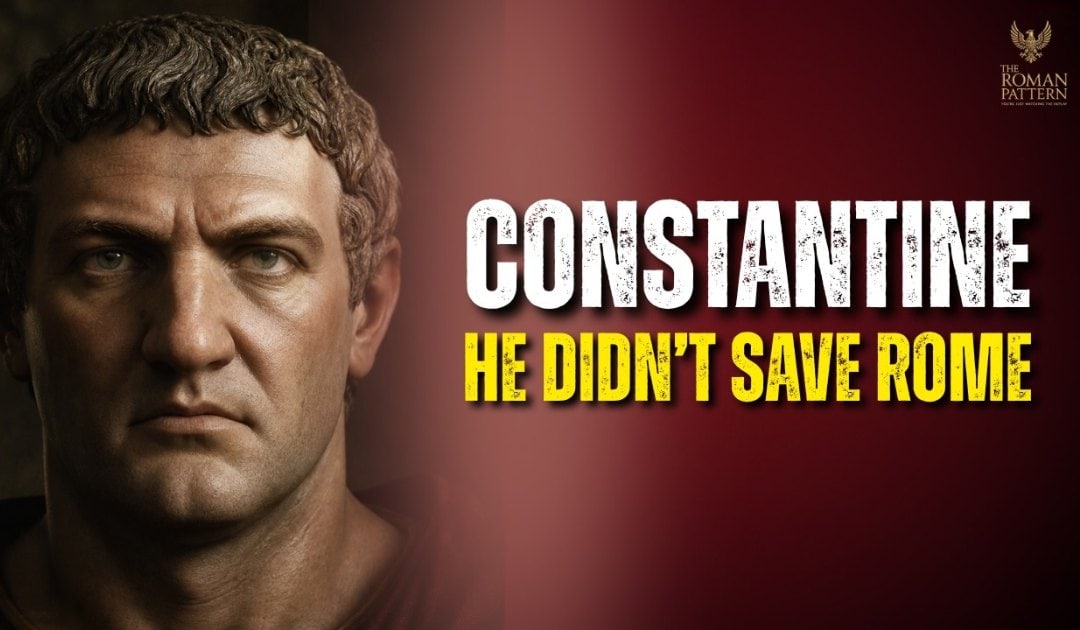
Most of us picture Constantine as the man who saved Rome, with the vision in the sky, the cross above the battlefield and Christianity rising to replace what came before. That’s the version people remember, and there’s truth in it. When I actually sat down with what he did, though, it read to me more like a transfer of control. Constantine stepped into the machine Diocletian had built, kept the structure and the force behind it, and pointed the whole thing somewhere else, and in a window of roughly fifteen years, from about 312 to 330 AD, he made four reforms that carried the Eastern Roman Empire for another thousand years.
Once you see it as a redirection, a few other things start to line up. The Western legions are still there, only thinner, and the Rhine is still guarded, though with less behind it than before. The gold moves east into Constantinople, and Rome itself starts to feel like something to keep up and little else. The belief system that once held the empire together gets replaced gradually and officially, through policy. The most dangerous kind of takeover, as I see it, is the one where someone keeps the system running, changes whatever no longer serves, and calls the change salvation.
I walk through the whole sequence in the video, starting with the machine Constantine inherited.
The machine he inherited
By the time Diocletian took power in 284, Rome had been unstable in a way that kept repeating, with fifty years of civil war and twelve emperors in thirty years, most of them killed by the men trying to take their place. The denarius had once been almost pure silver, and by then it was mostly copper with a thin coating of silver you could rub off, so soldiers were paid in money that didn’t hold its value, merchants stopped trusting it, and tax collectors adjusted. Diocletian answered that collapse of trust with structure. He divided the empire into four administrative zones under two senior emperors, the Augusti, and two junior deputies, the Caesars, so that if something broke along the Rhine somebody was already there. He ran a full census, fixed prices on thousands of goods and services with death as a possible penalty, and reorganized the army, and for a time the Rhine, the Danube and the eastern frontier all held.
He stepped down voluntarily in 305, healthy and with the system in place, believing it could run without him. Within a year the tetrarchy fractured because the men inside it wanted more than the roles they’d been given, and at one point six men claimed the title of Augustus. When Constantine’s father, Constantius Chlorus, died at York in Britain in 306, the army declared Constantine emperor on the spot, which was exactly what the system had been designed to prevent. He then spent eighteen years fighting his way to sole control, and he got there because he was better at using the machine than anyone else.
Milvian Bridge and the Edict of Milan
The decisive moment came in 312 at the Milvian Bridge. His opponent Maxentius held Italy and North Africa, the wealthiest provinces in the West. You know the story of the vision, the Chi-Rho and the words “By this sign, you conquer,” with the marked shields, the victory, and Maxentius drowning in the Tiber as he retreated. Look a little closer, though, and you see that Constantine was outnumbered and needed something stronger than pay or discipline to hold his army together. Christianity at that point already had a bishop in every city and a congregation in every neighborhood, an organized network loyal across class lines and operating everywhere inside the empire. My read is that what he saw was a system inside the system, and that he understood how to use it.
That leads to the first reform, because in 313, together with the Eastern emperor Licinius before their alliance broke down, Constantine issued the Edict of Milan and legalized Christianity across the empire, ending about 250 years of persecution. It’s usually framed as tolerance, and the edict did that and then went further by empowering the church. Property was returned, churches gained legal standing and could own land and receive donations, and Constantine started building churches at imperial scale almost immediately. He also granted bishops legal authority to hear disputes, free slaves in binding ceremonies and mediate property conflicts, which in effect made them a second layer of government running on voluntary loyalty. He never needed to outlaw the old religion, since imperial favor flowed one way, careers followed it, and conversions followed the careers.
The solidus and the two armies
The second reform was the solidus, introduced around 312. It was a gold coin of about 4.5 grams, one seventy-second of a Roman pound, and Constantine made it deliberately overweight so that any debasement would be obvious immediately. It held its purity for roughly 700 years, the longest run of monetary stability in world history. It was minted in the East, at Constantinople and Antioch, so the West used it without controlling it.
The third reform was military. Diocletian had already leaned toward a mobile reserve and permanent frontier troops, and Constantine finalized the split into the comitatenses, the mobile field armies held in strategic reserve, and the limitanei, the permanent border garrisons. It acknowledged what Rome could and couldn’t afford, and Byzantium ran versions of the system into the eleventh century. On paper it looked like an improvement, with better trained forces and faster response, but frontier troops were reduced, and borders tend to weaken long before anything breaks. Response times slow and deterrence fades while pressure from outside keeps coming. Germanic leaders also began entering the Roman command structure as officers, and the line between inside and outside started to blur until it became something you could negotiate.
If you’d rather have this one in your ears on a long drive, the audio version is right here.
A new Rome
Constantine became sole emperor in 324 after defeating Licinius, and his first major decision showed where he was headed. For the fourth reform he passed over Rome and Milan and chose Byzantium, an old Greek colony positioned between Europe and Asia, defensible and well removed from the old capital’s institutions. He rebuilt it with a new senate and forum, and in 330 it became Constantinople, the new Rome, without anyone consulting the old one. When the West collapsed in the fifth century, Constantinople was already the center of gravity of the Roman world, and it stayed that way until 1453.
Building it took immense resources, and in practice those came from the West. Western infrastructure was maintained but no longer expanded, and the frontiers were held without being strengthened. In a system that runs on how resources get allocated, I think that’s where the West’s decline starts, with attention relocating east years before anything collapses.
Redirecting a system
Each of those four reforms was politically impossible until he did it. The senatorial class opposed Christianity, the financial establishment opposed a new gold standard, the military resisted reorganization, and the aristocracy fought the move of the capital, and he did all four anyway inside fifteen years. Step back and you can see a sequence, with money moving first, borders thinning after it, and power concentrating, all done by a man who believed he was improving the empire, and for his moment he was, making it more efficient and more unified. The East survived the fall of the West by nearly a thousand years on institutions Constantine built, while everything in the West that no longer lined up with his direction started to drift, and by the time anyone could see the drift it was already locked in.
The full episode goes deeper into all four reforms, so watch it or listen whenever you have the time, and tell me in the comments whether you read Constantine as a rescuer or as a redirector.