
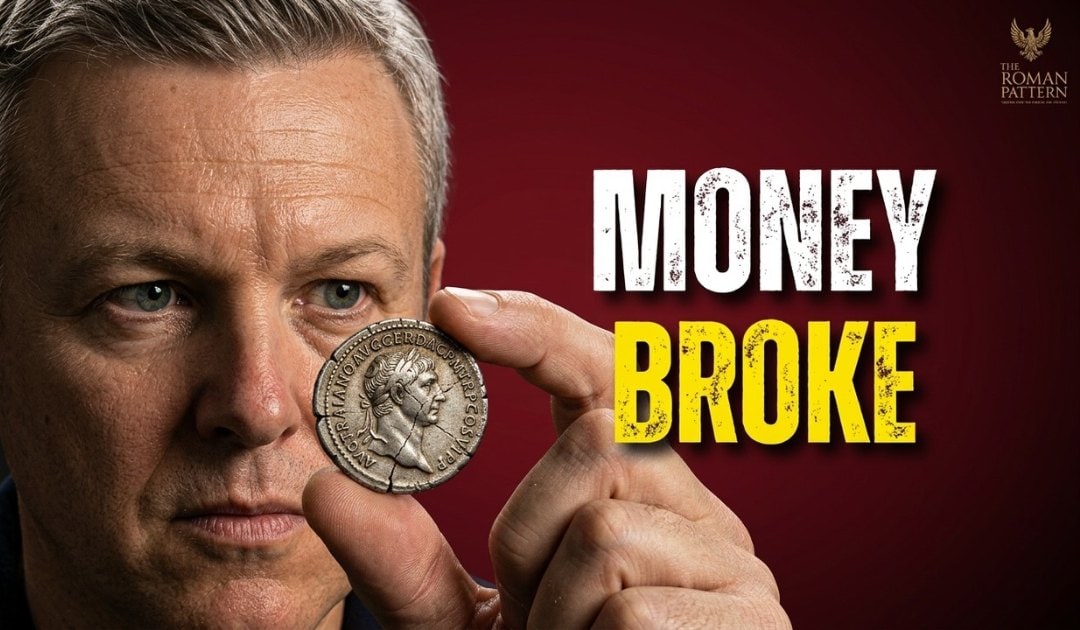
Most people assume Rome fell because of invasions or bad emperors. By the time the invasions really mattered, though, the system was already breaking down, and a big part of the reason was that Rome’s money had stopped working. For a very long stretch, Roman coins held their value, and people trusted them enough to build with them and pay armies with them. Then the silver started to disappear while the coins kept coming, and once people figured out that the coins weren’t worth what they claimed to be worth, they started losing trust in the system that stood behind them.
For this episode of The Roman Pattern I brought back Dean Kinzer, an ancient coin dealer who has been on the channel before to talk about propaganda on coins. He’s also the guy who supplies the coins I hand out to hosts when I go on shows, Shawn Ryan and Julian Dorey among them. We’ve spent the last several episodes on Diocletian and the bureaucrats who kept the empire running when emperors died, and Constantine is coming up soon, so this felt like the right moment to look at the period through the one kind of evidence that can’t be painted over.
We spent most of the conversation on how the money came apart and on the two emperors who tried to put it back together, and the whole conversation is here if you want to watch it.
The slide, one small step at a time
When Augustus took power in 27 BC, the denarius was struck at roughly 95 percent silver and weighed about 3.9 grams. Dean called it the American dollar of its day, which I think is about right, and for about a century it held that purity almost perfectly. Nero began the debasement in 64 AD, dropping the silver to about 90 percent and the weight to 3.4 grams, which was easy enough to justify after the great fire of Rome, and nobody really complained.
Every emperor after him kept going in the same direction. The silver held around 90 percent under Trajan and Hadrian, fell to about 75 percent under Marcus Aurelius to pay for the Marcomannic Wars, then to 70 percent under Commodus and 55 percent under Septimius Severus. Each cut was small enough that people using the coin from one year to the next barely noticed it, and each one made sense in the moment, but every one of them also set a new, lower starting point for whoever came next.
In 215 AD Caracalla introduced the antoninianus, the so-called double denarius. It was supposed to be worth two denarii, but physically it was closer to one and a half, at around 50 percent silver. I can never say that word cleanly, and my editor hears me apologize for it every time it comes up on the prompter. By the 260s, under Gallienus, the antoninianus was under 5 percent silver, a bronze coin with a thin wash that wore off after a few months in circulation, and soldiers who had been paid in silver a generation earlier were being paid in something closer to tokens.
You can see how much of this coinage was struck just from the sheer number of these coins still around today, which Dean compared to the German mark after World War I, a mountain of money worth less and less. He also compared the skimming that went on at every stage to the counting room in Casino, a little into one pocket and then another. How ordinary people coped is honestly something we don’t know a ton about, and even Aurelian’s better coin ran into a wall because people had spent fifty years learning something was wrong with their money. Dean’s best guess is that people looked for other ways to trade, and the record shows long-distance trade contracting, wealth moving into gold and hard assets, and barter showing up in the Western provinces.
Diocletian tries to control it
Diocletian saw the monetary problem clearly and tried several things, most of which didn’t work very well. He was a soldier from what’s now Croatia, and Dean thinks taking on the entire coinage says a lot about how his mind worked. He reintroduced the argenteus, a silver coin in the spirit of the old denarius, and often put all four members of the tetrarchy on the reverse to show every corner of the empire tied together. He also issued large bronze coins and the smaller types collectors now call AE2, AE3 and AE4, and those stayed in use for a long time.
The argenteus had a short life, and so did his attempt to fix prices by decree. The Edict on Maximum Prices in 301 AD tried to solve inflation by order and was a failure within a decade. Still, Dean’s view, which I share, is that Diocletian reorganized the empire enough to leave Constantine in a fantastic position, a bit like Philip II and Alexander, or really, the way I put it on the show, a dad who leaves his son the perfect race car and then watches him win ten titles.
If you’d rather listen to the full conversation with Dean on a drive or a walk, the audio version is right here.
Constantine replaces it
Constantine introduced the solidus around 312 AD, a gold coin he made deliberately overweight and too pure to debase without everyone seeing it. There’s a story I’ve heard, and I want to be upfront that I haven’t found a lot of supporting sources for it, that he set out to put the empire on a gold standard, minting a few new gold coins every year over roughly twenty years and requiring taxes to be paid in gold so it would stay in circulation. What Dean could confirm is that the solidus outlasted Constantine and outlasted 476, and it held its purity for something like 700 years. I’ve even read that its gold quality may have held as late as 1054, which is unheard of in the ancient world.
Gold suited the later empire partly out of necessity, since Constantinople had lost access to the Spanish silver mines and had to trade with the Sasanians and later the Islamic caliphate for silver. Dean also pointed to the scarcity of third-century gold coins today, with a gold aureus of that era worth considerably more than one from Nero’s reign, which suggests there was simply less gold around before Constantine changed things.
His coins tell their own story too. His portraits move from clean-shaven to stubble to sideburns and something close to a beard, and his reverses show Sol, the sun god, alongside civic pride coins for Rome and for the new city of Constantinople.
What the coins teach
Put a denarius of Marcus Aurelius beside a fifth-century bronze of Leo I and you can see the decline without reading a word, from a beautifully struck coin to one that’s crude, off-center and obviously made in a hurry. Buildings get painted over and built on, but a coin keeps the evidence in plain sight. Dean’s favorite is a hexagram of Heraclius, struck from church silver melted down to pay soldiers while Constantinople was under pressure, carrying the words God save the Romans.
We tried to keep the modern side non-political and focused on systems. Dean was born in the late seventies, when American coins still had real copper and silver in them, and today the copper coins have hardly any copper in them and the penny costs so much that the country stopped producing it, which I’d call a red flag. America went off the gold standard in 1971, and people are moving money into Bitcoin, gold and silver for the same reason Romans went looking for something solid. Dean was careful to say it doesn’t mean the end, and he pointed to the Roman story itself, which ran on for another thousand years in the East after the West fell.
If you want to see the coins themselves, and hear Dean on where a new collector should start (fourth-century bronzes of Constantine, or Gallienus’s set of zoo animals), watch the full episode or put the audio on for your next drive, and you can find Dean at StartAncients.com.