
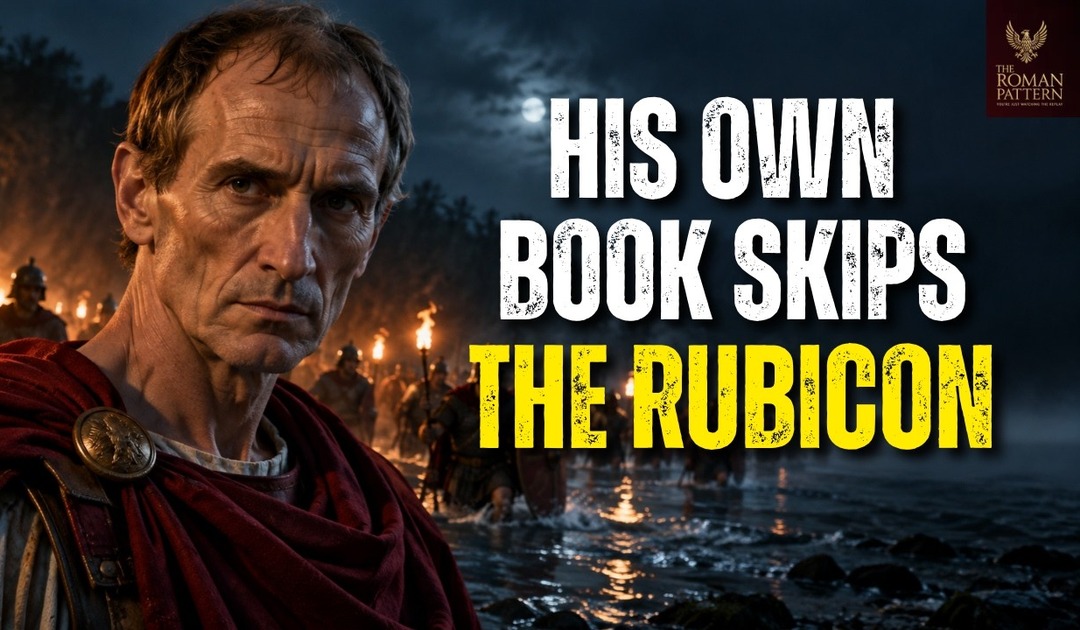
Most of us carry the same picture of the Rubicon, a lone general at a river at night saying the die is cast, and the more time I spend with the sources the stranger that picture gets. Caesar’s own account of the civil war never mentions the river, which leaves the most famous scene in Roman history missing from the only eyewitness account we have.
This week’s episode of The Roman Pattern follows the four years after the crossing, through Pharsalus, Pompey’s death in Egypt, Cato at Utica, and finally Munda in 45 BC. The Republic outlived the crossing by four years and died on the battlefields that followed.
The Vote That Never Became Policy
By 50 BC the Senate’s argument had narrowed to the date Caesar’s command in Gaul legally ran out, which historians still haven’t settled. Caesar wanted to step straight into a second consulship for 48 BC without a single day as a private citizen, because a private citizen could be prosecuted, and a courtroom was waiting for him the moment he gave up his army.
His tribune in Rome, Gaius Scribonius Curio, proposed that Caesar and Pompey give up their commands at the same time. On December 1st, 50 BC, 370 senators voted for both men to disarm and 22 voted against. The presiding consul, Gaius Claudius Marcellus, dismissed the Senate and left the vote sitting there, and a day or two later he went out to Pompey and charged him with the defense of the state, handing him a sword in Appian’s account.
I walk through that vote and everything it set moving in the full episode, which you can watch here.
What I keep noticing is that the great majority of the people responsible for the Republic looked at two armies and said plainly that both should stand down. A small group of hardliners holding the chamber’s procedure made sure that view never became policy, and each side kept saying it could only disarm after the other went first. I’d rather you notice for yourself which governing bodies today that sounds like.
The River Caesar Left Out
On January 7th, 49 BC, the Senate passed the senatus consultum ultimum, the final decree, a measure that had gotten easier to justify each time Rome used it. The tribunes Mark Antony and Quintus Cassius fled north that night, and since tribunes were supposed to be sacred, that handed Caesar exactly the grievance he needed.
He was waiting at Ravenna with one legion, the 13th. The traditional date of the crossing is January 10th, 49 BC, though it’s reconstructed by working backward, since no ancient source gives the day. Suetonius gives us alea iacta est, though he wrote more than a century later and his likely source, Asinius Pollio, is lost. Maybe Caesar thought the river was beneath notice, or maybe he understood that a general writing for Romans was better off skipping the moment he broke the law. I don’t know which, and even the river is uncertain now, since the stream carrying the name today was only given it in the 1930s.
Men who remembered Sulla’s march on Rome in 88 BC assumed they were about to see it again. Around January 17th or 18th, Pompey left Rome with the consuls, and in their hurry they left the state treasury behind, so the man who had broken the law walked into an Italy whose lawful government had just walked out.
Mercy and the Treasury Doors
At Corfinium, Caesar’s troops handed him Lucius Domitius Ahenobarbus, the man named to replace him in Gaul, and Caesar let him go. A letter in Cicero’s correspondence has Caesar saying he will not imitate Sulla’s cruelty and calling mercy a new way of conquering. I think he was sincere, and I also think he was very good at politics, and I don’t see those two things canceling out.
In April Caesar went to the treasury in the Temple of Saturn, where the tribune Lucius Caecilius Metellus invoked the same kind of veto Caesar had marched on Rome to defend. Caesar threatened to kill him, and Plutarch has him saying it was harder for him to say than to do. The money went to the war, which is how money tends to enter a civil war, because whoever controls the army controls the treasury and the treasury pays the army.
Pharsalus and the Counting of the Dead
At Dyrrachium in July of 48, Pompey broke Caesar’s siege lines and didn’t follow it through, and Caesar said afterward the enemy would have won that day with a commander who knew how to win, which may not be fair to Pompey, though it tells you how close it was.
They met on August 9th, 48 BC, at Pharsalus. By Caesar’s count he had around 22,000 infantry and 1,000 cavalry against Pompey’s 45,000 infantry and 7,000 cavalry, and those are Caesar’s numbers. Pompey’s cavalry, under Caesar’s old lieutenant Titus Labienus, was supposed to sweep around Caesar’s right, and Caesar had pulled six cohorts into a hidden fourth line that stepped out and met the horses head on. The cavalry broke, and Pompey’s army came apart from the flank inward.
Suetonius, drawing on Pollio, has Caesar looking over the Roman dead and saying hoc voluerunt, they wanted this. Caesar put the Pompeian dead at 15,000, while Pollio, who fought on Caesar’s side, put them at 6,000. I’d lean toward Pollio, though we don’t really know, or more accurately the thing I’d lean toward is noticing how winners count, since the man with the higher number wrote the official account.
If you’d rather take this one in on a drive, the full episode is also up on The Jeremy Ryan Slate Show.
Pelusium and Utica
Pompey sailed for Egypt, where the young king Ptolemy XIII’s advisers worked out that a dead Pompey offended no one who mattered, and as he came onto the beach at Pelusium, the king’s men killed him. When Caesar arrived, Theodotus brought him the head and Pompey’s signet ring, carved with a lion holding a sword, and Plutarch says Caesar turned away from the head and wept when he was handed the ring.
The survivors regrouped in Africa, and after Caesar beat them at Thapsus on April 6th, 46 BC, Cato, who was holding Utica, knew Caesar would pardon him, and in Plutarch’s telling he refused, because accepting the pardon meant accepting that one Roman citizen could now decide whether another lived. He read Plato’s dialogue on the immortality of the soul that night and then killed himself. Plutarch reports Caesar saying he begrudged Cato his death because Cato had begrudged him the chance to spare his life, which strikes me as an honest line from a man who had finally met someone who wouldn’t let himself be forgiven.
Every Office Still Standing
Set beside Sulla’s proscriptions, Caesar’s clemency looks like the decent alternative, and in human terms it was. What Cato saw was that it rested on the same foundation, because Sulla decided which citizens died and Caesar decided which ones lived. Or maybe more precisely, the deciding belonged to whoever won the last battle, and that happened to be one man.
In 46 BC Caesar was named dictator for ten years, and Pompey’s sons raised one more army in Spain. At Munda on March 17th, 45 BC, Caesar’s line was giving way for a long stretch of the day, and Plutarch and Appian both report him saying he had often fought for victory and at Munda he fought for his life.
After Munda, the Senate still met and the consuls still held their offices, and the tribunes kept their sacred status, at least on paper. Every institution that existed before the Rubicon was still standing in 45 BC, and every one of them now operated with the permission of the man who had won. Five years earlier, 370 senators had asked for both armies to stand down, and the survivors among them had since traded a republic that couldn’t act on its own majority for a government that didn’t need one.
Two and a half years after Munda, a 19-year-old named Octavian would march on Rome to force the Senate to make him consul, and he didn’t need to invent anything, since Caesar had already shown him every move. If you want to go further, read Caesar’s own account of the civil war and then Plutarch’s lives of Caesar, Pompey, and Cato, and notice where Caesar goes silent. I’m still working through some of it myself, so watch or listen to the full episode, and if you think I’ve read something wrong, tell me where.