
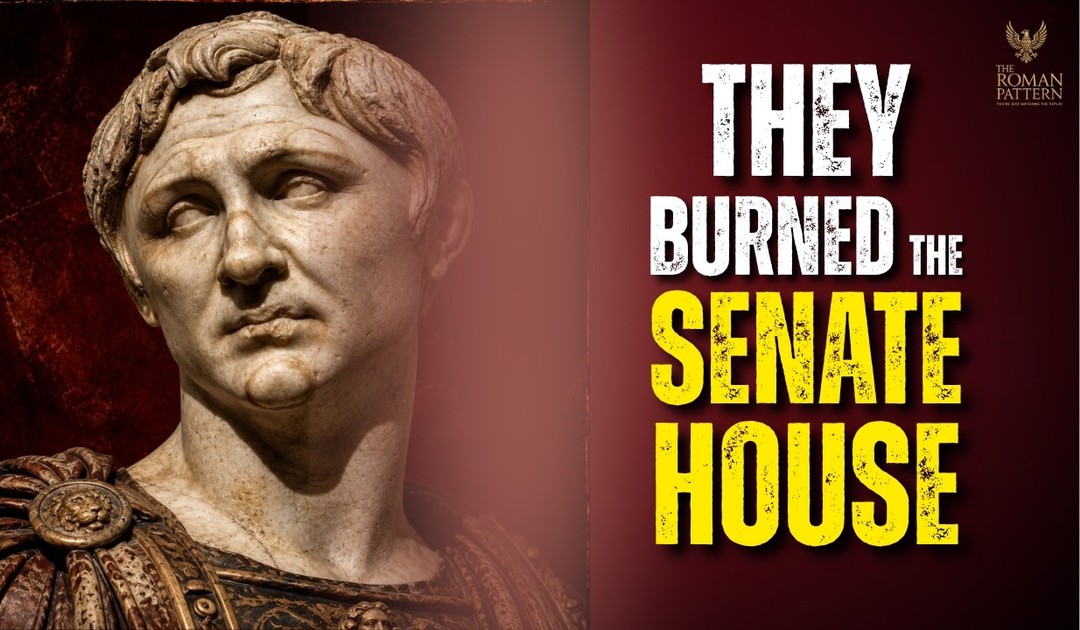
We tend to picture Julius Caesar overthrowing a Roman government that still worked, and the more time I spend with the years right before the Rubicon, the harder that picture gets to hold. Rome was still holding elections in 52 BC, but they had stopped deciding anything, and the men who called themselves the Republic’s defenders ended up choosing one man over the vote.
This week’s episode of The Roman Pattern follows the four years that got Rome there, from the violent election of 55 BC to the day Bibulus and Cato the Younger made Pompey consul without a colleague. It comes right after the Luca episode in the Fall of the Republic series, and it’s where a lot of the earlier pieces start to fit together, because it shows how far elections had drifted toward play-acting.
I walk through all of it in the video, and it helps to have the names and places in front of you for the rest of this.
Elections Settled by Weapons
Early in 55 BC, while it was still dark, Lucius Domitius Ahenobarbus set out for the Campus Martius to stand for consul, with a slave carrying a torch ahead of him and his brother-in-law Cato the Younger at his side. Armed men came at them before they reached the voting enclosures, the torchbearer was killed, Cato was wounded, and Domitius went home. He had said in public that as consul he would take Caesar’s armies away, which made him the one rival the deal at Luca needed out of the race. Plutarch puts the attack on men working for Pompey and Crassus, who were then elected consuls for the second time, and nobody was ever held to account for it.
Later that year a fight at the elections for aedile broke out close enough to Pompey that he came home with blood on his toga. When Cato looked like he might win the praetorship, Pompey was presiding and announced that he had heard thunder, which under Roman religious law meant the assembly had to be dissolved on the spot, and when the vote was held again Cato lost to Publius Vatinius, the tribune who had passed Caesar’s Gallic command back in 59.
When Bribery Moved the Interest Rate
The elections of 54 were where the money took over. Two candidates, Gaius Memmius and Gnaeus Domitius Calvinus, made a private deal with the sitting consuls, Ahenobarbus and Appius Claudius Pulcher, the older brother of Clodius. According to Cicero’s letters to Atticus, the candidates promised to produce augurs and former consuls who would swear to things about the consuls’ provinces that had never happened, with a cash penalty if they couldn’t deliver. Cicero also says so much cash was borrowed to buy votes that in July of 54 the interest rate in Rome doubled, from about 4 percent a year to about 8.
Then Memmius stood up in the Senate and read the agreement out, the elections collapsed under the exposure, and 53 began with no consuls at all. Rome got by for months on a chain of interreges, temporary officials who each held power for five days and existed mostly to hold an election, while the ordinary business of the state kept getting pushed back. When consuls were finally chosen in July, one of them was Calvinus, which tells you how much the scandal actually cost him, and that summer Crassus died after the defeat at Carrhae.
The Appian Way and the Burning Senate House
By then the city had two private armies inside its walls. Publius Clodius Pulcher had driven Cicero into exile as tribune in 58 and built an organization in the streets, and Titus Annius Milo had answered him with gangs of his own, gladiators among them. In 52 Milo was running for consul and Clodius for praetor, and every attempt to vote turned into a fight. Appian, writing about two centuries later, believed Pompey let the chaos run on deliberately so the city would beg him to take charge, which is an accusation Pompey never admitted to, though you can see why people made it.
On January 18, 52 BC, the two men met on the Appian Way near Bovillae, and after a fight between their followers, Milo had the wounded Clodius dragged out of a roadside inn and killed. Cicero, defending Milo, claimed Clodius had set an ambush, while Asconius, who went back to the official records about a century later, suggests a chance meeting that turned violent, and we honestly can’t be sure who struck first.
The next day Clodius’s supporters carried his body into the Curia Hostilia, piled up the Senate’s own benches and tables and record books into a pyre, and set it alight, and the fire took the Senate House and spread to the Basilica Porcia next door. I’ll admit it’s tempting to read that fire purely as a symbol, though I try to be careful with that, because the people who lit it thought they were honoring a champion of the people. To them Clodius was the tribune who had given the poor free grain, and to the Senate he was a gang leader, and both were true in a city with no institution left to settle the difference.
If you’d rather take this one in on a drive or a walk, the same episode is on The Jeremy Ryan Slate Show, and you can play it right from here.
The Republic’s Defenders Choose One Man
The Senate passed its emergency decree, but with no consuls to empower, it authorized Pompey to raise troops across Italy. Then Bibulus, the man who had sat in his house watching the skies while Caesar ignored him in 59, proposed that Pompey be made consul sine collega, consul without colleague, something Rome had never had, and Cato supported him. Plutarch gives Cato’s reasoning as any government being better than none, and the alternative on the table was naming Pompey dictator.
Rome had split the consulship in two since it drove out its last king, so every consul had a colleague who could block him, and in 52 that protection was set aside by its most committed defenders. Earlier in the series the pressure came from men pushing against the system, from Marius and Sulla through Caesar in 59. This time the system’s own guardians looked at the burned Senate House and decided one man was safer than the institutions they’d spent their careers defending, partly out of fear of the streets and partly, I suspect, because they figured Pompey on their side was safer than Pompey drifting back toward Caesar.
Pompey moved quickly with laws against violence and bribery, and the first major case was Milo’s, in April, with soldiers surrounding the Forum. Cicero, who owed Milo his recall from exile, spoke badly with Clodius’s supporters shouting, and Milo was convicted and went into exile at Massilia. The Pro Milone we read today is the version Cicero polished and published afterward, which means the most famous defense speech of the Republic was never actually delivered.
The Exception Written for Caesar
Earlier in 52, all ten tribunes had passed a law letting Caesar stand for a second consulship in absentia, so he could go from Gaul into office without ever becoming a private citizen open to prosecution, and Pompey supported it. Then Pompey’s own law on magistrates required candidates to declare in person in Rome, which, read plainly, canceled that exemption, and according to Suetonius Pompey added a clause exempting Caesar after the law had already been engraved. By the end of the year Pompey held the consulship in Rome, both Spanish provinces through his legates, and the grain supply all at once, while Caesar fought Vercingetorix in Gaul with an exemption that existed only because Pompey had chosen to add it.
What the Next Decade Remembered
Pompey’s sole consulship looks almost modest next to the dictatorship Caesar would hold a few years later, but each later step had something to point back to, and one of them was the year the Republic’s own defenders asked for one man. When institutions can’t fill their own offices, the call for a strong figure to restore order usually arrives sounding responsible, and it comes from people who say they’re protecting those institutions and mean it. You don’t have to think anyone in 52 acted in bad faith to see the danger, which is that everyone who comes afterward remembers the step and forgets the emergency, or, more accurately, the emergency is what people forget first and the precedent is what they keep.
If you want to see 52 through the eyes of someone close to it, Asconius’s commentary on Cicero’s speech for Milo is surprisingly readable and the best way to set Cicero’s version beside the record. The full episode is on The Roman Pattern on YouTube and on The Jeremy Ryan Slate Show wherever you listen, and next time we pick it up at a small river in northern Italy, with Caesar on one side and Pompey and the Senate on the other.