
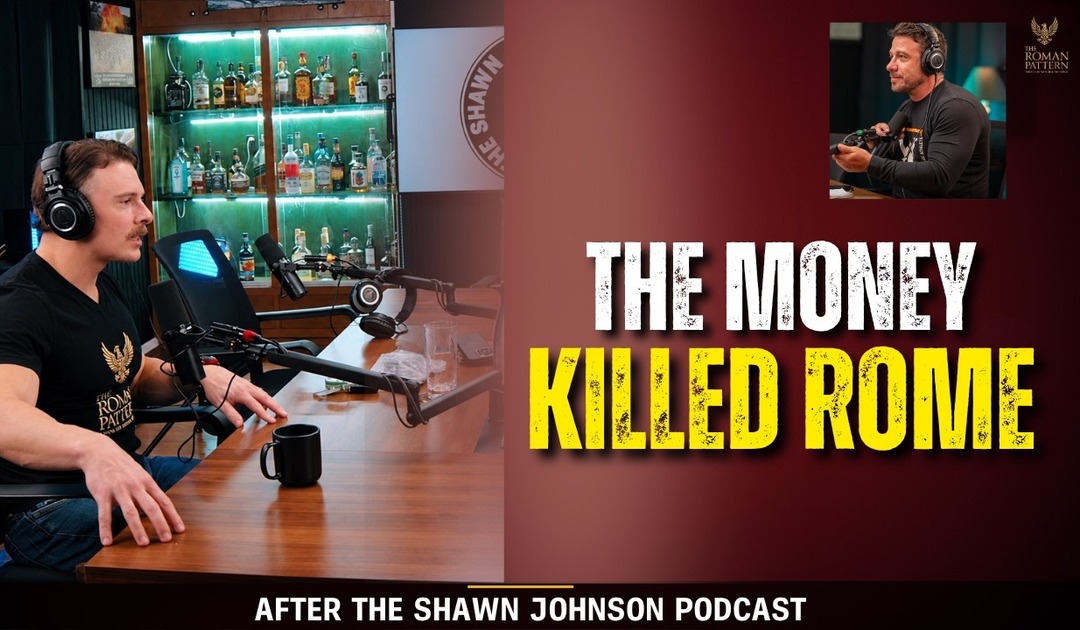
At the end of September, Shawn Johnson had me down to Texas for The Shawn Johnson Podcast, and we spent about an hour and a half on Rome, from Augustus’s coins to the fall of the West.
When he asked which of the three pressures worries me most, I told him the money, and I think that answer holds up. Rome survived bad emperors, weak borders, and jealous men at court for long stretches, as long as the coin in a soldier’s hand still meant something. Once it stopped meaning something, every other weakness had to be paid for in a currency nobody trusted, and this week’s video takes that case further than we had time for.
I’d also like two corrections on the record. I told Shawn that Marius changed the legion’s formation to the testudo, the tortoise, and while that was a real formation, the reform usually credited to Marius is the cohort, a unit of about 480 men, and historians still argue over how much of it was his. I also put Diocletian’s persecution of Christians in the 280s. He took power in 284, but the Great Persecution began in 303, near the end of his reign. The smaller slip-ups are in the pinned comment.
The coins Shawn was holding are on screen in the video, if you’d like to see them.
Two collapses at once
Shawn asked where America sits on Rome’s timeline. Rome went through two collapses nearly five hundred years apart. The Republic slid into one-man rule in the first century BC because ambitious men found they could break the rules for their careers and get away with it, and each break made the next one easier. The empire that followed fell apart in the West in the fifth century AD mostly over money and soldiers. My argument is that America shows the symptoms of both, with our politics running on the Republic’s pattern while our money and our place in the world run on the Empire’s.
On the Empire side I’d put us around the early third century. Actually, more precisely, I hold the placement loosely and the direction a lot more firmly, because the direction is where the evidence keeps pointing, and the third century is when Rome’s coins started to give out.
Silver over bronze
Near the end of the show I handed Shawn some real Roman coins, courtesy of my friend Dean Kinzer at Kinzer Coins. In the first century the denarius was around 95 percent silver, and by the 270s the coins Romans were spending had only a few percent left, a thin wash over bronze. One of the coins in Shawn’s hand was from the emperor Valerian, silver on the outside and bronze underneath. Romans could rub their wages and watch the silver come off, and they drew their own conclusions. Prices climbed for decades, and by the time Diocletian took power in 284 the usual estimates put the rise somewhere around 15,000 to 20,000 percent.
The emperors kept cutting the silver because of the army. The coin existed first to pay soldiers, and every new emperor needed them to like him, so the quickest way to find more coins for them was to put less silver in each one. Around 250, as far as the evidence lets us tell, the Nile failed to flood for several years in a row, which meant less grain from Egypt for the dole in the capital at the same moment the coin was losing value. Grain prices doubled and tripled, and a bad harvest on top of a failing currency turns political very fast.
Our version is harder to see, and you mostly notice it at the gas pump. On the show I gave Shawn a figure of 3,000 to 4,000 percent since about 1800, and I had the starting year wrong. As best I can tell from the price index, that number fits the years since 1913, and since 1800 it’s closer to 1,800 percent, though it’s worth running the numbers yourself. What I’m sure of is that the people who benefit from a currency losing value are the same people who would have to fix it. Rome had that problem too, and in the West it never found its way out.
When the edges break off
In 260 Valerian led an army against the Persian king Shapur I and was taken prisoner, the first Roman emperor ever captured by a foreign enemy, and Shapur had the scene carved into a cliff in southern Iran. I told Shawn that Valerian spent the rest of his life as Shapur’s footstool, and that story comes from Lactantius, a Christian writer whose whole point was that emperors who persecuted Christians came to a bad end. As for what happened to Valerian after the capture, we honestly don’t know.
His son Gallienus couldn’t get him back, and Rome began to fragment. The general whose name I blanked on was Postumus, who for most of the 260s ruled Gaul, Spain, and Britain from his own capital with his own consuls and his own coins. In the East it took longer than I made it sound, since Odaenathus of Palmyra stayed loyal to Rome on paper, and it was his widow Zenobia who broke away around 270 and held Egypt and much of the eastern provinces for about two years, a long way from the fifteen I gave Shawn.
That border pressure runs straight back to the money. An emperor who couldn’t rescue his own father couldn’t pay enough soldiers to hold every frontier, so the provinces that felt abandoned found their own protectors. Aurelian gave up gold-rich Dacia in the early 270s because the empire couldn’t hold it, and most of the decline went like that, one province at a time.
Competent men as threats
Aurelian put the pieces back together in about five years and issued better coin, and in 275 his own officers murdered him after a frightened secretary turned against him. Shawn liked a line I used about that, that even in an age when incompetence reigns, competent men are seen as dangerous.
By the 400s the western emperor Honorius had moved to Ravenna, and the man holding the West together was his general Flavius Stilicho, whose father was a Vandal. He beat Alaric’s Visigoths in 402 and 403 and destroyed Radagaisus’s army outside Florence in 406. A jealous courtier named Olympius got in the emperor’s ear, and Stilicho was beheaded at Ravenna in August of 408. In the purge that followed, thousands of barbarian troops whose families had been massacred went over to Alaric, and two years later he sacked Rome.
Our fullest account comes from Zosimus, writing about a century later, and some Romans blamed Stilicho himself for letting the Goths grow strong. I think the record supports the version where he’s the last capable man in the room, but book five of Zosimus’s New History is short enough to judge for yourself. Aurelian and Stilicho are more than 130 years apart, and the court did the same thing to both of them. Shawn’s answer, from his years in the military, was that the turds float to the top, which is a cruder way of putting it and probably more accurate.
The half that fixed its money
Shawn said he hoped we don’t fall like Rome, and I told him why I’m not a doom-and-gloom guy. Only one half of Rome fell in the fifth century. Constantine’s gold solidus was first struck around 309 and became the coin of the whole empire after he took the East in 324 (I had those dates loose on the show), and it kept its weight and purity until the middle of the eleventh century, about seven hundred years of a coin people could trust.
The West used the same coin for its last century and a half and still lost the provinces and taxes that paid its armies, so the coin alone couldn’t carry the load. I’d put it better this way, that the East kept both halves of the bargain, the honest coin and the means to keep earning it. I told Shawn I’m not sure gold is the answer for us, since our debt is so large that any repair will hurt.
If you found me through Shawn’s show, welcome. The channel is working through the fall of the Republic right now, and on Monday, October 19, we get to the meeting at Luca in 56 BC, where three men renewed the arrangement that was running Rome. The video above has the full argument with the coins and corrections, and I’ll see you Monday.