
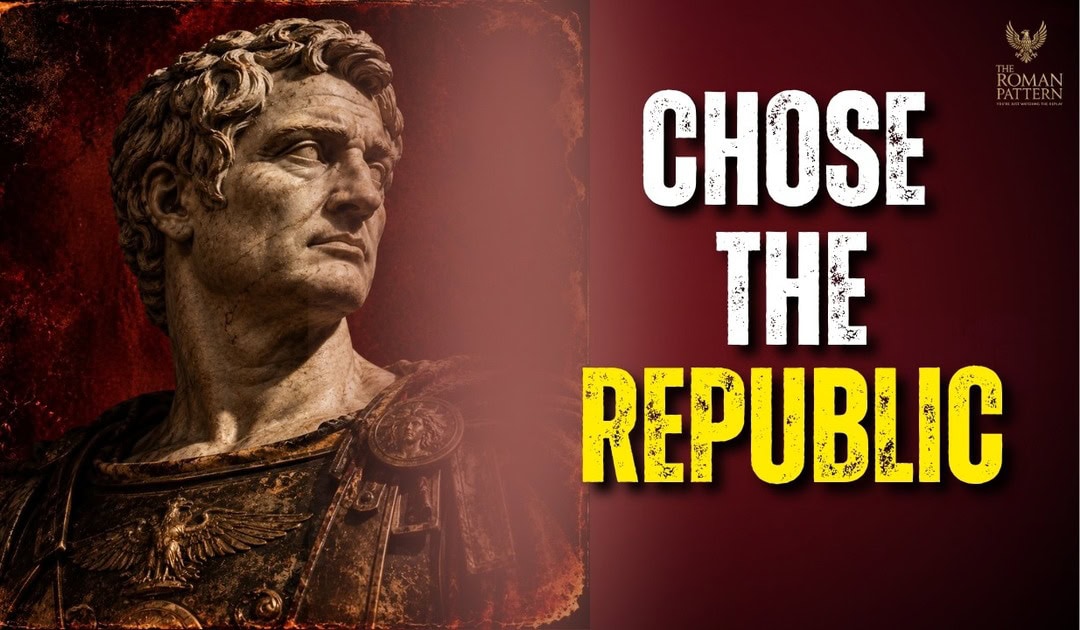
This week on The Roman Pattern I finally got to sit down with Gnaeus Pompeius Magnus, the man history remembers as Pompey the Great. I spent a good part of grad school with him, and as it happened I recorded this episode on September 29, which was his birthday, so it felt like his turn had come around.
What follows is the main thread of what I worked through in the episode, written up for anyone who wants to read it first or come back to it after watching.
A Career Built on Exceptions
Pompey was born on September 29, 106 BC, to a father named Pompeius Strabo, who was hated in Rome and very effective in war. When Strabo died his clients waited for the son, and at 23 Pompey raised three legions out of his father’s people in Picenum, paid for them and armed them himself, and marched them to Sulla, who was about to seize Rome and make himself dictator. Plutarch tells us Sulla got down off his horse to greet him and called him Imperator on the spot, an honor he hadn’t even given the senators who had come over to his side.
From there Pompey cleared Sicily and Africa for Sulla, and he did it so quickly and so ruthlessly that his enemies started calling him the young butcher. Power had already become personal by this point, and the law just hadn’t gotten around to admitting it. Sulla resisted giving him a triumph at first and then gave in, so before he was a senator, and before he was even 30, Pompey rode through Rome in a full triumph that broke every rule the city had, and the crowds cheered him for it.
In 77 BC he demanded the command in Spain against the rebel Sertorius, even though he’d never held a praetorship, and he threatened to keep his army if they turned him down. The war dragged on until Sertorius was murdered by his own lieutenant, Perperna, around 72 BC, and Pompey took the credit. In 71 BC he showed up at the tail end of the Spartacus revolt after Crassus had crushed the slave army, swept up about 5,000 fugitives, and wrote to the Senate that he was the one who had pulled the war up by the roots.
That letter tells you a lot about how credit worked in this period, as a kind of currency, or maybe more accurately as something you could take off another man’s account if you wrote to the Senate first. In 70 BC Pompey ran for the consulship at 35, when the law required 42 and a full ladder of offices he had never climbed. He ran alongside Crassus with both of their armies sitting outside the walls, and Rome gave them the consulship together.
If you’d rather watch me walk through it, here’s the full episode:
The Command That Worked Too Well
By 67 BC pirates controlled the Mediterranean and Rome’s grain supply was being cut, so a tribune proposed the Lex Gabinia, which handed one man the whole sea for three years. That meant 500 ships, 120,000 infantry, 5,000 cavalry, 24 legates and 6,000 talents, from Gibraltar to Syria. Quintus Catulus, one of the senior men in the Senate, warned them this was kingship under another name, they passed it anyway, and Pompey cleared the sea in a matter of months.
What Rome took from that was that extraordinary commands worked, and worked fast, in a way the normal system couldn’t match, so the next one came within a year. The Lex Manilia of 66 BC gave Pompey the war against Mithridates and sweeping authority over kings and provinces in the East. Cicero spoke for it, and in a speech we still have he points out that grain prices dropped the very day Pompey was named against the pirates.
Between 66 and 62 BC Pompey reorganized the eastern world. He finished off Mithridates, annexed Syria, took Jerusalem in 63 BC and founded cities he named after himself, and according to Plutarch, Rome’s public revenue went from roughly 50 million drachmas a year to about 85 million, which, if you sit with it, means one man had nearly doubled the income of an empire. By 62 BC the money of the East was moving through Pompey before it ever reached the treasury, which is why I call him Caesar before Caesar in the episode. He’d also built a network of client kings who owed him their crowns, and tens of thousands of veterans who expected their land from his hand.
The Beach at Brundisium
He landed in Italy in 62 BC with the largest army any Roman had commanded in generations, and since Sulla and Marius had both marched on the city, everyone expected him to do the same. Pompey disbanded his army right there on the beach, sent his men home, and walked into Rome without a guard. He asked the Senate to ratify his eastern settlement and to give his veterans the land they’d been promised, two requests that were both entirely legal.
For two years, through 61 and 60 BC, the Senate stalled him. Cato blocked him on principle, Lucullus out of jealousy over the eastern command Pompey had taken from him, Metellus Celer over a family grudge after Pompey divorced his half-sister, and Crassus out of plain rivalry. Any one of those reasons was defensible, but together they meant the most powerful man in Rome had done the constitutional thing and found the constitutional road closed, while his veterans sat at home waiting on farms that never came.
Prefer to listen? Catch it on The Jeremy Ryan Slate Show:
The Triumvirate and the Long Slide
So in 60 BC Pompey went around the Senate and made a private arrangement with Caesar and Crassus, what we now call the First Triumvirate. In 59 BC he married Caesar’s daughter Julia, and for as long as she lived the alliance held. During Caesar’s consulship that year Pompey finally got his settlement ratified and his men settled, though it took bribery and street gangs to get it done.
Over the next decade Caesar built a personal army in Gaul while Pompey stayed near Rome, holding the grain supply command from 57 BC and governing Spain through legates. Julia died in childbirth in September of 54 BC, and Crassus was killed at Carrhae in 53 BC. Pompey drifted toward Cato and the traditionalists who had once blocked him, and in 52 BC, after the gangs of Clodius and Milo had left the city in chaos, he was made sole consul, with no colleague and with Cato’s backing.
Pharsalus and Pelusium
When Caesar crossed the Rubicon in 49 BC, Pompey abandoned Italy and sailed for Greece with the Senate. The plan made sense on paper, though the same man who had disbanded his army at Brundisium to save the Republic was now sailing out of that harbor to save himself.
They met at Pharsalus on August 9, 48 BC. Caesar’s own account gives Pompey about 45,000 men against his 22,000, and I’d keep in mind that Caesar had every reason to make those numbers look lopsided. His veterans had spent eight years together in Gaul, and when Pompey’s cavalry charge failed his center broke, and he fled to Egypt hoping the young Ptolemy XIII, whose father Pompey had helped put back on the throne, would honor the debt.
On September 28, 48 BC, the day before his 58th birthday, his boat came in toward the shore at Pelusium. Three of the king’s advisers, the eunuch Pothinus among them, had decided Caesar would punish anyone who sheltered him. The man who killed him was Lucius Septimius, a former Roman officer who had once served under Pompey in the pirate war, and he greeted Pompey in Latin and stabbed him from behind while his wife Cornelia watched from the shore. His freedman Philip burned the body on the beach with driftwood, fourteen years after Brundisium.
What If He Had Marched?
The last part of the episode works through the counterfactual. In 62 BC Pompey could still choose to be constitutional, and by 49 that window had closed for everyone, Caesar included. Had he marched in 62, no army in Italy could have stopped him, and the Republic would likely have ended about 35 years early with him as its first emperor, so we might well be calling that imperial century Pompeian today.
I’d encourage you to check it against the sources yourself, starting with Plutarch’s Life of Pompey and Robin Seager’s biography. I see the same thing happening today when money starts flowing to individuals ahead of the offices they hold, when loyalty to a person starts doing the work of law, and when power outgrows its checks and calls itself normal. If this caught your interest, both versions of the episode are up above, and I’d like to hear where you think the window closed.