
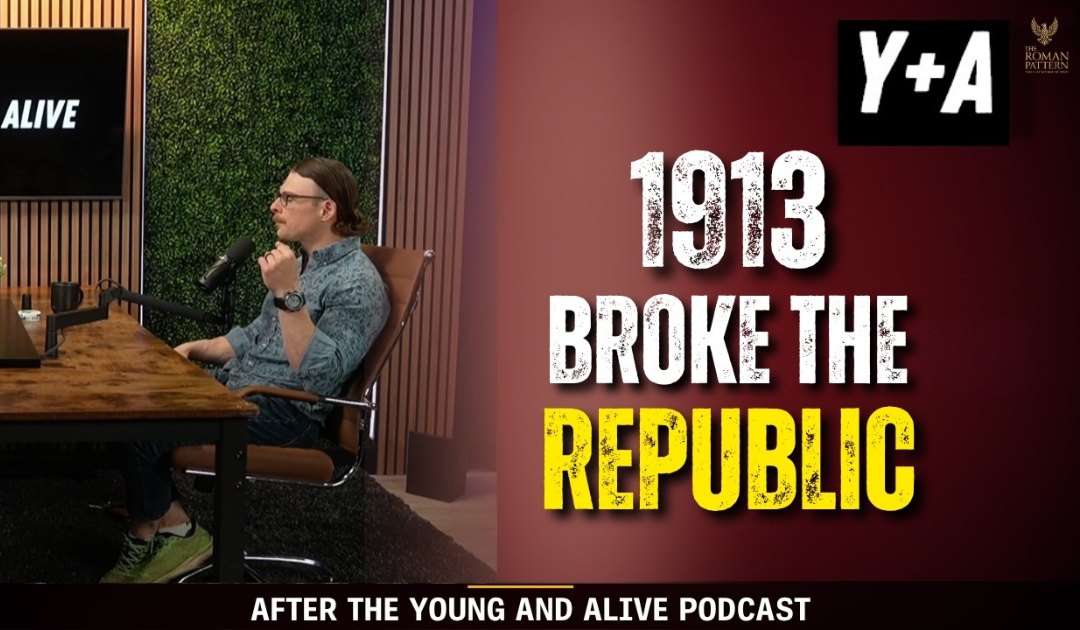
Young and Alive gave me a full sixty minutes to walk through the whole arc of Rome, from 753 BC through the kingdom, the Republic, the empire and the fall. When I sat down, the camera guy asked which one I was, young or alive, and I’ll admit young is a stretch for me these days, though I’m definitely alive. An hour was enough to build a fairly complete picture, and it also gave me room to make a few factual errors I need to correct before anything else. I’ll say too that I’m a lot sharper on some periods than others, and I told the host as much about the Punic Wars.
The first correction is one I keep making. I told the host Sulla held the dictatorship for four years, from 82 to 78. He was appointed in late 82 BC, held the office actively through 81, resigned voluntarily sometime in 81 or early 80, retired to his villa at Puteoli, and died in 78 as a private citizen, so his active dictatorship was closer to a year, maybe two if you stretch the definition. Four was Caesar, which I think is why it keeps coming out of my mouth under interview pressure, and this makes the fourth time I’ve had to fix it on the record.
The second is related, and I honestly cringed watching it back. I said the traditional Roman dictatorship was limited to six years, and the cap was six months. That’s the whole reason Sulla’s dictatorship was constitutionally unprecedented, because the six-month limit is what kept the dictator a controlled emergency response and kept him from becoming a tyrant. The third is about Valerian. I said he fell in battle to the Parthians in 260, and that’s wrong on a couple of levels, since the Sassanids had already overthrown the Parthian Empire decades earlier, and Valerian was captured alive in 260 by Shapur I of the Sassanid Persians. The rest of the story holds up, with Valerian spending the rest of his life as a prisoner and Shapur reportedly using him as a footstool to mount his horse. I’m forever mixing up those Persian dynasties. With all that cleaned up, the argument I couldn’t finish in the interview is in the video here.
Two patterns at once
When you cover twelve hundred years of Rome in one interview, you get to name the pattern without developing what it means for America right now. The three collapse pressures, monetary debasement, border failure and political corruption, show up in one clean sentence and the conversation moves on. The version I couldn’t tighten there is that America is running two of Rome’s collapse patterns simultaneously, the Republic’s collapse on the political side and the empire’s collapse on the economic side, both firing at once, and no civilization in history has faced both together.
How much we actually know
The host asked something most interviewers don’t, which is how much we really know about Roman history, and the accurate answer is less fun than people expect. Somewhere between 80 and 90 percent of the source material from classical antiquity is gone. Some of it burned, and the Library of Alexandria was burned at least three times on record, some was written on papyrus and lambskin that simply decayed, some was deliberately destroyed, and a lot was never copied forward once Rome’s institutions collapsed and nobody was left to make new scrolls. The dates, battles and speeches we know come from a fairly small group of authors, Plutarch, Appian, Tacitus, Cassius Dio and Livy, and their own work is partly lost. When Ronald Syme wrote The Roman Revolution in 1939, he was building the most influential modern framework for the Republic’s fall from maybe 15 percent of what Romans of that era could read. The framework can still be right, since it’s our best reconstruction, though reasonable historians disagree about pieces of it.
For the American parallel that cuts in an interesting direction. Every executive order, Senate vote and set of Fed minutes we produce is preserved and searchable, so we’re comparing incomplete Roman evidence against an overwhelming amount of American evidence, and we should be more confident about what we’re seeing at home than about our reading of Rome. We know far more about what’s happening to us, and it still looks like Rome’s pattern anyway.
Built against Rome, until 1913
The host also asked whether America’s founding paralleled Rome’s, and I’d say the resemblance was on purpose. The founders used Rome as an intellectual model while trying hard to avoid its specific mistakes, and the Constitution they wrote is a deliberate hybrid, blending what had worked in Rome, Greece and the British system with what they had watched fail in each over two thousand years. From Rome they took a bicameral legislature, an executive with defined powers and term limits, a judiciary with its own authority, and emergency offices more tightly limited than Rome’s ever were. They also built in protections against Rome’s failures, keeping military commands out of personal hands, writing the constitution down where Rome had left it to the mos maiorum, separating religious and political authority, and spreading taxing authority across the states, since Rome had run its taxes through the publicani.
Three of those four protections have collapsed since 1913. In one year the 17th Amendment ended the selection of senators by state legislatures, turning the Senate into a second popular-vote chamber that mirrors the House; the Federal Reserve Act created a central bank that could print currency without limit and fund the government’s debts indefinitely, where spending had been constrained by the actual gold supply; and the 16th Amendment gave Washington a permanent income tax that grew with the economy. On the show I called that year, borrowing a phrase from Dan Carlin, the death throes of a republic. It handed the federal government the same setup Rome had by the time of Diocletian, unlimited money and unlimited funding with nothing built in to check centralization, and Rome took roughly six hundred years to assemble what America assembled in twelve months. None of that was inevitable, which makes the real question whether we can dismantle the 1913 setup at all, and nobody in mainstream politics is willing to ask it.
The Syme chain and where we sit
Syme’s argument is that the Republic died through precedent breaking, one powerful man at a time, with no barricades anywhere and nobody storming the Senate. Tiberius Gracchus proposed land reform in 133 BC and the Senate had him beaten to death. Marius removed the property qualification for service in 107, and his soldiers started depending on their general, and by 100 BC he was holding his sixth consulship in defiance of the ten-year gap, though for those who’ll point it out, that rule had bent a little earlier with one of the Scipios. Sulla marched on Rome in 88, and in 82 he was named dictator with no time limit. Crassus and Pompey camped outside Rome in 70 and took the consulship, the First Triumvirate began governing privately in 60, Caesar crossed the Rubicon in 49, the Second Triumvirate posted proscription lists in 43 with Sulla’s exact machinery, and after Actium in 31, Augustus took the title princeps in 27 BC. Each break had a defensible justification, and each made the next one a little easier.
Look at the last thirty years in America, with executive orders extending emergency powers, agencies writing rules with the force of law, political prosecutions from both parties (the casualties there are political, thankfully), and officials defying constitutional norms without consequence. If I had to place us, I’d put America somewhere between Marius and Sulla, still short of Caesar, with the chain clearly running.
Constantine’s window
Near the end of the interview I mentioned Constantine’s currency reform almost in passing, and it deserves more, because it’s the only successful historical exit from a compound crisis like ours. In a fifteen-year window from roughly 312 to 330, he did four things. The Edict of Milan in 313 legalized Christianity and gave the empire back a shared moral framework after a century-long spiritual vacuum. The solidus, introduced around 312, was made deliberately overweight so any debasement would be obvious right away, and it held its purity for roughly seven hundred years. He split the army into mobile field armies, the comitatenses, and stationary border garrisons, the limitanei, a structure Rome could actually afford. And in 330 he founded Constantinople, moving the government out of the old capital and away from its accumulated dysfunction. Every one of those reforms was opposed by someone powerful, the senatorial class, the financial establishment, the military and the aristocracy, and he pushed all four through anyway, which bought the East another thousand years while the West fell in 476.
America doesn’t have a Constantine, and I’m not sure it produces one. The exit takes spiritual, monetary, military and administrative reform all at once, pushed through by a leader with enough concentrated authority to overcome the institutional class, so the likelier American outcome follows the Western pattern, a long fade and a gradual reorganization where nothing gets restored. Nobody wants that, and it’s still what the evidence suggests we should expect.
If you came over from Young and Alive, thanks for following me here. The full companion video goes through all three corrections and the two-patterns argument, the Fall of the Republic series is running on the channel every Monday, and Episode 115 lays out the Money, Borders, Power framework if you want the short version first.