
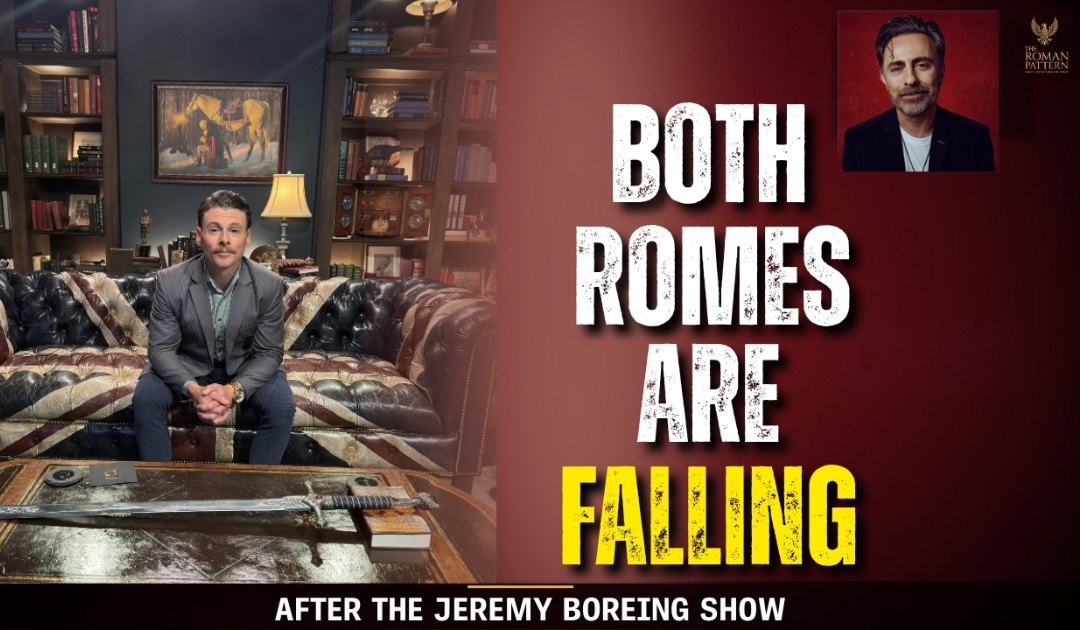
Jeremy Boreing had me on Weds Live Episode 57 of The Jeremy Boreing Show alongside Spencer Klavan and Stephen Ken, a wide-ranging panel on whether the West can survive. We got into China buying gold at a record pace, whether the West still knows how to build civilizations, why young men have checked out of the economy, what apprenticeship used to do, and whether America is running Rome’s collapse pattern. With two Jeremys on one panel it was a little harder to follow than usual, so I’ll call him Boreing here.
This is the fourth of these companion videos and the first one with no factual correction to open with, so I can go straight to an argument the panel kept moving past before I could land it, which is that America is running two versions of the Roman collapse at once, the fall of the Republic and the fall of the Empire, and those need completely different solutions.
I built it out properly in the companion video, with the clips from the panel, so here it is if you’d like to watch along.
Competence as a threat
The panel opened on the idea that America has entered a period where competence is seen as dangerous, and I think that’s a real historical failure mode with a known shape. The case I gave was Flavius Stilicho, half Vandal by birth and fully Roman by service, the most competent general Rome had in the early fifth century. He held the Western Empire together through the 390s and early 400s, kept the Goths at bay, and organized the defense of Italy, and as much as any one man can hold up an empire, he was the reason the West still existed in 408. His emperor, Honorius, a paranoid mediocrity who spent his time raising chickens in Ravenna, was afraid of what Stilicho could do and had him killed. Two years later, in 410, Alaric sacked Rome, the first time the city had been taken in eight hundred years. Jerome was in Bethlehem when the news reached him, and he wrote that his voice failed him and he couldn’t dictate for days, because the city which had taken the whole world was itself taken.
Set that against America. Across the military, the intelligence services, and the technical leadership at the agencies that keep the lights on, what gets rewarded now is political and ideological loyalty, along with long service without ever embarrassing anyone above you. Being the person who could hold the wall if something real came at us has started to read as a threat. In Rome the damage was indirect, leaving the empire unable to defend itself when the threats finally arrived.
Where competence comes from
Spencer Klavan made a good point that competence is what philosophers call an instrumental virtue, virtuous only when it’s pointed at the right thing. That’s true, and it skips the harder question of where competence comes from in the first place. My answer on the show was confidence, built from all the times you’ve tried something and either failed or succeeded at it, stacked up over years. Nobody ever got it from being told they had it.
The American education and debt system, and I’d say the debt is doing half the work, has engineered that out for an entire generation. You spend twenty-plus years in a supervised environment where the goal is to avoid mistakes, then graduate carrying six figures of debt into a first job where one real mistake could end your career. Rome had its own version, with an elite so insulated by family names and patronage that by the third century it was turning out generation after generation who couldn’t run the empire that carried their name. That’s part of why Rome was relying on barbarian generals like Stilicho at all, and it’s why American institutions now import competence from veterans, immigrant entrepreneurs, and a shrinking pool of people who built themselves through real trial and error.
What apprenticeship actually did
When the panel drifted into what should replace college for young men, my answer was apprenticeship, and we never got to what it did that an internship doesn’t. The first piece is discernment. I went to Catholic undergrad and grad school with a lot of seminarians, and the seminary is still built around this, with years spent working out whether you should be a priest while you learn how to be one. An apprenticeship put you inside a trade long enough to decide whether it was right for your life, and acquiring the skill was almost the smaller half of it. The modern internship turned that into a two-month line on a resume.
The second piece, which Boreing called out, is male mentorship. The old model paired a young man with an older craftsman for years, showing him how to work and how to take disappointment without walking away from the trade. Interns rarely meet the senior people at their firms, and remote work has broken even the incidental proximity that used to stand in for mentorship. Rome, as I see it, lost this capacity to pass competence from one generation to the next long before the currency or the borders failed, and everything else came downstream of that.
Republic and Empire at the same time
Boreing pushed on whether America is falling like a republic or like an empire, and my honest read is both. Being from the eighties, I think of the map at the mall that says you are here, and history never hands you one of those, since so much of it rhymes without exactly repeating. The Republic’s collapse runs on the political side, with broken precedent staying broken, executive orders doing the work legislation used to do, constitutional limits treated as advisory, and a Praetorian-style class that outlasts administrations. Rome ran that from Marius in 107 BC to Augustus in 27 BC, and America has been running it since roughly 1913, a date I’d defend. The Empire’s collapse runs on the economic side and shows up in the money first, around 15,000 percent inflation in Rome by 284 AD set against the dollar losing 97 percent of its purchasing power since 1913, along with borders that cost more than they produce, a federal security apparatus loyal to itself, and overseas commitments the treasury can’t sustain.
Rome had those in sequence, with the Republic pattern finished before the Empire pattern started, and as far as I know no civilization has faced both stacked on top of each other the way we are. The Republic fixes don’t touch the Empire problems and the reverse is true as well, so neither historical exit applies directly.
Constantine’s exit
The one case I think is worth studying is Constantine, who held the Eastern Roman Empire from 306 to 337 and inherited exactly that kind of compound crisis. He legitimized Christianity with the Edict of Milan in 313, giving the empire back a shared moral framework. He introduced the solidus around 312, a gold coin the eastern half of Rome used for the next seven hundred years without meaningful debasement. He split the military into mobile field armies and stationary border garrisons, a structure that could function inside the resources that existed. And he founded Constantinople in 330, lifting the administration out of the old capital and its accumulated dysfunction. The East lasted until 1453 and the West fell in 476, a thousand-year gap, and every one of those reforms was opposed by someone powerful, the senatorial class, the financial establishment, the military, the aristocracy. He did all four inside a fifteen-year window.
America doesn’t have a Constantine, and I don’t know that it produces one. My honest answer is that the likelier outcome is the western one, a long fade with the system reorganizing itself and nothing ever really getting restored. I’d have put that to the panel with another hour, though honestly I also really needed the bathroom by then. Watch the video for the full version, and if you want the whole chain that broke the Republic, the series is running on the channel now, with Sulla just out and Spartacus next.