
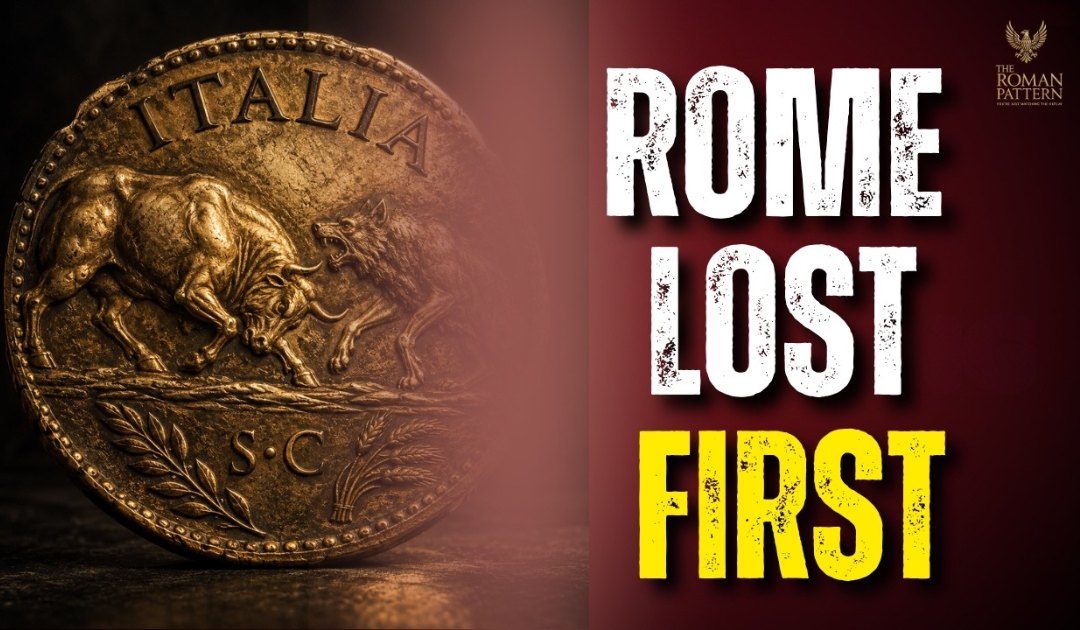
The war that came closest to killing Rome in this period was fought against men who had marched under Roman standards for generations and whom Rome still refused to call Romans. The usual picture of Rome falling has barbarian hordes at the gates, a civilization beaten by people from somewhere else, and the Social War of 91 to 87 BC runs in exactly the opposite direction. What nearly finished Rome here was exclusion, and Rome did it to itself over about a century.
For a hundred years Rome took the allies’ sons for its legions, made the allies arm them and pay them and bury them when things went badly, and then denied them citizenship. It taxed these people in blood, which is the harder thing to give. When I talk about borders in the Roman Pattern framework, this is the episode where the border turns out to be a contract between Rome and the people holding it, and Rome broke its end of it.
I walk through the whole thing, coins and tribes and all, in the video, so if you’d like to see it laid out, here it is.
The allies who were the border
Rome was never Rome alone, at least militarily. By 100 BC more than half the soldiers under Roman command were allies, the socii, and some estimates push that to two-thirds. Velleius Paterculus, writing about a century later and of Italian stock himself, put it about as plainly as anyone, saying that year after year and war after war the Italians had supplied Rome double the men, cavalry and infantry both, and gotten nothing back. The Marsi, Samnites, Lucanians, Paeligni, Vestini, Frentani, and Picentes fought Rome’s wars and garrisoned its frontiers, and they were self-governing peoples with their own magistrates and laws. Rome kept no officials and no garrisons among them, which made them something like partners in the enterprise, partners who happened to have no vote in any of it, couldn’t run for office in Rome, and couldn’t stand trial with the protections a citizen took for granted.
Reformers had been saying it out loud for decades, and every time the political class refused, for reasons that had little to do with the argument. Citizenship meant votes, votes meant power, and power in Rome had already become too valuable to share.
Drusus and the murder that started the war
In 91 BC Marcus Livius Drusus the Younger, tribune of the plebs, tried to break that. He was an insider from one of Rome’s great families, about the least likely firebrand you could find, and he understood that without citizenship you eventually lose the loyalty, and without the loyalty you lose the army. So he put full citizenship for all the Italian allies on the table. Tiberius Gracchus had proposed land reform and been beaten to death, and Gaius Gracchus had proposed grain and citizenship and been hunted until he died. Drusus was stabbed at his own front door late in 91 BC. Appian, who gives us the fullest surviving account of the war, adds that nobody ever found out who did it, and there was no arrest and no trial.
When that news reached the allied towns, the calculation changed overnight. If the best-connected insider in Rome couldn’t get citizenship through without being murdered for it, it was going to have to be taken. At Corfinium in central Italy they renamed the town Italica and made it the capital of Italia, with a Senate of 500, two consuls, and twelve praetors split between the northern and southern fronts. Those details come to us through Diodorus Siculus, and what they describe is a constitution written by people who had spent a century studying the one that shut them out.
They minted a coin, too, with the Italian bull goring the Roman wolf on one side and eight warriors swearing an oath on the other. Some issues carry the name of the country in their own language, Oscan, as Víteliú, a language Rome had never bothered to recognize. I’m careful with the word rebellion here, because what they built at Corfinium looks a great deal more like a secession, and they put more than 100,000 men in the field.
Legions against legions
In 90 BC Rome started losing badly in the north and the south, and the consul Publius Rutilius Lupus was killed at the Tolenus River, a sitting consul of Rome dead in Italy about sixty miles from the Forum. The men across the field wore the same armor and had been drilled by the same centurions, because for generations they had been the same army. Rome had spent a century training and arming its future enemy and teaching it every road and pass in Italy. By the end of 90 BC Rome was enrolling freedmen and arming teenagers.
For anyone who’d rather take this part on a commute, the audio episode is right here.
Winning by conceding
So Rome capitulated and called it strategy. The consul Lucius Julius Caesar, a relative from another branch of the family that would produce the famous Caesar, who at that moment was a boy somewhere in the city, proposed the Lex Julia late in 90 BC. Any Italian community that had stayed loyal, and on most readings any community that laid down its arms quickly enough, would receive full Roman citizenship. That was the exact thing Drusus had been killed for proposing, now handed over under duress, and it worked the way it was designed to. Some peoples took the deal, others held out, and the oath of eight started to crack.
The next year came the Lex Plautia Papiria, which we know in detail because Cicero quoted it in court decades later, defending a poet’s right to call himself Roman. You had to be enrolled in an allied city, resident in Italy, and present yourself before a praetor within sixty days. Rome was more or less begging Italians to become Roman roughly a year after burying a man for suggesting it. By 88 BC the military war was essentially over, although the Samnites never really stopped, and their resistance folded into the civil wars until Sulla destroyed them at the Colline Gate in 82.
The settlement that lit the fuse
Rome had thirty-five voting tribes, and it packed hundreds of thousands of new citizens into a handful of them, eight by one ancient account and ten by another. Either way the new citizens could always be outvoted, so their citizenship was real and their vote was diluted on purpose. Rome granted the name and kept the machinery of the vote for itself, and that is what set up 88 BC.
The tribune Publius Sulpicius Rufus built a coalition out of the new Italians who wanted their votes spread across all thirty-five tribes, the urban poor, and an old man who wanted one more command, Gaius Marius. Sulpicius passed his redistribution and attached a price to it, transferring the command against Mithridates from the sitting consul, Lucius Cornelius Sulla, to Marius. By the letter of the constitution that was legal, and Sulla’s answer was that nothing passed by a mob in violent streets was legal, and I think they were both right, which is what a dying constitution looks like. Sulla was outside Nola with his legions, and he asked his soldiers whether they would follow him against Rome itself. They said yes, and Plutarch preserves the detail that every one of his officers walked away except a single quaestor.
The Social War ended with more Romans in the world than there had ever been and a republic that had already taught its best generals to take it, which is why next week’s episode on Sulla opens where it does. Watch this one, or listen to it, before you get there, because the march on Rome makes a lot more sense once you’ve seen what the Italians were promised and what they got.