
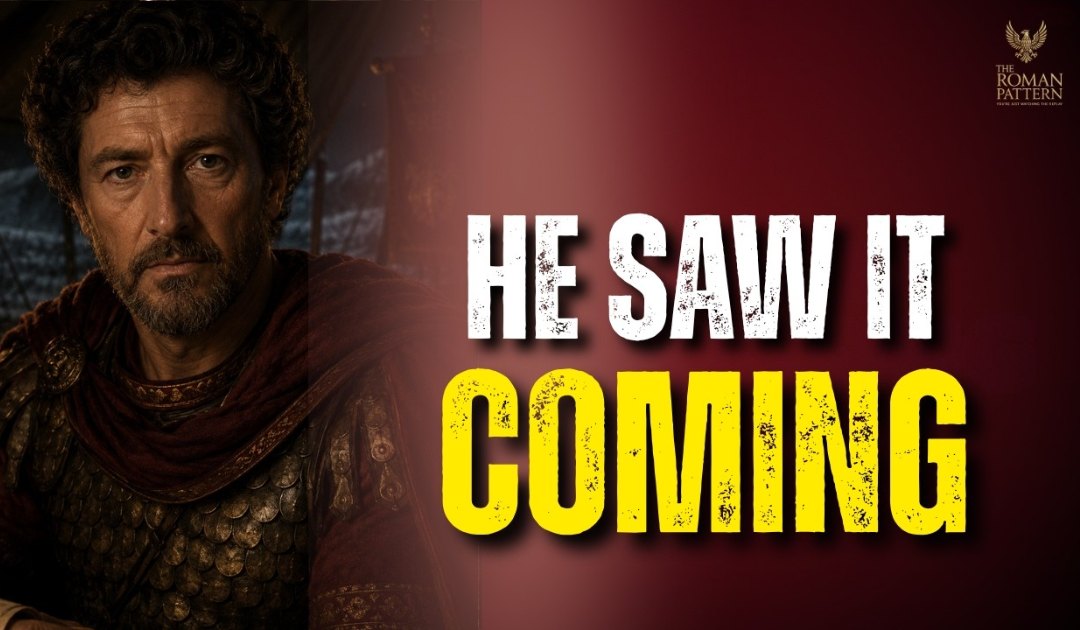
Rome reached a point where being great simply stopped being enough, and Marcus Aurelius is where you can watch that happen. We tend to picture him in marble, a serene philosopher king sitting calmly above it all, and I think that picture is wrong. He was writing from a campaign tent on the frozen Danube, with the plague emptying his legions and the treasury so drained he was auctioning off imperial jewelry to pay for the wars, while one of his own generals declared himself emperor on nothing more than a rumor that Marcus had died.
He ruled from 161 to 180 AD, and I wanted to stop right here at the peak, at the moment when everything should have been fine. Most people see a success story in his reign. What I see is the first time all three fault lines, money, borders and power, opened at the same time, and the clearest proof we have that individual competence, even at its absolute maximum, can only buy time for a system that’s already failing.
I go through the whole reign, from the plague years to the choice of Commodus, in the video.
The inheritance
When Marcus became emperor in 161, Rome was about as vast and stable as it had been in generations. He followed four emperors in a row who had done the job well, Nerva, Trajan, Hadrian and Antoninus Pius, with no civil wars and no succession crisis between them, and the system behind them was adoptive succession. Each emperor adopted the man who seemed most capable, though Hadrian’s adoption is a little murky, since Trajan’s wife only announced it after Trajan was dead.
Trajan had pushed the empire deep into Dacia and Mesopotamia, Hadrian deliberately pulled back to stabilize it, and Antoninus Pius gave Rome 23 almost uniquely quiet years. If you set out to design a system that would produce the ideal leader, Marcus is what it looks like when that system works exactly right, and what followed was still decline, slow and well handled but decline all the same. The foundations had been working against themselves for decades before he showed up.
The plague and the money
In 165 soldiers came home from a campaign in the east carrying a disease, most likely smallpox, though the ancient descriptions aren’t detailed enough for anyone to be completely sure. Cassius Dio gives us a figure of 2,000 people a day dying in the city of Rome at the worst of it, though he’s describing a later wave around 189, after Marcus was dead, which he lived through himself. Over about 15 years the usual estimate is that it killed somewhere between 5 and 10 percent of everyone in the empire, and honestly we don’t really know. Walter Scheidel and others have shown the ancient data won’t pin it down, and the guesses run from a few percent up to a quarter of the population in the places hit hardest.
The economy and the army drew on the same population, so Marcus faced a collapsing tax base and a shrinking pool of soldiers at the moment the frontier needed more of both. His response was strikingly disciplined. He trimmed the silver in the coinage a little while stopping well short of the wholesale debasement later emperors resorted to, held off on new taxes for a population being wiped out by disease, and raised the money by selling imperial property, auctioning palace furniture and jewelry publicly in the Forum of Trajan. Our main source for that is the Historia Augusta, which needs a heavy grain of salt because a good chunk of it is invented, but on this detail it lines up with other accounts, two months of selling gold cups, silk and his wife’s jewels. It was still the right call, and the plague kept killing people anyway.
The border and the rumor
In 166 the northern frontier broke, with the Marcomanni and other tribes putting coordinated pressure on the whole Danube line at once, which was something new for Rome. Marcus recruited freed slaves and gladiators into the legions, both things Roman military tradition frowned on outside an outright emergency, and he hired Germanic mercenaries to hold sections of the frontier against Germanic tribes. It worked as long as Rome could outpay everyone else, which is a dependency that turns dangerous once money gets tight. He spent more than a decade personally commanding on the Danube, and Cassius Dio tells us he meant to annex both Marcomannia and Sarmatia as provinces and probably would have with more time. The borders held, but they thinned, and thinning looks like something you’re handling right up until the moment you aren’t.
For anyone who’d rather listen on a drive or a run, the full episode is on the podcast as well.
Then in 175 a rumor spread through the eastern provinces that Marcus was dead. He was seriously ill, and he’d pull through, but in Syria one of his most trusted generals, Avidius Cassius, who had served with real distinction in the Parthian campaigns, declared himself emperor. The revolt lasted three months before Cassius was killed by one of his own officers. Most histories treat it as a footnote, and I’d say its importance lies in the fact that it happened at all. Marcus had spent years building authority on personal integrity, and the moment the system merely believed he might be gone, the institutional hold broke, which tells you the stability had been personal all along.
A man who could see it
What separates Marcus from almost every other emperor in a crisis is that he understood what was happening analytically. His Stoic training was about holding clear judgment when outcomes are outside your control, and he knew the Roman record well enough to see his reign sitting inside the same arc as the Gracchi, Sulla and Caesar. In the Meditations, the notebook he kept for no one but himself, he asks how many a Chrysippus, how many a Socrates, how many an Epictetus time has already swallowed up. I read that as the work of a man who understood on some level that he was losing.
Commodus
This is where most people put the blame on Marcus, because he named his biological son Lucius Aurelius Commodus co-emperor in 177, when the boy was around 15. Mary Beard makes a sharp point in SPQR, though, that none of the four adoptive emperors before him had a legitimate son who outlived him, so the adoption streak may have been what you do when biology leaves you no other option. Commodus became sole emperor at 18 when Marcus died on the Danube in 180, shut down the campaigns, handed government to palace favorites and later fought as a gladiator in the Colosseum. Marcus seems to have known what his son was, and surrounded him with experienced advisers.
The reason he didn’t name someone else comes down to the institutions. By 177 the Senate had been bypassed for years on military decisions, and the army’s loyalty had become personal to Marcus, so naming a competent outsider would have turned Commodus, who already had his own supporters, into a rival claimant and guaranteed a civil war the moment Marcus died. He chose the least bad option in the short term, and it wrecked the empire over the long term. I’d call Commodus the system’s mistake, delivered through Marcus.
What it means now
Every right decision Marcus made bought real time, something like 10 or 15 extra years of coherence. Once institutions weaken, everything comes down to individuals, and individuals die. Every generation has its own version of him, a genuinely competent person in a failing structure making the right calls while the problem sits in the 20 years of decisions that led to that room. The lesson I take from his reign is to fix the system before it ever needs a Marcus Aurelius, because by the time you need one you’ve waited far too long.
The fault lines that opened under him in 161 were built into the Roman model from the start, which is why the next stop is the Republic. Watch the full episode, or put the podcast on, before we start that autopsy.