
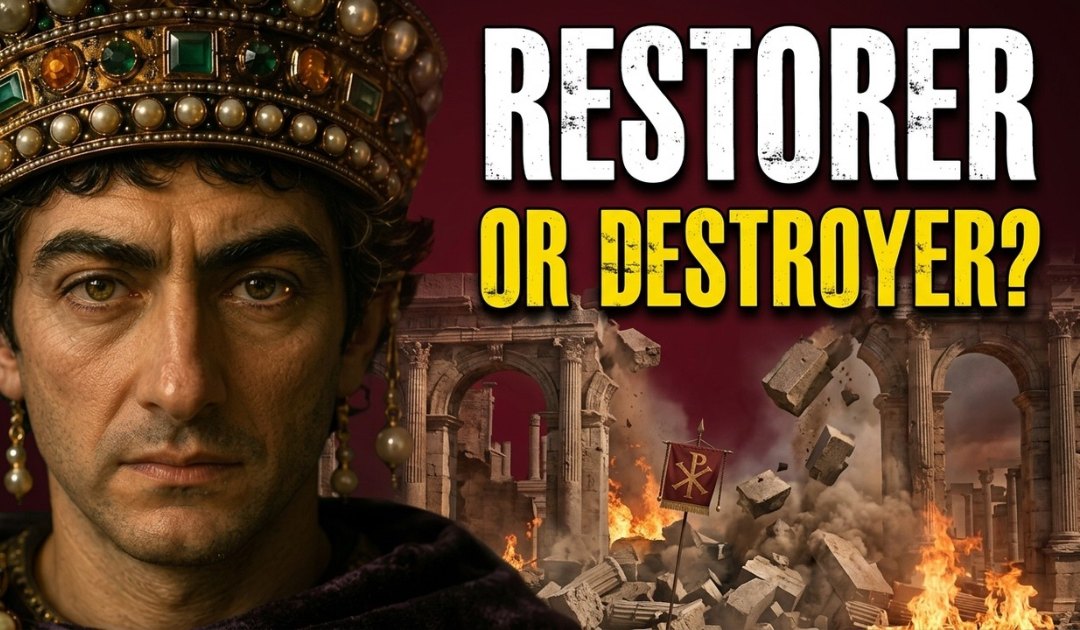
We usually file the end of Roman Italy under 476, with the last emperor deposed and the lights going out across the West and Constantinople watching from too far away to help. The more I worked through this episode, the more I came to think the year Italy actually died was 554, at the end of a twenty-year war launched by the Eastern Empire to rescue it. Justinian set out to restore the West, and what his armies left behind was an Italy so emptied out that by the end, the pope was the one governing Rome because nobody else was left standing.
It helps to start with what Italy looked like in 535. Odoacer had kept the Senate, the bureaucracy, and the aqueducts going after 476, and from 493 Theodoric the Great, king of the Ostrogoths, ran the place like a Roman, with Roman law for Romans and Gothic law for Goths. His right hand, Cassiodorus, left a collection of official letters, the Variae, and when you read them you see a Gothic king governing through Roman titles and the Roman tax office as if nothing much had broken. Left alone, it probably would have followed every other Germanic successor state, with new masters at the top and the same civilization carrying on underneath.
The video goes year by year through what happened when Justinian decided he wanted it back.
The emperor and his general
Justinian was born a peasant in what’s now North Macedonia, and his uncle Justin brought him to Constantinople, where he studied law, theology, and administration. He married Theodora, an actress who turned out to have the sharpest political mind in the palace. He believed in one empire under one law and one church, and he’d already done a lot of it. He’d pulled Roman law together into the Corpus Juris Civilis, built the Hagia Sophia, and survived the Nika riots by staying in the palace when Theodora talked him out of running, in a week when something like 30,000 people died in the Hippodrome, according to Procopius, who was there. About the only thing left to restore was the map.
He had the general for it in Belisarius. In 533 Belisarius went to North Africa, where the Vandals had held Carthage since 439, and took the whole territory back in fourteen months. That speed handed Justinian a proof of concept, and I think it was the most dangerous thing that could have happened to him, because Africa had been an isolated, divided kingdom and Italy was a very different animal. The Ostrogoths were battle-hardened and politically sophisticated, and they were fighting for their homes.
How the war fed on itself
It started well, and that’s part of the problem. Belisarius landed in Sicily in 535, and the Gothic king, Theodahad, a bookish nephew of Theodoric who had taken the throne by murdering Theodoric’s daughter, barely resisted. At Naples in 536 Belisarius sent soldiers up through an old aqueduct tunnel under the walls in the dark, and the Gothic garrison was massacred. The Goths replaced him with a real soldier, Vitiges, who pulled back to Ravenna, and in December of 536 Belisarius walked into Rome with the senators cheering and the pope coming out to meet him.
Vitiges came back with an enormous army. Procopius, on Belisarius’s staff, puts it at 150,000, and he inflates Gothic numbers when it suits him, so I’d hold that one loosely. The siege began in 537, and the first thing Vitiges did was cut the aqueducts, which had never happened in the city’s history. Rome’s grain mills ran on water, so the city suddenly couldn’t make bread, and Belisarius anchored floating mills in the Tiber to let the current turn the stones. The siege lasted a year and nine days before Vitiges withdrew, and the war still had eighteen years to go.
Each step in the next stretch sets up the one after it. Justinian was fighting Persia in the east and holding the Danube, and Africa still needed troops, so Belisarius kept asking for men and getting a fraction. He was good enough to keep winning anyway, but a war won without enough behind it drags on, and a long war in Italy killed everything around the soldiers too. Justinian had come to power with one of the biggest treasury surpluses the empire had ever seen, and the western wars burned through it. Africa was supposed to help pay for Italy, and Berber revolts kept that from happening. Neither side could afford to win fast, so neither did.
In 538 a faction in Milan opened the gates to Belisarius, Vitiges brought in Burgundian and Frankish allies, and relief columns were held up by subordinate commanders who couldn’t coordinate. Milan fell in 539. The men were slaughtered, the women and children enslaved, and the city pulled down. Procopius claims 300,000 men were killed, which is almost certainly too high, but even scaled down, one of the great cities of the north was erased in a war meant to restore the empire that used to protect it. Procopius, by the way, wrote three very different books about all this: the careful official Wars, the flattering Buildings, and the Secret History, which he kept unpublished because it would have gotten him killed, and where he calls Justinian a demon in human form.
If you’d rather take this one in on a long drive, the full episode is on the podcast too.
Plague, Totila, and a victory over nothing
In 541 the plague arrived through Egypt along the trade routes the empire had worked to reopen. It was the first recorded outbreak of Yersinia pestis, the bacterium that would come back as the Black Death, and in Constantinople Procopius describes bodies stacked in the towers of the walls. Estimates run from 25 to 50 million dead across the Mediterranean, maybe a quarter to a third of the known population, though modern historians argue hard about that and plenty think the older numbers are too high. In Italy it landed in the middle of the war, at the moment the money and the men to hold the peninsula were needed most, and both armies lost men they couldn’t replace while the farms went unworked and the survivors faced famine.
Belisarius captured Vitiges and took Ravenna in 540, and Justinian, nervous about a general whose army loved him, recalled him. The Goths eventually found Totila, who retook Rome in 546, lost it, and took it again in 549. He freed slaves who joined him and canceled debts, setting himself up as the protector of ordinary Italians against Byzantine taxes, and the people Justinian was rescuing started preferring the Gothic king. At that point you’re looking at a collapse of legitimacy, and the fighting is just still going on. Narses, an elderly eunuch general, finally beat Totila at Busta Gallorum in 552, the last Gothic king, Teia, died at Mons Lactarius that same year, and the Pragmatic Sanction of 554 declared Italy Roman again.
Rome in 554 held maybe 50,000 people, a city that had held over a million under Augustus and several hundred thousand under Theodoric. The aqueducts were never fully repaired, the Circus Maximus held its last chariot race in 549, and the Senate eventually stopped meeting because there was nothing left to govern. In 568 the Lombards came over the Alps from Pannonia into an Italy with no army and no people left to resist (there’s a tradition that Narses, humiliated by Justin II, invited them in), and Italy wouldn’t be unified again until 1861. By 590 Gregory I was organizing Rome’s food supply and its defense and dealing directly with the Lombards, and the medieval papacy grew up in the space the reconquest left behind.
I’d stop well short of calling Justinian uniquely evil, and Belisarius plainly knew what he was doing. The trouble was that Justinian couldn’t accept that a transformation was permanent, and the cost landed on the people he meant to save. Or, more precisely, he kept asking whether he could win and never asked what would be left once he had. Watch the full episode, or listen to it on the podcast, and read Procopius for yourself, starting with the Secret History.