
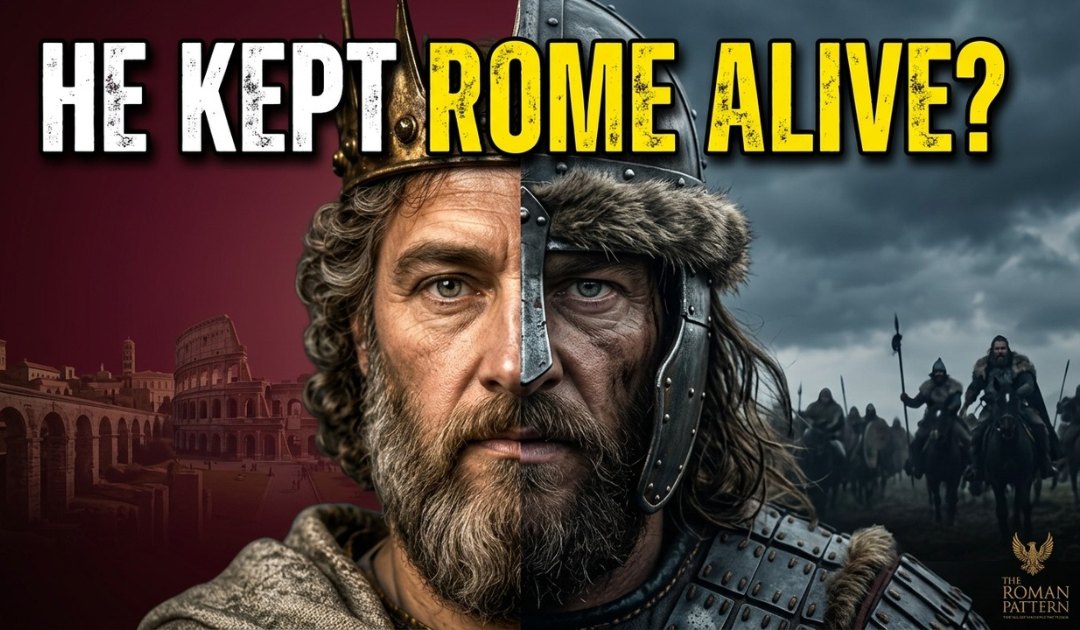
Most of us carry around a picture of the fall of Rome that looks like an invasion, with Gothic warriors in the streets and marble burning and the whole thing over in a night. The episode I just finished on Theoderic the Great pushes hard against that picture, because the man who did more than almost anyone to keep Roman Italy running in the late fifth and early sixth centuries was a Gothic king. He took Italy in 493, kept the Senate and the laws and the Roman administrators, and for about thirty years governed more competently than the last six Western emperors put together.
To see why that matters, you have to go back to 476. A seventeen-year-old named Romulus Augustulus was on the Western throne, put there by his father Orestes, the general who held the real power. Then a Gothic general named Odoacer led a mutiny of the Italian garrison troops, Orestes was killed, and Romulus was sent off to a villa in Campania with a pension while the imperial insignia went east to the emperor Zeno. Peter Heather makes the case in The Fall of the Roman Empire that 476 amounted to a change in the bookkeeping, and the evidence backs him up. Odoacer ran Italy for seventeen years, the Senate still met, the grain still came in from Sicily, and he even minted coins in the Senate’s name because he knew his legitimacy was borrowed from Roman institutions.
That idea of borrowed legitimacy ties the whole episode together, and I walk through it in more detail in the video.
The hostage who learned how Rome worked
In 461 a Gothic king named Theodemir, whose Ostrogoths had been settled on the Pannonian frontier (roughly modern Hungary and Serbia), handed his seven-year-old son Theoderic to Constantinople as a royal hostage to guarantee the peace. The boy was raised inside the imperial court alongside the sons of the Roman aristocracy, studying Latin and Roman law and the practical side of how provinces were governed, how tax records were kept, and how armies got supplied. He came home at eighteen after about ten years of watching Roman political culture from the inside, so when he looked at Roman civilization he saw a working system he could operate.
By 488 he and his people were strong enough to be dangerous inside imperial territory and still short of the strength to take Constantinople, which gave Zeno a problem. Zeno’s answer was to commission Theoderic to take Italy from Odoacer and govern it as an imperial viceroy, under Constantinople in theory and fully independent in practice. Theoderic brought his entire nation across the Alps, something like 100,000 people with their livestock and wagons, won all three major engagements, and then besieged Odoacer in marsh-ringed Ravenna for almost three years. The two men finally agreed to govern Italy jointly, and in March of 493 Theoderic invited Odoacer to a banquet to celebrate. The accounts differ, though the contemporary source we call the Anonymus Valesianus says Theoderic ran Odoacer through the collarbone with his own sword. He had already won and could have exiled him, but even a defanged Odoacer, alive and pensioned off, would have been a rallying point hanging over the new reign.
A Roman state with a Gothic king
The Senate kept meeting, the consulship was filled every year in a ceremony reaching back to 509 BC, Roman law applied to Roman citizens through Roman courts, and the bureaucracy stayed in place, down to the eleven aqueduct systems feeding Rome, which he kept repaired. The army was Gothic, though, and a third of Italian estates went to Ostrogothic settlers. Theoderic called the arrangement civilitas, a civilized Roman order, and used the word in his decrees as a claim that he was continuing Rome.
Mary Beard’s argument in SPQR helps here, since she reads Rome’s genius as institutional, a matter of citizenship and law and an administration that could outlast any single ruler, and Theoderic was betting his reign on Rome being portable in that way. The man who made it coherent on paper was Cassiodorus, a senator who served as something like his chief of staff and gathered twelve volumes of official correspondence into the Variae, which we can still read. It reads like the paperwork of a Roman government that happens to have a Gothic king at the top, and after Alaric in 410 and Attila in the 450s, one contemporary source describes a peace older generations had never lived through.
If you’d rather take the full episode with you on a drive, it’s on the podcast as well.
Boethius and the fear of a declining system
Underneath it sat a religious fracture. The Goths were Arian Christians, a position condemned at the Council of Nicaea in 325, so the two peoples shared the same territory and never shared an altar. Theoderic’s policy was formal tolerance, and for a long time it held. His most trusted intellectual was a Catholic, Anicius Manlius Severinus Boethius, who was translating Greek philosophy into Latin as the West lost access to Greek, and for about six hundred years, until Aristotle came back through Arabic sources in the twelfth century, Western philosophers worked mainly from his versions. In 522 Theoderic made him magister officiorum, the most powerful Roman in Italy in practical terms. Around 523 he was arrested for treason, accused of secret correspondence with Constantinople. Whether that was true, we honestly don’t know, and he denied it and named his accusers.
The context explains the fear. In 519 the Acacian schism between Rome and Constantinople had ended, giving an Orthodox emperor a ready pretext to intervene wherever Arians ruled Catholics, and Theoderic was in his seventies with no male heir. Stilicho had been executed in 408 on a similar charge by the emperor he served, and I think the same thing was happening again, a system in decline becoming afraid of its most capable people. Boethius wrote The Consolation of Philosophy during about a year in prison at Pavia, a book King Alfred, Chaucer, and Elizabeth I would all translate. In 524 he was executed, along with Symmachus, his father-in-law and head of the Senate, and after that the Senate went quiet and what had been trust turned into compliance.
What came after
Theoderic died in 526 after thirty-three years. His daughter Amalasuntha ruled as regent for her son Athalaric, but the Gothic military aristocracy rejected a Roman education for the boy, who died young (the account comes mostly through Procopius, a hostile source). Amalasuntha was later imprisoned on an island in Lake Bolsena by Theodahad and strangled, and Justinian used her murder as his pretext. Belisarius landed in Sicily in 535 and about twenty years of war followed. Rome changed hands five times, and by 554 the estimates put its population somewhere between 30,000 and 50,000. In 568 the Lombards came into an Italy with nothing left to defend it.
The people doing the preserving were Theoderic, Cassiodorus at his monastery at Vivarium, and Boethius working inside a Gothic structure, or more accurately, people who looked at Rome from the edges and decided it was worth keeping, while the formal heirs spent two centuries tearing it apart. When a system starts treating its competent administrators as threats and the institutions keep working on paper while the trust drains out, you’re looking at Ravenna in 524. Watch the full episode, or listen on the podcast, and check the sources I list there for yourself, because Boethius gave Fortune a line about the wheel that spins, and it reads differently once you know where he wrote it.