
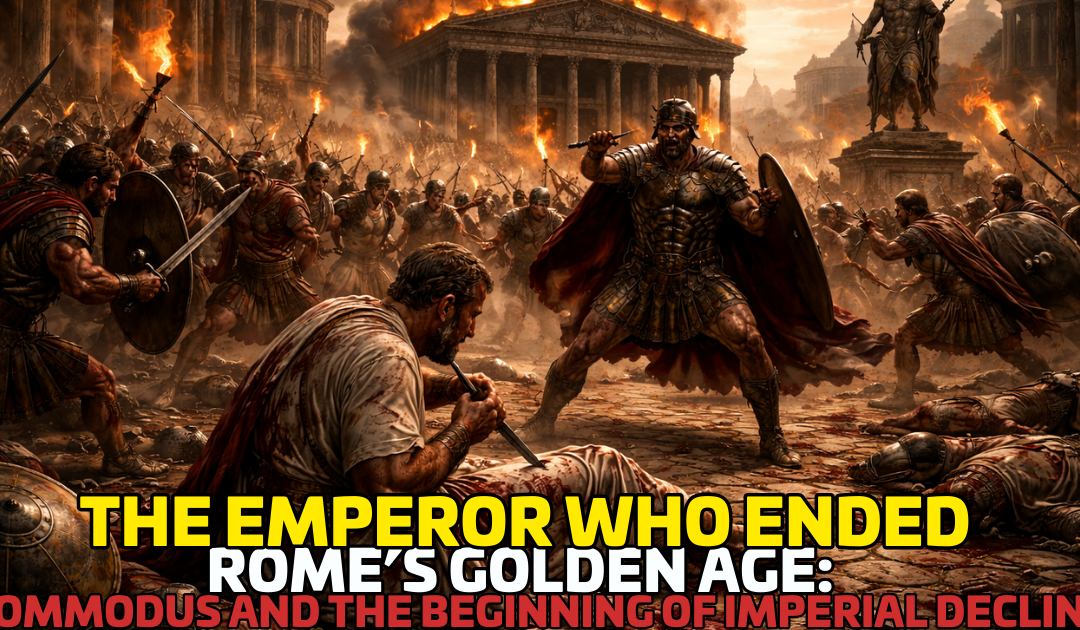
When people think about the fall of Rome, they usually picture barbarian invasions centuries later. But in my view, the real turning point came much earlier—with a single emperor: Commodus.
The son of the philosopher-emperor Marcus Aurelius, Commodus inherited one of the most stable and prosperous empires in human history. The Pax Romana had delivered nearly two centuries of relative peace and prosperity.
And yet, within just a few years of his reign, the cracks began to appear.
A Dangerous Ego
Commodus didn’t simply rule Rome—he wanted to remake it in his own image. At one point, he even planned to rename Rome itself “Colonia Commodiana.”
Months of the year were also renamed after him. It was a striking display of ego that alarmed Rome’s political class.
Paranoia followed. Commodus began executing senators he suspected of plotting against him. Political life in Rome became increasingly dangerous.
His erratic behavior also extended into religious persecution. Christians, already viewed with suspicion by Roman authorities, faced new waves of harassment and violence during his reign.
The Emperor Who Wanted to Be a Gladiator
Perhaps the most infamous aspect of Commodus’ rule was his obsession with the arena. Unlike previous emperors who sponsored games, Commodus entered the arena himself as a gladiator.
To Romans, this was shocking. Gladiators were often slaves, criminals, or prisoners of war—far below the social standing expected of an emperor.
Yet Commodus not only fought publicly but demanded payment for his appearances, billing the Roman treasury enormous sums for the spectacle. Ancient sources like the Historia Augusta portray him as completely consumed by this obsession.
Modern historians, including Anthony Birley, tend to take a more measured view. Rather than simply labeling Commodus as “mad,” they often see him as a symptom of deeper problems inside the Roman system itself.
The Plot That Ended His Reign
By 192 AD, Commodus had alienated nearly everyone around him. The conspiracy that ultimately ended his life came from within his own inner circle.
His mistress Marcia, chamberlain Eclectus, and Praetorian prefect Narcissus feared for their safety as Commodus’ paranoia intensified.
They decided to act first. The plan began with poison. When that failed to kill him quickly enough, Narcissus finished the job—strangling the emperor in his bath.
Commodus died at just 31 years old after ruling for 12 years.
Damnatio Memoriae
After his death, the Roman Senate declared Commodus a public enemy. They imposed damnatio memoriae, the Roman practice of erasing someone from history.
Statues were destroyed, inscriptions removed, and his name was stripped from public monuments.
It was the ultimate political condemnation. But removing Commodus from memory didn’t solve Rome’s problems.
The Year of Chaos
Commodus’ death unleashed immediate instability. Pertinax briefly became emperor but ruled for only a few months before being murdered by the Praetorian Guard. What followed became known as the Year of the Five Emperors in 193 AD.
Eventually, Septimius Severus emerged victorious and founded the Severan Dynasty. While Severus restored order, the damage had already been done. The political stability that had defined the Pax Romana was gone.
The Long-Term Consequences
Many historians see Commodus as the emperor who ended Rome’s golden age. The decades following his reign saw increasing political instability, civil wars, and economic strain.
By the mid-third century, the Roman Empire was facing a severe crisis. Inflation spiraled out of control—reaching levels historians estimate at nearly 1,000% by 250 AD.
The empire didn’t collapse immediately, but Commodus’ indulgent leadership weakened the system that had once kept Rome stable. It would take nearly a century before Emperor Diocletian, in 284 AD, restored a measure of order through sweeping reforms.
A Symptom of Decline
Was Commodus the cause of Rome’s problems? Or was he simply the symptom of deeper structural decline?
That’s the real question historians debate. Rome survived him—but it was never quite the same afterward.
Final Thoughts
Commodus inherited the greatest empire on earth. Instead of preserving it, he helped usher in an era of instability that would haunt Rome for generations.
The Pax Romana ended not with a dramatic collapse, but with a slow unraveling—and Commodus played a key role in starting that process.
But history is rarely simple. Was the real turning point the death of Marcus Aurelius? The rise of Commodus? Or something deeper in Rome’s system?
What do you think?
If you enjoy historical insights like this, follow me @jeremyryanslate and share this article. And if you have a message you want to get out on top podcasts, DM me or connect with my team at CYB Media.