
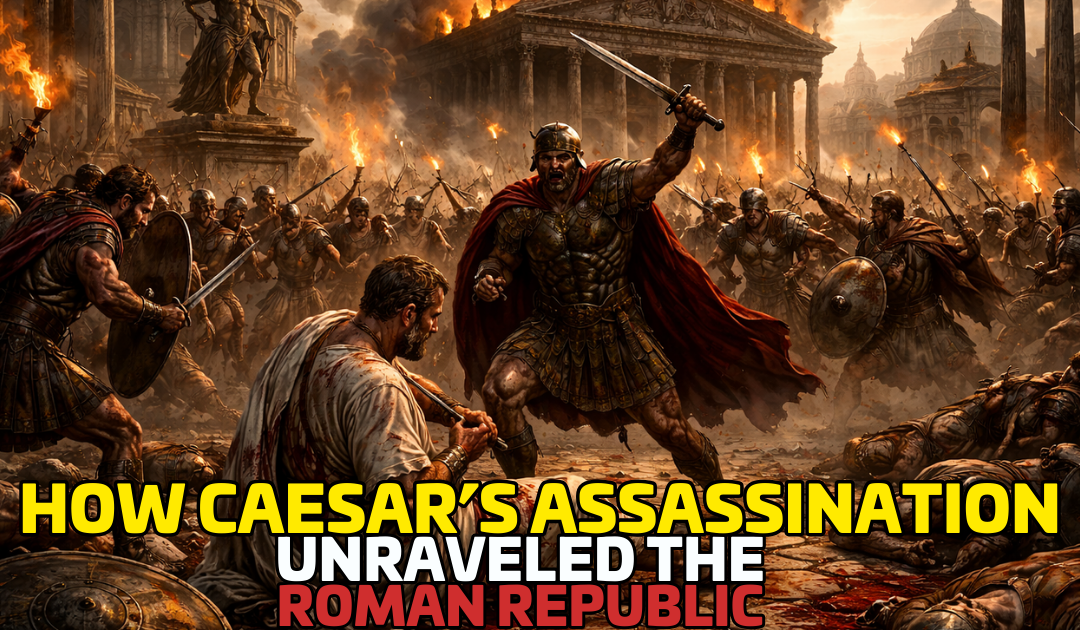
On March 15, 44 BC, the Ides of March, Brutus, Cassius, and their co-conspirators stabbed Julius Caesar 23 times in the Senate. The conspirators believed they were saving the Republic.
They thought removing one man would restore balance, preserve liberty, and uphold centuries of Roman tradition. They were wrong.
The assassination unleashed more chaos than it prevented. Riots erupted across Rome. The streets ran with fear and outrage. Purges followed.
And the Second Triumvirate—Octavian, Mark Antony, and Lepidus—took brutal revenge, including the beheading of Cicero, a man celebrated as the voice of the Republic.
Assassination Backfired
Caesar’s killers believed that eliminating a single figure would preserve democratic norms. In reality, their act accelerated the Republic’s collapse. Civil wars raged across the Mediterranean for over a decade.
Loyalty shifted from institutions to generals. Rome had learned a dangerous lesson: violence could solve political disputes.
By 31 BC, Octavian had defeated Antony and Cleopatra at Actium. The Republic, already fractured, was beyond repair.
Augustus and the Birth of Empire
By 27 BC, Octavian became Augustus, the first Roman emperor. He cleverly maintained the appearance of republican governance—Senate meetings, magistrates, elections—but real power rested in his hands.
The lessons are clear: endless violence disillusioned Romans with self-rule. The Republic’s institutions were undermined not just by ambition, but by the repeated failure of violence to solve disputes peacefully.
In the end, Rome exchanged freedom for stability. The Pax Romana brought peace, but at the cost of liberty.
Echoes for Today
History is rarely polite. The fall of the Republic shows us that democracies falter when politics becomes violent. Assassinations, coups, or even the threat of force erodes trust in institutions. Once people begin to accept that power is won by violence rather than law, strongmen emerge.
Rome teaches a critical lesson: political violence rarely restores liberty. It destroys it. Each act of violence leaves citizens more cynical, less willing to participate in governance, and more eager for a single figure to solve systemic problems.
Can It Happen Again?
I often ask myself: could this happen in modern democracies? Are we seeing signs of systemic erosion when rhetoric becomes dehumanizing, norms are disregarded, and political opponents are treated as existential threats?
History does not repeat exactly, but it rhymes. The fall of the Roman Republic offers a warning: institutions alone cannot protect liberty if citizens lose faith in them and tolerate violence as a political tool.
The lessons are urgent. Stability and freedom require trust, restraint, and respect for institutions. Without those, even the most robust republics can crumble.
Final Thoughts
Caesar’s assassination did not save the Republic. It marked the beginning of the end. Violence solved nothing and created a vacuum that allowed a single ruler to consolidate power. The Republic’s demise reminds us that the cost of political violence is never temporary.
What do you think? Is our political environment showing the symptoms of an empire in decline? Comment below.
If you value this kind of historically grounded insight, follow me at @jeremyryanslate and share this article. And if you have a message to amplify on top podcasts, DM me or connect with my team at CYB Media.