
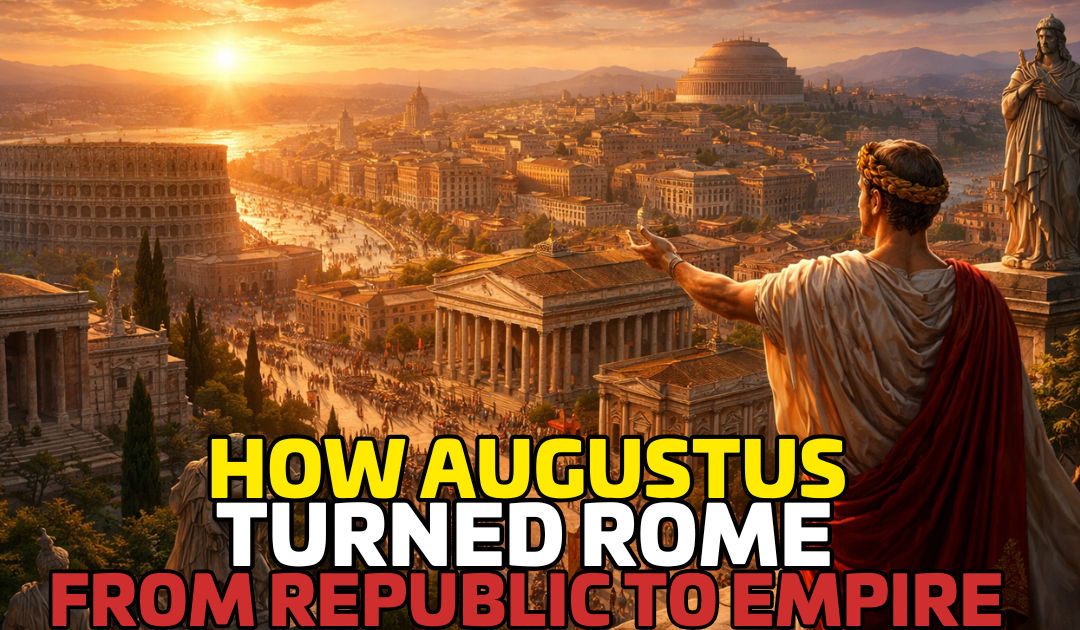
The collapse of the Roman Republic was not sudden. It was decades in the making, driven by corruption, civil war, and ambitious generals. But one man rewrote the rules of power and fundamentally changed Rome’s trajectory: Augustus.
Before Augustus, Rome was chaotic. Julius Caesar had just been assassinated in the Senate in 44 BC, victims of the same clemency he had shown others. Civil war raged, corruption was rampant, and generals prioritized personal gain over civic duty. The Republic was faltering.
Then, from the pages of Caesar’s will came a surprise: his 19-year-old great-nephew Octavian, later known as Augustus, was named heir. The stage was set for one of history’s greatest political transformations.
Building Power with Strategy and Alliances
Octavian’s first move was pragmatic and bold. He leveraged Caesar’s name to build a loyal army, gaining legitimacy and influence that extended far beyond his youth or experience.
He joined forces with Mark Antony and Lepidus to confront Caesar’s killers at Philippi in 42 BC. The conspirators were defeated, and while the Republic was “saved,” it was a hollow victory. Its institutions were broken, and Rome was still rife with instability. The spoils of power were now divided among three ambitious men, each with his own agenda.
But Octavian’s genius lay not in brute force alone. He understood that perception could be as powerful as an army. While Antony ruled the wealthy East and lived openly with Cleopatra, Octavian stayed in Rome, managing civic issues, stabilizing the city, and winning public favor.
He framed Antony as betraying Rome for a foreign queen, whether entirely true or not. It did not matter, the story stuck.
Mastering Public Relations in Ancient Rome
Octavian’s approach to power was part political savvy, part strategic storytelling. He used subtle PR tactics to shape public opinion, portraying himself as the protector of Roman tradition while Antony became the symbol of corruption and foreign influence.
This manipulation of narrative ensured loyalty not only from the people of Rome but from key political allies. By controlling the story, Octavian set the stage for his eventual sole rule. Public perception, carefully managed, became a weapon as effective as any legion.
From Republic to Principate
The key to Augustus’ success was balance. Unlike Caesar, he avoided the appearance of overt ambition that could alarm senators or provoke civil unrest. He adopted the title of princeps, or “first citizen,” rather than king or dictator.
Yet in reality, he held ultimate authority over Rome’s military, finances, and administration.
Through careful legal reforms, political alliances, and narrative control, Augustus maintained the façade of the Republic while consolidating power. By the time of his death, he had stabilized Rome and created an imperial system that would endure for centuries.
Lessons From Augustus’ Rise
- Strategic Alliances Matter
Power is rarely achieved alone. Augustus’ coalition with Antony and Lepidus was essential to securing early victories and legitimacy. - Perception is as Important as Reality
Octavian’s careful management of public opinion ensured loyalty and minimized opposition. Narrative shapes history. - Incremental Power Consolidation
Augustus did not seize total control immediately. He built authority gradually, preserving the appearance of republican institutions while holding real power. - Legacy Through Systemic Change
Augustus did not just win; he built a system that outlasted him. His reforms and strategies became the foundation of the Roman Empire.
Why This Still Matters Today
Augustus’ rise from a teenage heir to Rome’s first emperor demonstrates how strategy, timing, and narrative mastery can reshape civilizations. He turned instability into order, chaos into a lasting system, and personal ambition into enduring legacy.
The culture, governance, and even civic architecture of the Roman Empire continue to influence the Western world. Augustus’ ability to balance perception, power, and policy offers lessons for leaders across time, whether in politics, business, or culture.
Final Thoughts
Rome’s transition from Republic to Empire was not inevitable. It required vision, calculation, and a mastery of both people and story. Augustus succeeded because he understood that power is multidimensional. It is not just about armies or laws, it is about narrative, perception, and timing.
History judges him as the model by which emperors were measured. The Republic may have died, but the Empire he built still echoes in our culture today.
What do you think? Could anyone today emulate an Augustus-level strategy in politics or leadership? Comment below.
If you enjoy historical analysis like this, follow me at @jeremyryanslate and share this article. And if you have a message you want to amplify on top podcasts, DM me or connect with my team at CYB Media.