
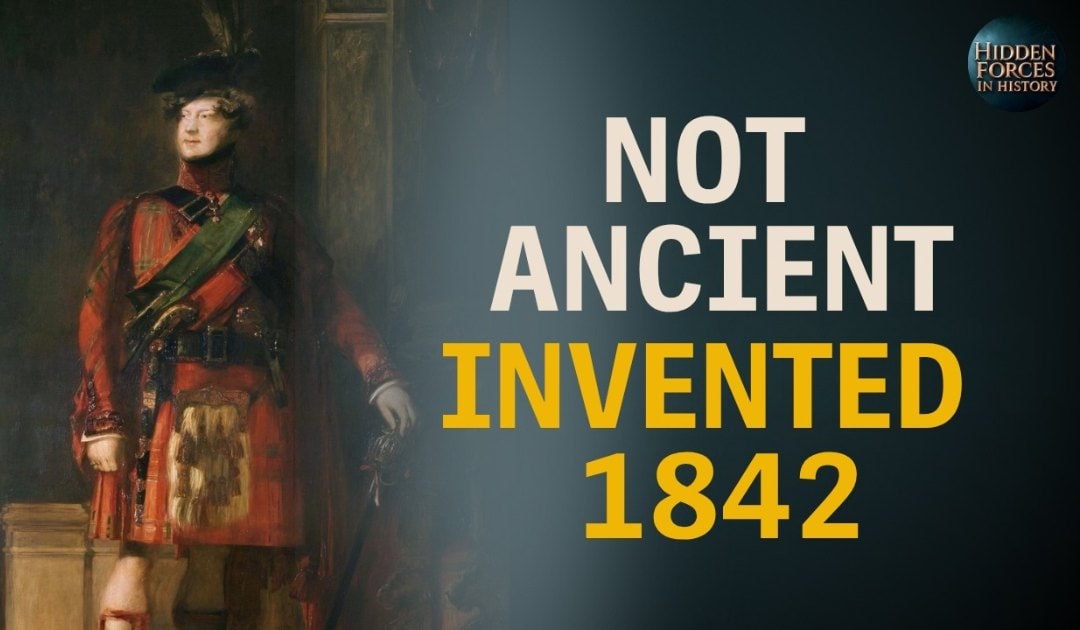
Most of us have been handed the same picture of Scotland, with its clans and their sacred tartans and a warrior culture supposedly older than memory. In this episode of Hidden Forces in History I tried to follow where that picture came from, and the trail kept leading to people who built it on purpose and built it to sell. There were two brothers from England with a manuscript nobody could ever produce, a weaving firm near Stirling, a king who badly needed good press, and a novelist who understood that a nation without a legend is a nation without a market.
The story starts on a wet, flat moor outside Inverness on April 16, 1746. The Battle of Culloden lasted less than an hour, and government cannon tore apart a Highland army that was poorly fed, poorly armed, and standing on the wrong ground. Something like a thousand Highlanders died on the field and roughly another thousand in the hours after, and what came after it was government policy.
The full episode walks through every step of what came next, from Culloden all the way to Tartan Day.
Outlawing a Piece of Cloth
The Duke of Cumberland, the man history remembers as the Butcher, wanted to end the clan system, and within months the British government passed a series of acts designed to do it. The Heritable Jurisdictions Act took the chiefs’ legal authority over their tenants, and the Tenures Abolition Act pulled down the feudal military structure that had made a Highland army possible. Then came the Dress Act of 1746, which made it illegal to wear Highland dress in public. A first offense meant six months in prison, and a second meant being shipped to the colonies for seven years. What they were criminalizing was a symbol, and symbols hold a culture together a lot like load-bearing walls hold up a house.
The ban lasted 36 years. Over that time the chiefs lost their military power and their legal authority, and as the agricultural revolution pressed in, they lost their economic reason to exist too, because sheep turned out to be worth a great deal more than people. That math is where the Highland Clearances came from, with whole communities pushed off land their families had worked for generations and loaded onto ships for Canada, Australia, and Nova Scotia. The landlords and improving aristocrats doing the clearing needed a proud story about the Highlands, and the odd thing is that someone was already writing one.
Ossian and the Sobieski Stuarts
In 1760 James Macpherson published what he said were translations of ancient Gaelic poetry gathered from oral tradition, attributed to a bard named Ossian. The poems were genuinely good, dark and full of mist and loss, and they were entirely made up. Samuel Johnson called Macpherson a fraud almost immediately and told him to produce the originals, which he never could. Nobody could prove the forgery in a way that stuck, though, and in that gap the market moved. Napoleon carried Ossian on campaign, Goethe quoted it in The Sorrows of Young Werther, Schubert set it to music, and Mendelssohn traveled to Scotland partly because of it. By the end of the century a bard who never existed was one of the most influential literary figures in Europe.
The authentication came from John and Charles Allen, who were born in England to Thomas Allen, a lieutenant in the Royal Navy. In the early 1820s they turned up in Scotland claiming to be grandsons of Bonnie Prince Charlie, lost heirs of the Stuart line, and they changed their names to John Sobieski Stuart and Charles Edward Stuart to match. You’d expect two Englishmen making that claim to meet suspicion, and they were welcomed. The Dress Act had been repealed in 1782, and the chiefs wanted their heritage back, or put more honestly, they wanted to look like they had one, and they didn’t know what the right costume was.
In 1842 the brothers published the Vestiarium Scoticum, which they said was based on a sixteenth-century manuscript recording which tartan belonged to which clan. No historian had seen the manuscript and no library or estate archive mentioned it, and whenever scholars asked, it was too fragile or being protected or just unavailable. Hugh Trevor-Roper, who did more than anyone to take the story apart, later called it pure fantasy and barefaced forgery. The chiefs bought the book and the premise both, and they dressed their families and tenants in patterns that were at most about twenty years old.
The Factory and the Pageant
The cloth itself came from Bannockburn, where William Wilson had started a weaving business in the 1770s. By the early 1800s Wilson and Sons dominated tartan production, and their surviving order books show them designing a pattern first and naming it afterward, sometimes for a clan and sometimes for a place, with the same weave turning up later under a different clan’s name. When a chief asked for his clan’s ancient tartan, Wilson opened the pattern book and found him one.
For anyone who’d rather listen to the rest on a drive, the audio version is here.
The launch belonged to Walter Scott, who I think may be the most important figure in the whole story, a true believer who also understood the commercial power of belief. Waverley, Rob Roy, and the rest had made the Highlands fashionable across the English-speaking world. In 1822 George IV announced the first visit to Scotland by a reigning monarch in about 170 years, at a moment when his public fight to divorce Caroline of Brunswick had made him a laughingstock, and Scott was put in charge of staging it. He had about six weeks. He told the chiefs to appear in full Highland dress, most of them didn’t own any, Edinburgh’s tailors were buried in orders, and Wilson’s looms ran double shifts. Scott even put Lowland chiefs in tartan, or more precisely he specified that they appear in Highland dress too, men whose ancestors had fought against the Highland clans.
George IV arrived on August 15, 1822, at Leith in a Royal Stewart kilt with flesh-colored tights underneath, and the crowd loved it. John Prebble later called his account of the visit The King’s Jaunt. Twenty years after that, Queen Victoria and Prince Albert made their first trip to Scotland, and in 1852 they bought Balmoral outright. Albert designed the gray, black, and red Balmoral tartan himself, the castle was done in tartan down to the stair runners, and Victoria’s Leaves from the Journal of Our Life in the Highlands became a bestseller. Industrialists from Manchester bought shooting estates and dressed the part.
What the Cloth Covered
The Clearances ran under all of this the whole time. In Sutherland the Countess of Sutherland cleared hundreds of thousands of acres for sheep through the 1810s and 1820s, with homes burned so families couldn’t return. Her factor, Patrick Sellar, was tried for culpable homicide after elderly tenants died during removals, and he was acquitted. T. M. Devine makes the point that dispossession ran through the same decades the tartan industry took off, and the big wave came in the 1840s with the potato famine, while the Vestiarium was still selling. So a Highlander cleared off his land who wanted to feel connected to what he’d lost had to buy it back, his own clan’s name on the label.
Scholars were questioning the Vestiarium out loud by the mid-1840s, and it changed nothing, because by then the tartans had been commissioned and worn and painted into portraits. Eric Hobsbawm later gave this a name, the invented tradition, and the Highlands were the case study his collection opened with. Today there’s a Tartan Day on April 6 recognized by the United States Congress, and there are registered tartans for Disney, Coca-Cola, and Dolly Parton. I’d encourage you to read Trevor-Roper and Devine and check me on this, and then watch the episode, because I suspect you’ll look at a tartan scarf in an airport gift shop a little differently afterward.