
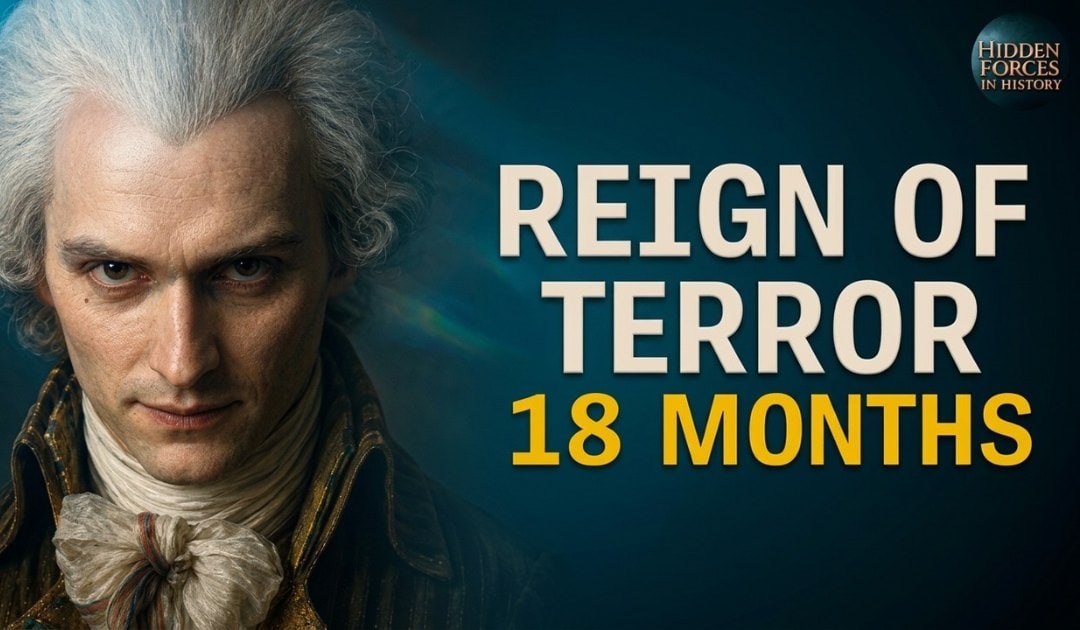
The usual story says the Terror came out of ideology and fanaticism, and out of Robespierre’s madness. I think that explanation is much too small for what happened in France between January 1793 and July 1794. The engine I keep coming back to is a legal machine, built step by step by the Committee of Public Safety, that turned suspicion into evidence and political position into guilt. In the last 47 days of it, the guillotine took 1,376 lives in Paris alone, and by the end the machine had consumed most of the people who built it.
In January 1793, Paris was hungry. The assignats, the revolutionary paper currency, were collapsing, bread cost more than a day’s labor earned, and Austria and Prussia were massing troops on the borders. Louis XVI went to the scaffold on January 21, and the executioner, Sanson, held his head up to the crowd. The king’s death was supposed to settle things, and it did the opposite, leaving a republic at war with half of Europe, with no money, where the streets controlled the government more than the government controlled the streets.
I go through all eighteen months, faction by faction, in the full video.
The man who defined virtue
The National Convention was already split into hostile camps. The Girondins sat on the right, wanting a decentralized republic and fearing the Paris mob and, more than anyone, Maximilien Robespierre. Robespierre sat with the Montagnards on the left. He was a lawyer from Arras, thin and pale and extremely precise, who dressed immaculately, spoke softly and took opponents apart in long legal arguments that sounded like prosecution briefs. He controlled the definition of virtue, and that proved more dangerous than commanding armies or running the treasury, neither of which he ever did, since he never really held executive power in the way we’d think of it now.
The Law of Suspects
On September 17, 1793, the Law of Suspects created a legal category French law hadn’t had before. A suspect was anyone who, “by their conduct, their relations, their words, or their writings,” showed themselves to be partisans of tyranny or federalism, or enemies of liberty. Those four categories are vague enough to take in almost anyone. All it took was becoming the kind of person somebody no longer trusted, whether or not you had committed any crime.
Surveillance committees appeared in every Paris neighborhood and district, and eventually in every town. They kept lists and accepted denunciations from anyone, signed or anonymous, so a neighbor or a business rival could put your name into the system. With habeas corpus gone, you were guilty until the committee decided otherwise, and it almost never did. Between September 1793 and July 1794, roughly 500,000 people were declared suspects, in a nation of 28 million, which comes to nearly 2 percent of the population living under active legal suspicion.
Three factions, one after another
The Girondins felt it first. They had opposed the committee’s centralization and questioned the September massacres of 1792, and in October 1793 their leadership went before the Revolutionary Tribunal. The trial took five days, the verdict was decided before it started, and 21 Girondins went to the guillotine. Every bit of it was legal. It all happened inside the government’s own emergency framework, and when the rules got in the way, the committee rewrote them.
Then the pressure moved left. Jacques Hébert, editor of Le Père Duchesne, wanted the Revolution pushed further and faster, down to dechristianization and violent enforcement of price controls. Robespierre called the Hébertistes the foreign faction, meaning, more precisely, that their extremism served foreign interests whether they intended it or not. In March 1794, Hébert and 18 allies were arrested, tried in three days, and guillotined on March 24.
Then came Georges Danton, the great orator of September 1792 (“audacity, more audacity, always audacity”), who by 1794 wanted the Terror to end and called for clemency, peace negotiations and restraint. Robespierre branded his faction the Indulgents. Danton and 13 allies were arrested on March 30, 1794, and because Danton was genuinely popular and could sway a tribunal and its galleries, the committee changed the procedure.
22 Prairial
The Law of 22 Prairial passed on June 10, 1794, drafted by Robespierre and Couthon. It broadened crimes against the Republic until almost any political behavior qualified, removed defense counsel and defense witnesses, removed meaningful cross-examination, and left the tribunal two possible outcomes, acquittal or death. From June 10 to July 27, the tribunal in Paris executed 1,376 people, about 29 a day, where before Prairial it had averaged five in a week. The same guillotines did that work, once everything standing between accusation and death had been taken away.
Danton’s own trial had happened under the older procedures, and his brilliant defense made no difference. He went to the scaffold on April 5, 1794, and told the executioner to show his head to the people, that it was worth seeing. I think he understood by then that the machine had no reverse gear.
If you’d rather listen to this one while you’re driving or out for a walk, the audio version is right here.
Where you stood
With the Girondins purged from the right, the Hébertistes from the left and the Dantonists from the center, the band of survivable opinion narrowed to almost nothing. Revolutionary justice ran on position. The Girondins were virtuous revolutionaries in 1792 and counterrevolutionary suspects in 1793, holding the same views, because the committee’s center had moved. The Hébertistes went from celebrated radicals to foreign agents in a year. Your safety depended on where your faction happened to sit in a taxonomy that kept moving.
That trapped Robespierre too. By the summer of 1794 he was the most powerful man in France, and he couldn’t step down, because stepping down meant irrelevance and irrelevance, for a man who had signed that many death warrants, meant the guillotine. On July 26 he gave a two-hour speech to the Convention warning of conspiracies and demanding another purge, and he never named his targets. Every deputy had voted for executions, so every deputy assumed the next list might include him.
On July 27, 9 Thermidor, Saint-Just was speaking when the chamber erupted with shouts of tyrant and dictator, and someone shouted, “The blood of Danton chokes him.” Robespierre was arrested, freed that night by the Paris Commune, and at 2 a.m. Convention troops stormed the Hôtel de Ville where he had fled. He was found with a shattered jaw (whether the shot was his own or a guardsman’s is still debated), and the next day he went to the guillotine. The deputies who ended the Terror had approved every purge and every tribunal, and they discovered the danger of unlimited revolutionary justice at exactly the moment they became potential targets.
The same machine elsewhere
In the episode I follow the same structure into Stalin’s purges, where Old Bolsheviks who built the 1917 revolution became enemies of the people, ending with the purge of the NKVD itself. Mao’s Red Guards purged the rightists and were then purged in turn, and the Khmer Rouge went further still, until Tuol Sleng prison was processing members of its own staff. Almost every major figure of the French Terror died by it, from Robespierre and Saint-Just to Hébert, Danton, Desmoulins and Fouquier-Tinville, the tribunal’s chief prosecutor. Joseph Fouché was the exception, and he survived because he never held a fixed position long enough to be caught inside the narrowing band. He voted for the king’s execution, helped bring down Robespierre, served Napoleon and then the Bourbons, and died peacefully in bed.
I end the video asking whether some of these ingredients are running now, in laws that criminalize position, surveillance that creates suspect categories, and tribunals of one kind or another operating without real procedural protection. Watch it or listen to it and decide for yourself, and forgive my French pronunciation along the way.