
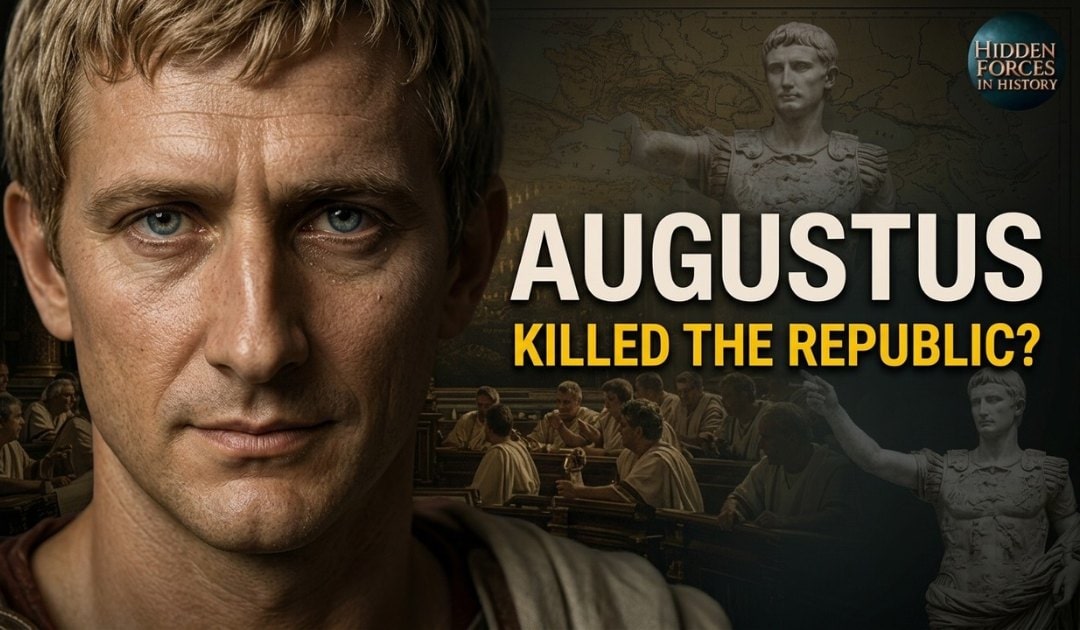
The usual telling goes that Caesar died and Rome was saved, and I’ve come to think of that as something close to a cover story. Brutus and the others killed a man, and the machine that man had built kept running. It passed to Octavian, still a teenager and already moving with a plan, and he kept everything visible exactly the same. The Senate still met, consuls were still elected and the fasces still stood on the Rostra, so all the forms were there while their function shifted underneath.
This episode of Hidden Forces in History, made in collaboration with The Roman Pattern, is about how that happened, and I wanted to start where most tellings skip ahead, which is with a will.
The video takes it step by step from the Ides of March to the succession of Tiberius.
A name in a will
Julius Caesar was murdered on March fifteenth, 44 BC, by twenty-three senators with twenty-three knives, and his body was left on the floor of the Theater of Pompey. The men who did it expected gratitude and recognition, and what they got was silence, then panic, then riots. They had removed the most powerful figure in Rome and realized almost immediately that they had nothing to put in his place. Brutus tried to explain himself and the crowd didn’t follow, Cassius issued statements nobody listened to, and within weeks they had been driven out of the city they thought they had just freed.
Into that opening stepped Gaius Octavius, eighteen years old and in Macedonia studying military tactics, with no army or treasury or real political base to speak of, and the one thing in his favor was a name. Caesar’s will was read publicly in the forum, and it adopted him, making him Gaius Julius Caesar Octavianus, and he dropped that last part almost immediately. From then on he was Caesar, the same name the city was already mourning. The conspirators thought they had ended something, and what they had actually done was hand it on, because the power in Rome sat with symbols as much as with any individual, and Caesar’s name was the strongest symbol the city had.
Clearing the field
What came next usually gets labeled civil war, and people move past it quickly. If you slow down, though, it looks deliberate. In 43 BC Octavian formed the Second Triumvirate with Mark Antony and Lepidus, publicly presented as a restoration of order, and privately it started with a list. Under the proscriptions, names were posted across the city, and anyone on the list could be killed legally, with the killer paid and the victim’s property taken and redistributed by the state. Three hundred senators and two thousand equestrians were removed, and the selection was careful, aimed at anyone who could organize resistance, fund opposition or argue for the old system.
Cicero was on that list, the most prominent voice still defending the Republic. He tried to get away and didn’t make it, and they cut off his head and his hands and placed them on the Rostra, the same platform where he had spoken about liberty, which was a message put exactly where it would land, and Octavian, at twenty-one, approved it.
Every consolidation of power seems to need an enemy, and something bigger than a rival works best. After the triumvirate fractured, Antony moved east, commanding massive forces and aligning himself politically and personally with Cleopatra, and Octavian’s team turned that into a narrative in which Antony had stopped being Roman in his customs and in his loyalties. Octavian then declared war on Cleopatra. A war on Antony would have been Roman against Roman, while a war on Cleopatra could be framed as the defense of civilization, and the legions could march for Rome itself. The Senate granted him extraordinary powers because the story made them feel justified. At Actium in 31 BC Octavian won, within a year Antony and Cleopatra were both dead, and he came home as the man who had resolved the crisis.
The restoration that kept the keys
On January thirteenth, 27 BC, Octavian stood in the Senate and announced that the crisis was over and the Republic was restored, and that he was returning power to the Senate and stepping back, or at least that’s how it was presented. The reaction was shock and then relief, and the senators asked him to stay just long enough to stabilize things. He agreed to manage certain provinces temporarily, namely Syria, Gaul, Spain and Egypt, and if you look closely those held the legions, the grain supply and the wealth, so he was giving back what mattered least and keeping what mattered most, all of it inside the system.
The Senate voted him the name Augustus and, over time, tribunician authority, proconsular command and religious leadership, each piece added separately and each one justified, until everything that controlled the system sat with one man. Nothing looked broken, since every step had moved through the existing structure.
If you’d like to listen while you’re driving or out for a walk, the audio version of the episode is right here.
Making people accept it
Holding power and keeping it are two separate problems, and keeping it means people have to accept the new system, or at least stop questioning it. Augustus worked through what people read, the history they were taught, and the coins in their hands. Virgil wrote under patronage, in a setting where the themes were understood well enough that direct orders weren’t necessary, and the Aeneid built a lineage connecting Augustus to divine origin. Livy reconstructed Roman history in a way that framed decline and positioned the present as its correction. The coins reached everyone else, because most people didn’t read but everybody bought things, and after Actium the imagery shifted to Augustus on the front and victory, stability, provision and peace on the back, coordinated and constant and moving across every region of the empire.
Most of the old opposition adapted, since the choice was to resist and be removed or align and remain. Over time, the people who had been performing agreement started to believe it, because the chamber, the roles and the procedures all looked the same, and only the outcomes had changed. The Senate still met and debated and voted, though what it controlled came down to appointments, contracts and minor functions, while the military, the resources and the direction of the state sat with Augustus. He kept the Senate anyway, sitting among the senators and speaking with them, because its survival made the whole arrangement look intact, and he did that carefully for decades.
Succession, and the word he never used
Succession was the hard limit, since Augustus had no direct heir and couldn’t name one openly without exposing what the system was. So he used adoption, positioning candidates over time, some of whom died and some of whom failed, until his stepson Tiberius was placed into the role and given authority, and when the transition came it looked procedural, as if it had always been going to happen that way. For forty-one years Augustus held power while avoiding the words king and emperor, I think because naming power makes it visible, and visible power can be challenged. When he died, the Senate declared him divine and carried on with the process he had built, which kept going for almost five hundred years under the same language of restoration, virtue and continuity.
If you want to check this against the sources yourself, Ronald Syme’s The Roman Revolution is the classic place to start, and the full episode, where I go further into how the forms stayed put while control moved, is there to watch or listen to whenever you’re ready.