
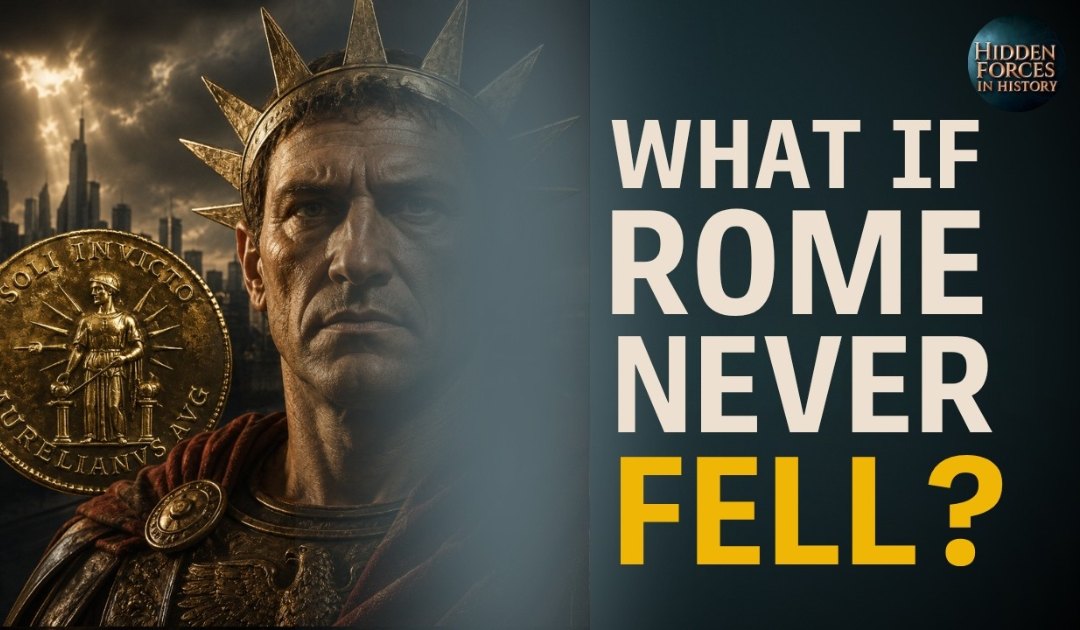
This one is a departure for the channel, and I want to say so up front. Most of what I put out on Hidden Forces in History is researched history, and this episode is an alternate-history thought experiment, a counterfactual that a YouTube subscriber, history1099, gave me the idea for. The coin, the currency reform, and the assassination at the center of it are real. Everything after the moment the blade misses is invented.
The real part goes like this. Aurelian spent five years on the throne undefeated, pulled a collapsing empire back together during the Crisis of the Third Century, reminted the coinage, and put the sun on the money. In 275 AD he was murdered by his own officers over a forged kill list, nine years before Diocletian had to redo the entire recovery. The question I wanted to play with was simple enough, which is what happens if he survives that night.
The world I built in this episode is a strange one, and it’s more fun to hear it told than to read my summary of it, so here’s the video.
A coin as control
Everyone assumes an empire gets saved by its legions, and Aurelian saved his with coin. Before him the empire ran on dozens of mints, with provinces striking their own money and silver cut with base metal until a coin was worth a fraction of what it claimed. That’s why the army was broke and the frontier was rotting, because money had stopped meaning anything. So he closed the mints and put the money supply in one place, under a single standard of silver with one face on the metal, Sol Invictus, the Unconquered Sun.
When you held that coin, you were looking at the sun, the emperor, and the god all at once, and you couldn’t question any one of them without questioning all three. You could call that religion, and I think control works just as well as a word for it. A coin is a promise that a piece of metal is worth what the issuer says it’s worth, and in this version of history Aurelian’s coin was backed by the unbroken name of the empire itself. What he was really minting was consent, with every sun coin in every pocket acting as a small daily vote that Rome was real and would outlive you.
The families who kept the ledger
In the fictional world, the empire’s wealth bypassed the emperor’s hands and flowed through a small number of banking families, the gens who kept the books, who called themselves financiers and money changers and keepers of the imperial treasury. Their real job was keeping the ledger, every loan, tax, and payment from the walls of Britannia to the Euphrates. If a man owed money, they knew it before he did, and when an emperor wanted a war, whether he could win it was a question for his generals and whether he could afford it was a question for the books.
That’s why this Rome had no head to cut off. Its power sat outside the palace, spread across a dozen families who all had every reason to keep each other alive, and emperors came and went, some murdered, some honored, some forgotten, while the families kept the books for 1,700 years. For a long time the ledger was ink on parchment. Or, more accurately, it was ink on parchment for as long as the empire stayed small enough for a man to cross on horseback in a season. When it outgrew that, the families built a machine made of light to settle the empire’s accounts in the time it takes to say a name, the abacus made electric.
The lie that swallowed an ocean
A record is a decision about what happened dressed up as a description of it, and whoever controls the ledger decides what gets written down, what gets erased, and which version of the world people live inside. In the history you and I were taught, Rome pulled out of Britannia because the money was gone and the legions were needed elsewhere. In this counterfactual, Aurelian fixed the money, so the legions stayed, and Britannia remained Roman for 1,700 years. Nothing ever sailed west from it, so England never formed, and neither did the British Empire or the United States. The continent across the Atlantic is a western province called Nova Britannia in official documents, with no flag of its own and no money of its own, spending the same sun-stamped coin as everyone else in the western half of the world.
I also play with the faint, almost physical resistance you probably feel at the idea that there was no America, and in the story, that resistance is the record doing its job.
If you’d rather have this one in your ears on a drive, the audio version of the episode is right here.
Three empires and one cartel
The same logic handles the other two powers. China was ancient when Rome was young and too large and too old to write out of any record, and Persia was older than Rome, patient and unshakable. So the ledger left them in the record, since erasing them would have been bad business, and found ways to handle them. Rome and Persia shared a frontier along the Euphrates for four hundred years and fought to a standstill so complete it became permanent. In my version Persia is Rome’s mirror, built from money and religion bound together by a ledger, and it understood something Rome never quite admitted, that an empire gets beaten by being outlasted. So Persia sat in the middle, held the crossing, taxed the trade, and sold to both sides. Everyone calls Persia the weak one, and that suits Persia fine. Rome and China, meanwhile, met along the Silk Road with silk and silver.
What ties all three together in the story is one shared system, the families who kept the books, whether that’s the gens of Rome, the merchant houses of Persia, or the financial clans of China. A war between empires is bad business for the people financing every side of it, so for 1,700 years the great powers never fought a war with armies. People in that world would call it geopolitics, and I’d call it a cartel, probably the oldest one there is.
2026 and the war on the ledger
So by 2026 there are three superpowers, 1,700 years of cold war, and a war everyone says is coming between Rome and China that has been fought the whole time with ledgers, in interest rates and reserves and transfers between families whose names you’ll never hear. What the three empires move now is the numbers behind their borders, and those numbers have never moved faster. The tell, if you want one, is the money in your pocket, which still carries the sun and the emperor’s face and is backed by the same thing it was in 275, which is trust.
What Aurelian survived in this story was bigger than a forgery. He survived the slow rot of money that stops meaning anything, the thing that killed every empire before his, and in surviving it he set the world on the course I spent the episode walking through. It’s fiction, and I had a lot of fun with it, so watch it or listen to it with that in mind. If you want the heavily researched version of my Rome work, most of it is living on The Roman Pattern channel now, and I’d love to have you over there too.