
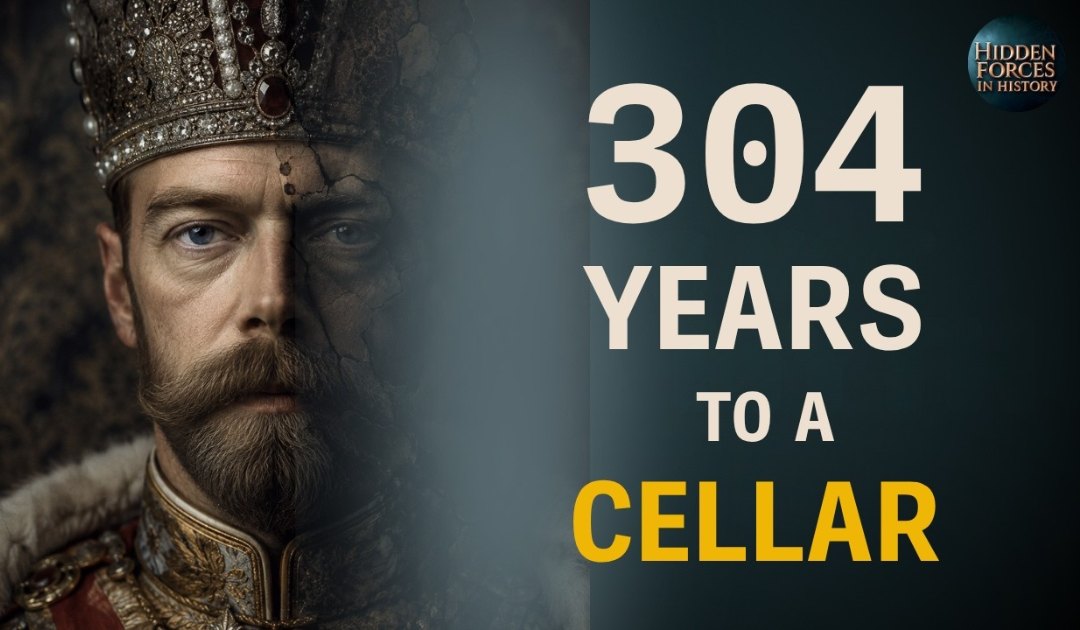
On July 17, 1918, in a half-basement room of the Ipatiev House in Yekaterinburg, with one barred window and no way out, the last Romanov family was shot. Told the usual way, it’s a tragedy, filed under murder. I think that version is too small for what actually happened. What happened in that cellar was a demolition 304 years in the making, and it traces back to a decision taken in 1613, when the first Romanov built a state that was the tsar and nothing else, with no machinery underneath him that could outlive him or reform itself while he was still breathing.
So this episode starts at the beginning, with a 16-year-old boy who didn’t want the job, and follows the dynasty all the way down the basement stairs, and you can watch that whole descent here.
A throne they called a state
Russia in 1613 was barely holding together as a country. The old Rurikid dynasty had run out of heirs, and fifteen years of the Time of Troubles had brought famine, civil war, and foreign enemies moving through Moscow more or less at will, with the Kremlin itself at one point in Polish hands. The boyars, the church and the surviving generals met in an assembly and elected Michael Romanov, who was, to put it honestly, the least objectionable man in the room. He was 16, tied to the old line through a great-aunt who had been Ivan the Terrible’s first wife, and too weak on his own to threaten anyone who mattered. They gave him absolute authority, divine backing, and no obvious ceiling.
There were checks at the founding, to be fair. The assembly of the land sat almost continuously through Michael’s first decade, and his father came back from Polish captivity in 1619 and effectively co-ruled as patriarch with the title Great Sovereign. Nobody wrote those checks down or made them permanent, though, and within two generations they had withered, because a state built around a sacred ruler has very little use for a body whose job is telling him no. Simon Sebag Montefiore keeps circling back to this bargain, a survival mechanism built by men who had watched Russia drown because nobody could give an order that stuck, and none of them stopped to ask what would happen the day the man in the middle turned out to be ordinary.
Peter the Great dragged the country into the modern world by force, with a navy, a professional army, and a new capital at St. Petersburg built on a swamp, and he did it while leaving the crown unlimited. He bolted the medieval idea of a sacred autocrat onto a modern state. Richard Pipes calls the result patrimonial, meaning the tsar owned Russia the way a landowner owns an estate, people included, with no line between the ruler’s property and the public state. A state that runs on one man is only as strong as that man, and Peter happened to be strong, while most of the men who followed him weren’t.
Reform, panic, reversal
By the nineteenth century the country was modernizing underneath a frozen crown, and the dynasty fell into a cycle of reform and panic and reversal. Alexander II freed the serfs in 1861, 23 million people, because he understood Russia couldn’t industrialize with an enslaved peasantry underneath it. Reform woke the country up, and on the morning of March 1, 1881, he signed a proposal from his interior minister, Loris-Melikov, for locally elected representatives to advise the crown on legislation, a small thing and still the first crack in 250 years of a tsar answering to God alone. That afternoon a bomb went off at his carriage on the Catherine Canal, and when he got out to look at the wounded, a second one killed him. The proclamation was never published.
Alexander III decided reform had caused the chaos and slammed the door, with censorship, Russification, and a political police he expanded into the Okhrana. Pipes’s point is that any real reform meant sharing power, and a sacred autocrat who shares power stops being sacred.
Then came Nicholas II, and you have to be careful with him. He was a decent husband, a devoted father and a genuinely pious man, and he was simply the wrong man for the century he’d been handed, running an industrializing great power while filling his diaries with the weather and his walks. Orlando Figes, in A People’s Tragedy, shows a man who fought reform because he believed limiting the autocracy was a sin, a betrayal of the anointing itself. Nicholas was gentle and stubborn, sitting on top of a machine that could only run with a strong man in that seat.
This is the Ibn Khaldun pattern that runs through this whole channel, where a founding generation hardened by struggle has real cohesion, asabiyya, and every generation after drifts further from it. His clock ran fast, about 120 years, and the Romanovs lasted 304 years and 18 rulers, which I’d argue is the interesting part, because Peter reset the clock by force and Alexander II by reform, right up until the man on the throne had no particular will of his own.
If you’d rather hear the rest of this story on a drive, the audio version is right here.
1905 and the half-reform
On a January Sunday in 1905, workers carrying icons and singing hymns marched to the Winter Palace to petition the tsar, and the soldiers opened fire. The official count was around 130 dead, and most historians put it closer to 200. Nicholas wasn’t even in the city, and nervous officers gave the order, but in a personal state every bullet ends up on one man’s doorstep, since there’s no government or prime minister to resign and absorb the blame. Bloody Sunday became his personal sin, and the country rose.
So he conceded, with the October Manifesto, a parliament called the Duma, and civil liberties, and that was the fatal move, because a concession from a sacred autocrat reads as a confession of weakness. Six months later the new Fundamental Laws still described his power as autocratic. Figes puts it plainly that the manifesto satisfied nobody, and a Duma that existed only when the crown allowed it became a stage everyone could see through.
Rasputin and the war are usually blamed, and both answers stop a couple of layers too early. When the hemophiliac heir Alexei nearly died at Spala in 1912 and a telegram from Rasputin got credited with his recovery, Alexandra came to depend on him. In a functioning system he’s a gossip item, and in a state that is one family, he’s a crisis, so what Rasputin did was reveal the shape of the collapse. The war called up something like 15 million men, and Nicholas took personal command in 1915, leaving the capital to his wife and Rasputin. Dominic Lieven is careful to treat the war as an accelerator on something already coming, and so am I.
The railway carriage and the cellar
In February 1917 the bread riots came, the garrison mutinied, and within days the apparatus simply stopped obeying. Trotsky, writing later from exile, insisted nobody organized February, and since he had every motive to claim credit, I find that admission useful. Diverted to Pskov, Nicholas abdicated on his generals’ advice, first for his son and then, after asking a doctor whether the boy could survive being separated from him, for his brother Michael. Michael said he’d accept only if an elected assembly offered the crown, and that assembly had never been built, so it never made the offer. Within eight months the Bolsheviks filled the vacuum.
The dynasty ran 304 years to the abdication, and one more year to the bullet. We know that night in unusual detail because Yakov Yurovsky, the commandant of the house, wrote an account for the Bolshevik archives about two years later that reads like a logistics report, irritated about the jewels and about a disposal that took all night and went wrong twice. Eleven people died in that room, the family and the doctor and the cook and the maid and the footman, so that the symbol could never come back. A geologist and a filmmaker found the grave in 1979 and, frightened, told nobody for 12 years, and after the official exhumation in 1991 and the discovery of Alexei and one of his sisters in 2007, DNA accounted for every member of the family. Anastasia died in that basement with the rest of them, and the myth of her survival was kinder than the truth.
A state that modernizes its economy while freezing its politics around one person builds this same fault line into itself, whatever the man at the top calls himself. The Romanovs are the longest, best-documented version I know, three centuries of warning played out in slow motion, and the full episode, on video or audio, walks through every tick of it.