
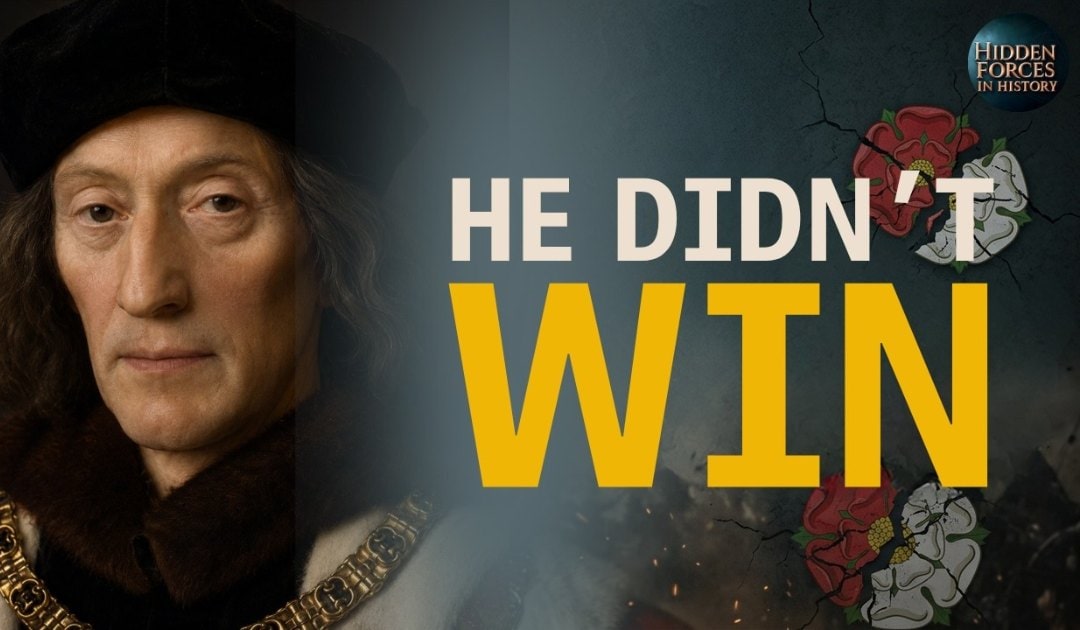
The version of the Wars of the Roses most of us inherited is a chivalric one, with Lancaster and York trading the crown back and forth until Henry Tudor wins at Bosworth and the Tudor age begins. What happened across those thirty years between 1455 and 1487 was a lot darker than that, and honestly a lot more mathematical. In 1450 England had roughly two hundred noble houses with the wealth and military power to shape the kingdom, and by 1490 about half of them were extinct. So the question I kept coming back to in this episode was whether Henry VII really won the crown at all, or whether he walked into a country where the class that could have stopped him had already killed itself.
I’ve nerded out on this period for a couple of years now, and for this one I brought in Medieval Scholar, one of my favorite accounts on X, who writes on Substack under the same name about medieval culture, religion, trade, and warfare. He was a good partner for it, because he pushes back on the habit of blaming the whole thing on one king.
We cover far more battles and personalities in the conversation than I can fit here, so the full video is the place to start.
A kingdom on its way to trouble
England in 1450 was still a powerful kingdom, living on the memory of Henry V’s conquests in northern France and the Treaty of Troyes that would have made him king of France after Charles VI. Henry V died first, though, and the crown went to a very young boy who became Henry VI. In 1450 Jack Cade’s rebellion ran from April to July, with people voicing local grievances, corruption and taxes high among them, all stacked on top of a Hundred Years’ War in its final years. Medieval Scholar’s phrase for it was a kingdom on its way to trouble.
Henry VI himself was religious, charitable, and committed to peace, and he’s personally admirable in a lot of ways. The trouble is that a medieval king was expected to lead politically, manage competing noble interests, reward supporters and punish opponents, and Henry couldn’t do any of that well. After England lost at Castillon in 1453 and the Hundred Years’ War ended, he went catatonic and couldn’t govern for a long stretch, and Richard, Duke of York, was made protector. Henry’s wife, Margaret of Anjou, was politically savvy in all the ways he wasn’t. England already had structural problems, and the tensions were already there before Henry, and once that train got moving he couldn’t stop it. There’s a Roman rhyme in the rising power of the knightly class, too, which made me think of the equites in the late Republic, who started as cavalry and turned into a political class that didn’t serve in the army at all.
From St. Albans to Towton
The first battle of St. Albans, on May 22, 1455, is the traditional flashpoint. It was small for the period, maybe 3,000 to 7,000 Yorkists against around 2,000 Lancastrians fighting through the streets of the town. Richard Neville, the Earl of Warwick, flanked through the gardens off the market square and broke the Lancastrian line, only about two hundred men died, and Henry VI was captured. York came back to London with the king in tow and Parliament made him protector again.
From there the road gets bloodier. At Wakefield, Richard of York rode out of Sandal Castle into an ambush and was killed, and his son Edward took over the Yorkist cause. After Warwick lost the second battle of St. Albans and Margaret’s forces got Henry back, Henry and Margaret moved north, partly for safety and partly because Lancastrian atrocities had cost them support. Edward went to London, declared himself Edward IV, and marched north after them.
Towton was fought on Palm Sunday, March 29, 1461, in North Yorkshire, in a snowstorm. The numbers are still disputed, and chroniclers inflated everything, but the episode works with the estimate of around 28,000 dead, and everyone agrees it was the largest and bloodiest battle on English soil. The wind made the Lancastrian arrows fall short, so the Yorkist archers shot back with the wind behind them and then pulled the Lancastrian arrows out of the ground and fired those too. The Lancastrians had to charge, the Yorkists were pushed back, and Edward, about six foot four and by the guest’s count undefeated in his career (eight and oh, if he remembered right), went to wherever his line was bending and fought there himself until Norfolk’s reinforcements arrived on the flank. Both sides had been told to give no quarter. Gregory’s Chronicle says forty-two knights were killed after being taken prisoner, and the skull archaeologists call Towton 25 shows a face split by what was probably a poleaxe. Fleeing men were cut down in what’s now called the Bloody Meadow, and the river was said to be so choked with bodies that the Yorkists crossed on them.
If you’d rather take the whole conversation with you on a long drive, it’s up on the podcast as well.
Warwick, Tewkesbury, and the princes
Edward should have been secure after that, and from 1461 to 1470 he mostly was, but Warwick, who’d been instrumental in making him king, fell out with him over foreign policy and patronage and above all over Edward’s secret marriage to Elizabeth Woodville. Warwick allied with Edward’s brother, the Duke of Clarence, and restored Henry VI in 1470 in what’s called the Readeption, and Edward came back in 1471. At Tewkesbury that year Henry’s only son, Edward of Westminster, was killed, Edmund Beaufort, the fourth Duke of Somerset, was beheaded right after the battle, and Henry VI died shortly afterward in the Tower. It can’t be proven, but a lot of people believe he was murdered.
When Edward IV died of illness his sons were too young to rule, and his brother Richard, Duke of Gloucester, became regent and then Richard III. The princes in the Tower disappeared. Medieval Scholar doesn’t believe Richard did it, and I’ll admit I tend to think Richard got a bad rap, a lot of it from Shakespeare, because a Henry Tudor with very little legitimacy needed a tyrant to have killed. We had Matt Lewis on the show for an episode on Richard and the princes, if you want to go further. People have spent whole careers on that question, and it’s worth reading them yourself.
Bosworth and what Henry built
At Bosworth on August 22, 1485, Richard had somewhere between 7,500 and 12,000 men on Ambion Hill against Henry’s 5,000 to 8,000, which included 1,800 French mercenaries. Oxford kept Henry’s army tight so it couldn’t be enveloped the way York had been at Wakefield, Northumberland’s men never moved, and the Stanleys waited to see who was winning. Richard led a charge straight at Henry and came surprisingly close before the Stanleys’ men surrounded him, and he was killed, probably by a Welshman with a halberd, the last English king to die in battle. Stoke in 1487 came later, though it was mostly a fight with small rebel forces.
Henry VII’s aristocracy stayed rich and powerful, but its power now depended on royal favor. Private retinues were restricted, the crown stepped into noble disputes, and Henry built the Council Learned in Law, prosecuted nobles for retaining private armies, revived old feudal dues, and filled the treasury. Medieval Scholar’s view, which I think is the right one, is that the wars created the conditions and Henry made deliberate choices inside them. It reminded me of how a century of civil war in Rome is what produced Caesar.
When an elite turns its weapons on itself, what fills the space afterward tends to be whichever institution underneath has the strongest hand, and in England that was the crown, which is how Henry VIII could later break with Rome from a position no medieval king had held. Go follow Medieval Scholar on X and Substack, and watch or listen to the full episode for everything we couldn’t squeeze in here.