
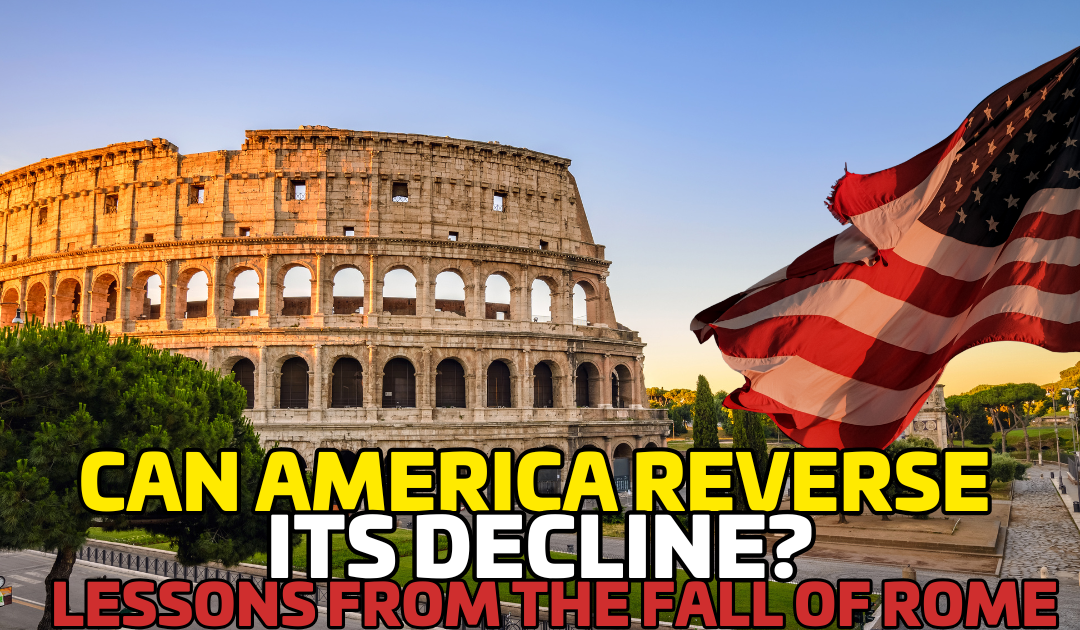
The parallels between ancient Rome and modern America have been on my mind a lot lately, and honestly, they’re getting harder to ignore. When I study the signs of Rome’s decline, I see the same warning signals flashing in our own country. Economic instability, bloated bureaucracy, cultural erosion, uncontrolled migration. Rome had all of it, and Rome fell.
The good news is that we’re not past the point of no return. America still has a shot at being the first great republic to survive what looks like an end-stage decline. But the window to act is getting smaller every year, and the longer we wait, the harder the course correction becomes.
The Late Roman Patterns We’re Repeating
In the final centuries of the Roman Empire, the signs were everywhere for anyone willing to look. The Roman people lost touch with what made them strong, and their leaders were more focused on holding power than on preserving the Republic. Modern America faces a similar crossroad. We’ve enjoyed global influence and prosperity for decades, but the cracks in our foundation are becoming impossible to paper over.
Inflation is eating away at the value of our currency, and mass illegal immigration is straining systems that were never designed to handle this kind of volume. Both problems, left unaddressed, threaten the stability that made this country exceptional in the first place. There’s something about this that really bothers me, because these aren’t new problems. They’re the same ones that ground down one of the most powerful civilizations in human history.
What Happens When a Nation Can’t Define Its Own Borders
Rome started losing its grip when its borders became porous and the meaning of citizenship weakened. The empire’s leaders looked the other way as outside groups flooded in, diluting the culture, traditions, and values that had held Rome together for centuries. America is facing a version of the same situation right now. Our border is no longer secure, and our immigration system is chaotic at best.
This isn’t about compassion versus cruelty. It’s about preserving the rule of law and making citizenship mean something. A nation that can’t control who comes in and who doesn’t eventually loses the ability to define itself at all. We’ve also seen our sovereignty erode in quieter ways. As global interests and bureaucratic systems grow more powerful, the voice of the individual American citizen gets weaker. If we keep going down this road, we risk becoming a country that exists in name only while the founding ideals that gave it meaning fade into memory.
How Inflation Quietly Kills from the Inside
Rome’s economy didn’t blow up in a single event. It eroded slowly through inflation and government overspending that went on for generations. When emperors devalued their currency to fund wars and social programs, prices soared and people stopped trusting the coins in their hands. I keep coming back to this parallel because it’s so exact.
America is going through a similar erosion of trust in its financial system. The cost of living keeps climbing, the middle class is shrinking, and national debt is spiraling past any level that previous generations would have considered sane. Inflation isn’t just an economic number on a chart. It’s a symptom of deeper instability that reflects a government more focused on printing money than building anything that lasts. If we want to avoid Rome’s fate, restoring fiscal discipline and rebuilding trust in the value of our currency has to be at the top of the list.
Why This Republic Can Still Make It
Rome’s fall teaches us that no empire is immune to decline, but it also shows that leadership and principle can alter the course of history. The Roman Republic gave way to an empire, but America has something Rome never had: the knowledge of what went wrong the first time. We could become the first great republic to survive what looks like terminal decline.
That requires facing problems head-on instead of kicking them to the next generation. Inflation and uncontrolled immigration aren’t isolated policy debates. They’re indicators of a system that has drifted away from its founding principles. We need to get back to self-governance, accountability, and a real understanding of what it means to be a free nation. This isn’t about political parties. It’s about whether the foundation of the Republic itself holds up.
The Path Forward
Immigration has to be legal, orderly, and sustainable, because every sovereign nation has both the right and the duty to protect its borders. Fiscal responsibility has to return, because you can’t solve an inflation crisis by piling on more debt. Americans need to reconnect with what actually unites us, meaning shared values, personal responsibility, and civic engagement rather than partisan identity. And we desperately need leaders who serve the Republic instead of their own ambitions, leadership rooted in character and principle rather than poll numbers.
I don’t think America is past saving. History may be rhyming, but it also gives us a map for recovery if we’re willing to use it. Rome fell because it ignored the warning signs until there was nothing left to save. We still have time to act on them. America can be the first great republic to survive what appears to be an end-stage decline, but it won’t happen by accident. It will take courage, clarity, and citizens who choose to fight for their country while there’s still a country worth fighting for.