
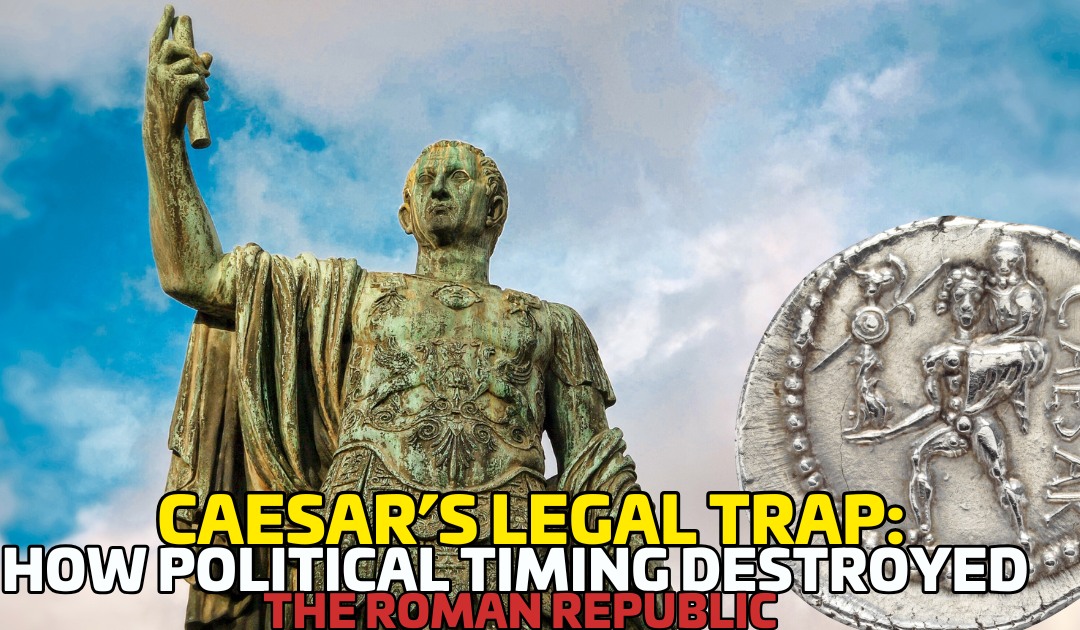
One of the most misunderstood moments in Roman history is Julius Caesar’s crossing of the Rubicon. It is often framed as a sudden power grab or an impulsive act of ambition.
In reality, it was the final move in a long and calculated political chess match, shaped by law, timing, and survival.
To understand why Caesar crossed the Rubicon, you have to understand the Roman political system and how legal immunity functioned inside it.
This was not just about ambition. It was about avoiding prosecution in a system weaponized by political enemies.
The Legal Shield of Roman Office
In the late Roman Republic, holding office was not just about prestige or power. It was about protection. Magistrates enjoyed legal immunity while in office, shielding them from prosecution. Once that office expired, the protection vanished.
Caesar had accumulated enemies over decades. His military campaigns in Gaul brought him immense popularity, wealth, and loyalty from his legions. They also made him deeply threatening to the senatorial elite.
Men like Cato the Younger were determined to see him stripped of power and dragged into court the moment his command ended.
Caesar understood this reality clearly. The law was no longer a neutral system. It was a weapon.
The Problem of Standing for Election
Roman offices were typically annual. With few exceptions like the Censors, power rotated quickly. This created constant vulnerability for ambitious politicians. Timing mattered more than ideology.
Caesar wanted to run for consul again, but under Roman law he was required to stand for election in person in Rome. That single requirement was the trap.
If Caesar returned to Rome without holding office, he would immediately lose his legal immunity. Prosecution would follow, not for justice, but for political revenge. His enemies knew this and insisted on strict enforcement of the law, not out of principle, but strategy.
Cato demanded Caesar return to Rome as a private citizen. Caesar demanded to stand for election in absentia. The Senate refused.
The standoff was intentional.
Office Manipulation as Political Survival
This moment reveals something uncomfortable about the late Republic. Offices were no longer about governance. They were about survival.
Political factions manipulated legal technicalities to destroy opponents. Annual elections, once a safeguard against tyranny, became tools for constant instability. Power was fragmented, but ambition was not.
Caesar’s strategy was simple and dangerous. Maintain office or command long enough to preserve immunity, then secure election before exposure. His enemies understood this and blocked every legal path forward.
At that point, Caesar faced a choice that no Roman should have had to make. Submit to political destruction or defy the system entirely.
Crossing the Rubicon
In 49 BC, Caesar crossed the Rubicon with a single legion. That act was illegal. It was also inevitable.
By forcing Caesar into an impossible legal position, the Senate ensured civil war. The Republic’s institutions had failed to resolve conflict peacefully. Law had become a tool of factional warfare rather than justice.
Caesar did not cross the Rubicon because he rejected the Republic. He crossed it because the Republic no longer functioned.
That is the tragedy.
Cato, Principle, and Consequence
Cato the Younger is often portrayed as a moral hero. He defended tradition, law, and republican virtue. Yet his rigid insistence on legal purity without compromise helped push Rome into catastrophe.
This is not an argument against principle. It is a warning about inflexibility in a broken system. When institutions lose legitimacy, enforcing rules selectively accelerates collapse.
Rome needed reform. Instead, it got civil war.
Lessons From Rome’s Collapse
The fall of the Roman Republic was not caused by a single man. It was caused by systems that could no longer manage ambition, rivalry, and power.
Several lessons stand out. First, legal systems lose authority when they are used as political weapons. Once citizens believe the law exists only to punish enemies, legitimacy collapses.
Second, rigid institutions cannot survive changing realities. Rome’s annual offices made sense in a city-state, not a sprawling empire.
Third, timing matters more than ideology in late-stage republics. Survival becomes the priority, not governance.
Caesar exploited these weaknesses, but he did not create them.
Why This Still Matters
Modern societies like to believe they are immune to Rome’s mistakes. History suggests otherwise. When law becomes partisan, when institutions fail to adapt, and when political enemies seek destruction rather than compromise, escalation becomes inevitable.
Rome teaches us that collapse does not come from chaos alone. It comes from systems that force people into impossible choices.
Caesar’s march was not just an act of ambition. It was a verdict on a Republic that had lost its ability to govern itself.
Final Thoughts
The crossing of the Rubicon was the end of the Roman Republic, but the causes ran much deeper than one general and one army. Political timing, legal immunity, and institutional decay set the stage long before Caesar made his move.
When politics becomes a zero-sum game, law stops protecting society and starts destroying it.
What do you think? Was Caesar a tyrant in the making, or a product of a system that had already failed?
Comment below. If you enjoy deep historical analysis like this, follow me at @jeremyryanslate and share this piece. And if you have a message you want to get out on top podcasts, DM me or connect with my team at CYB Media.