
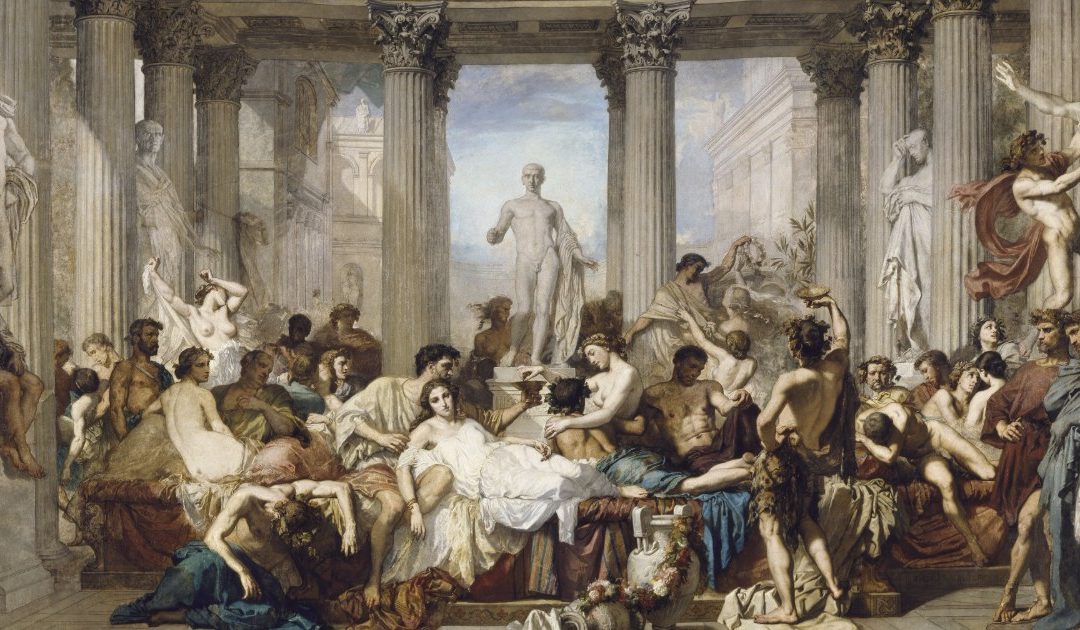
I’ve spent years studying how Rome fell apart, and the thing that keeps hitting me is how familiar it all feels. The same patterns that hollowed out the most powerful empire in history are playing out right now, and most people either don’t see it or don’t want to talk about it. Rome didn’t fall because barbarians showed up one day and kicked the door in. The empire rotted from the inside first through lost civic identity, eroded shared purpose, and political division that made governing almost impossible.
I recently compared Rome’s forums to today’s digital platforms on X, and the more I sat with that comparison, the more uncomfortable it got. Are we genuinely more connected than any previous civilization, or are we just producing more noise at a faster rate than Rome’s forum-goers could have ever imagined?
Rome’s Forums Were the Original Social Media
Rome had literal open-air spaces where citizens gathered to debate politics, share news, and argue about the direction of the empire. These forums were central to civic life, even under the early Empire, and they allowed ideas to collide in ways that could actually influence leadership decisions. But those same public spaces also revealed how fragile societal unity really was. Arguments escalated, rumors spread faster than facts, and factions formed around personalities rather than principles.
Fast forward to today, and forums have gone digital. Platforms like X and Facebook amplify voices across the globe instantly. Ideas travel faster, conflicts erupt in seconds, and millions of people can watch debates and outrage unfold in real time. The scale is completely unprecedented, but the underlying dynamics are eerily similar. In Rome, citizens screamed past each other in the forum. Today, we scream past each other on digital platforms. The only difference is that modern amplification is instantaneous, global, and completely unfiltered.
What Actually Destroyed Rome From Within
Rome did not fall because of external pressure alone. Barbarian invasions were usually the final blow against a structure that was already crumbling. The glue that held Rome together for centuries was a combination of shared identity, cultural cohesion, and respect for institutions, and all of that eroded gradually over time. Citizens became disengaged, leaders became self-serving, and civic rituals that once meant something turned into empty performances. Corruption spread, and loyalty became purely transactional.
There’s something about this that should make any modern observer uncomfortable. Polarization, tribalism, and digital echo chambers are creating an illusion of connection while actually fragmenting trust and shared purpose. Rome’s forums eventually became stages for factionalism and performance rather than genuine debate. When every citizen prioritizes individual expression over collective cohesion, the bonds that hold societies together start to weaken in ways that are hard to see until the damage is done.
Technology Amplifies Everything, Including Our Worst Instincts
Modern technology is both incredibly powerful and incredibly dangerous. Platforms allow people to connect globally, share ideas instantly, and mobilize communities around causes that matter. At the same time, technology magnifies human flaws with ruthless efficiency. Echo chambers, outrage cycles, and performative activism all get supercharged by algorithms designed to maximize engagement rather than understanding.
Rome had no social media, but it had forums where debates regularly descended into chaos. The difference today is scale and speed. One post can reach millions in seconds, and misinformation can outrun the truth before anyone has time to think critically about what they just read. Amplification without reflection undermines understanding and weakens the social fabric that every functioning society depends on. Connection without cohesion is just organized noise.
The Story People Believe In Matters More Than the Tools They Use
Rome fell not because citizens could not speak or act, but because they no longer believed in the story of Rome itself. Shared myths, values, and civic pride once bound an incredibly diverse population together across thousands of miles. Once those bonds weakened, fragmentation accelerated faster than anyone expected.
I keep coming back to this because the same dynamic is playing out today. National, civic, and organizational narratives provide the context for cooperation and common purpose. Without them, societies risk becoming a wall of competing voices, each demanding attention but failing to coordinate any meaningful action. Can we maintain a shared story strong enough to hold people together across deep divisions, or are we heading toward Rome’s pattern where internal decay creates the conditions for collapse from outside pressure?
What Rome Teaches Us About Surviving This Moment
Rome teaches us that technology and ambition alone cannot sustain a civilization. Cohesion, genuine engagement, and a shared sense of purpose matter more than amplification or spectacle. Citizens must participate meaningfully in governance and public life rather than retreating into comfortable bubbles. Common values and narratives need to be actively cultivated by leaders who can articulate and reinforce shared principles across different groups. And critical thinking needs to become a cultural habit rather than an afterthought. Rome’s decline accelerated as citizens lost faith in their institutions, and modern societies face the same risk if democratic, legal, and civic structures lose legitimacy in the eyes of the people they serve.
Connected or Just Loud
The digital age presents a genuine paradox. We have more tools for connection than any society in human history, yet our divisions are more visible and more amplified than ever before. Rome shows us that connectivity without cohesion accomplishes nothing. Without trust, shared values, and real engagement, connection can be meaningless or even destructive.
But history does not have to be destiny. We can learn from Rome’s mistakes and use technology to strengthen the bonds between people rather than weaken them. That requires deliberate effort, reflection, and leadership that prioritizes long-term cohesion over the short-term dopamine hit of viral attention. Rome lost its internal cohesion, its shared story, and its trust in the institutions that held it together. We have the advantage of knowing how that story ended, and the choice of whether to repeat it is still ours to make.