
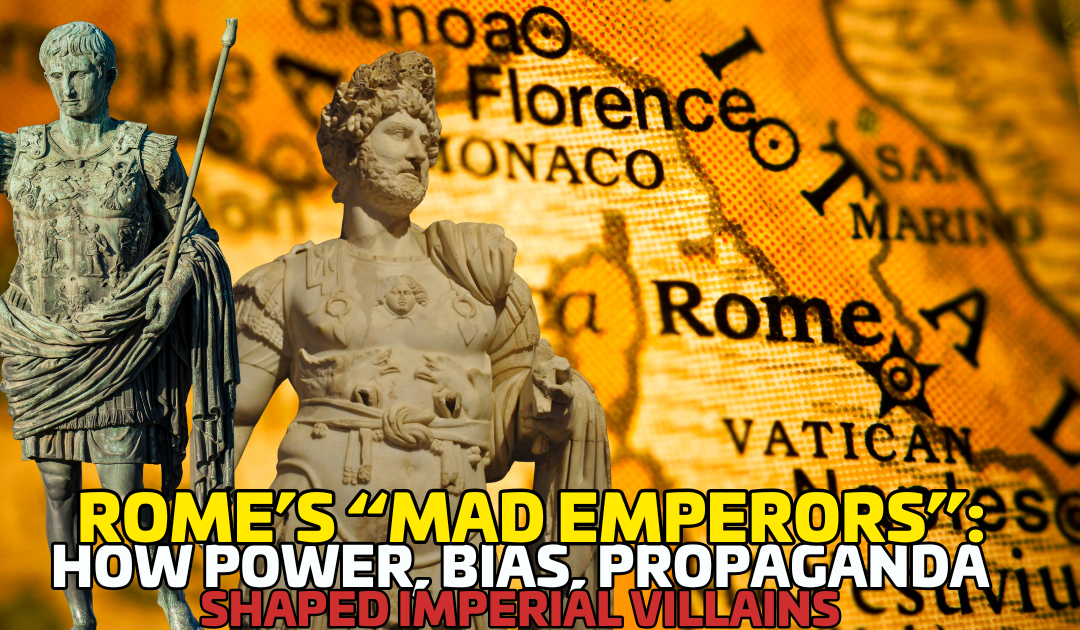
Few periods in history are as misunderstood as the Roman Empire, and few figures are more misrepresented than its so-called mad emperors. Names like Caligula, Nero, Commodus, and Domitian are shorthand for tyranny, insanity, and cruelty.
Popular culture paints them as monsters detached from reality, ruling through terror and whim. But history is rarely that simple.
One famous legend claims an emperor would sit alone in his chamber pulling the wings off flies. When someone asked, “Is anyone with the emperor now?” the response came back, “Not a fly.”
It is a memorable image, but it raises an important question. Is this history, or is this character assassination? To understand Rome’s most infamous rulers, we must first understand who wrote their stories.
Who Controlled the Narrative?
Most of what we know about Rome’s emperors comes from a narrow group of sources. Senators, elite historians, and members of the upper class recorded the history that survived.
Figures like Tacitus, Suetonius, and Cassius Dio were brilliant writers, but they were not nFdeutral observers.
The senatorial class had a long history of tension with emperors who centralized power. When an emperor bypassed the Senate, reduced its authority, or challenged its privileges, resentment followed.
That resentment often found its way into historical accounts.
This matters because history is shaped by victors, but also by survivors. Senators survived regime changes. Emperors often did not.
The Problem With “Evil Emperors”
Take a closer look at how Rome’s most hated emperors are described. The accusations are often extreme. Madness, sexual depravity, cruelty for entertainment, and total incompetence.
Yet when these claims are examined carefully, many rely on rumor, hearsay, or hostile commentary written after the emperor’s death.That does not mean these rulers were saints. Some committed brutal acts.
Some ruled harshly. But the question worth asking is whether their reputations reflect reality or political necessity.
When a new regime takes power, it often legitimizes itself by condemning the previous one. Rome perfected this tactic.
Declaring an emperor a tyrant or madman justified assassinations, coups, and political purges. It also absolved the elite of their own complicity.
Madness or Misdirection?
Modern scholarship has begun reevaluating these figures with a more critical lens. Instead of accepting ancient narratives at face value, historians now ask why certain stories were emphasized and others ignored.
Was an emperor truly insane, or simply hostile to senatorial interests? Was his cruelty exaggerated to make his removal appear justified? Did administrative competence get buried beneath scandal because it did not fit the desired narrative?
In several cases, emperors labeled as tyrants were effective administrators. They stabilized finances, reformed the military, or expanded infrastructure.
These accomplishments rarely receive the same attention as sensational anecdotes. That imbalance should raise suspicion.
Power Struggles and Reputation
Rome’s political system rewarded narrative control. An emperor who alienated the Senate often paid for it in reputation if not in life.
After death, there was no defense. No press conference. No rebuttal.
The Senate could condemn memory through damnatio memoriae, erasing statues, defacing inscriptions, and reshaping public perception. History was rewritten not with evidence, but with authority.
This dynamic reminds us that history is not just about events. It is about who gets to explain them.
Why This Still Matters
The Roman Empire may be ancient, but the mechanics of power have not changed. Political enemies still weaponize narratives. Leaders are still reduced to caricatures.
Complex figures are flattened into heroes or villains depending on who tells the story. Rome teaches us an uncomfortable lesson.
Truth often becomes collateral damage in power struggles.
Understanding this does not excuse abuse or authoritarianism. It simply demands intellectual honesty. If we want to learn from history, we must be willing to question it.
Reading Between the Lines
When we read Roman histories critically, patterns emerge. Sensational stories appear where evidence is weakest. Administrative successes are minimized. Moral outrage increases in proportion to political rivalry.
Between the lines, we often find rulers who were pragmatic, strategic, and sometimes effective, but ultimately destroyed by elite opposition. Their legacies were crafted not by impartial observers, but by enemies who controlled the pen.
Rome’s history reminds us that narratives are built, not discovered.
So Who Was Rome’s Most Evil Emperor?
That depends on how you define evil. Is it cruelty, incompetence, corruption, or manipulation? Or is it the ability to control history itself?
Perhaps the real danger lies not in individual emperors, but in systems that allow power struggles to distort truth. Rome fell not only because of bad rulers, but because trust in institutions and narratives collapsed.
Understanding that collapse requires us to challenge comfortable myths.
Final Thoughts
Rome’s so-called mad emperors force us to confront an uncomfortable reality. History is not neutral. It is shaped by power, bias, and survival.
When we accept inherited narratives without scrutiny, we risk misunderstanding the past and repeating its mistakes.
If we read carefully, question motives, and examine context, Rome’s villains become something more human. Flawed. Complex. Sometimes effective. Often misunderstood.
What do you think? Who was Rome’s most evil emperor, and why?
Comment below. If you enjoy deep historical analysis like this, follow me at @jeremyryanslate and share this piece. And if you have a message you want to get out on top podcasts, DM me or connect with my team at CYB Media.